




Sound Healing vs. Meditation Apps
The Singing Bowl Does What the Meditation App Can't.
Apps are good. A singing bowl works through a completely different mechanism. Here's why that matters for the people apps don't quite reach.
Meditation apps work. Headspace, Calm, Insight Timer. These are well-built products backed by real research, and millions of people use them to manage stress, sleep better, and build a consistent mindfulness practice. This article is not an argument against them.
But a meaningful percentage of people try these apps, stick with them for a while, and quietly conclude that they are not a meditation person. The app sits unused. The subscription lapses. The mental loops continue.
Those people are not broken. They have not failed at meditation. They encountered a specific mechanism that doesn't work for how their brain operates in that moment. They never found out that a different mechanism exists.
A handmade singing bowl is that different mechanism. The way it works has nothing in common with how an app works. That's the whole point.
01 / How Meditation Apps Work
The discipline model. Effective, and it asks a lot.
Meditation apps are built around a fundamentally sound principle: with enough repetition, you can train your brain to disengage from its own noise. The default mode network (the neural system responsible for rumination, anxiety, and the mental loops that run without your permission) can be quieted through consistent attentional practice. This is documented, real, and worth pursuing.
The mechanism is discipline-based. You sit. You focus on a breath, a sound, a guided voice. Your mind wanders. You notice it wandered. You bring it back. Repeat. Over time, that return motion becomes easier. The wandering shortens. The quiet deepens.
It works. The problem is the entry point.
The gap between starting and working
The discipline model requires you to do the hard thing first, before you've built the neurological infrastructure to do it well. In the early weeks of a meditation practice, you are asking your mind to control itself using the very systems that are most dysregulated. For many people, that gap between where they are and where the practice requires them to be is wide enough that the practice doesn't stick.
This is not a character flaw. It's a mismatch between mechanism and nervous system state. Some minds, in some seasons of life, need an external anchor before they can develop an internal one. The app can't provide that. A singing bowl can.
An app asks your mind to control your mind. A singing bowl gives your mind something outside itself to hold onto. The destination is the same. The path is different.
02 / How a Singing Bowl Works
External anchoring. No discipline required at the start.
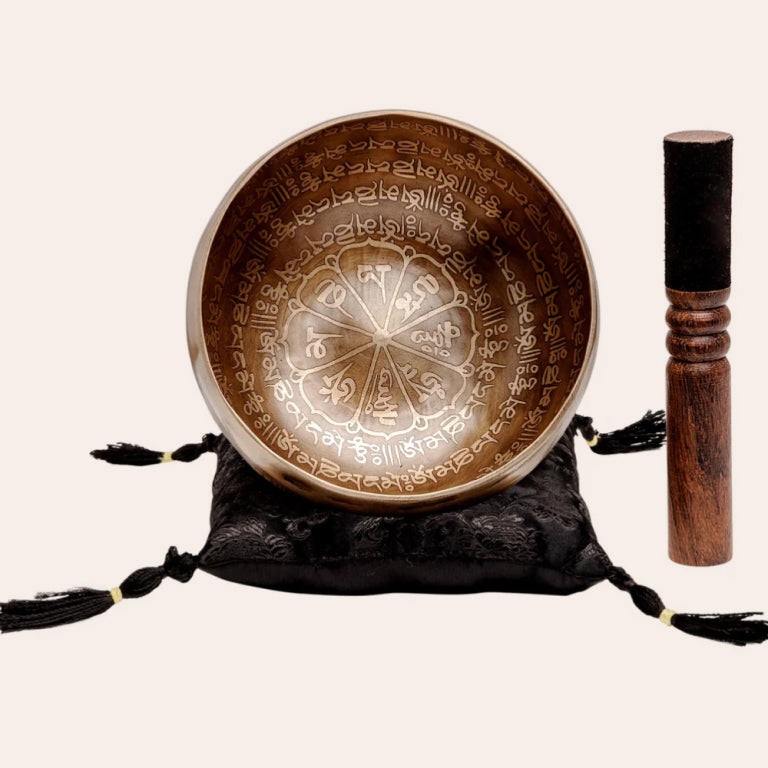
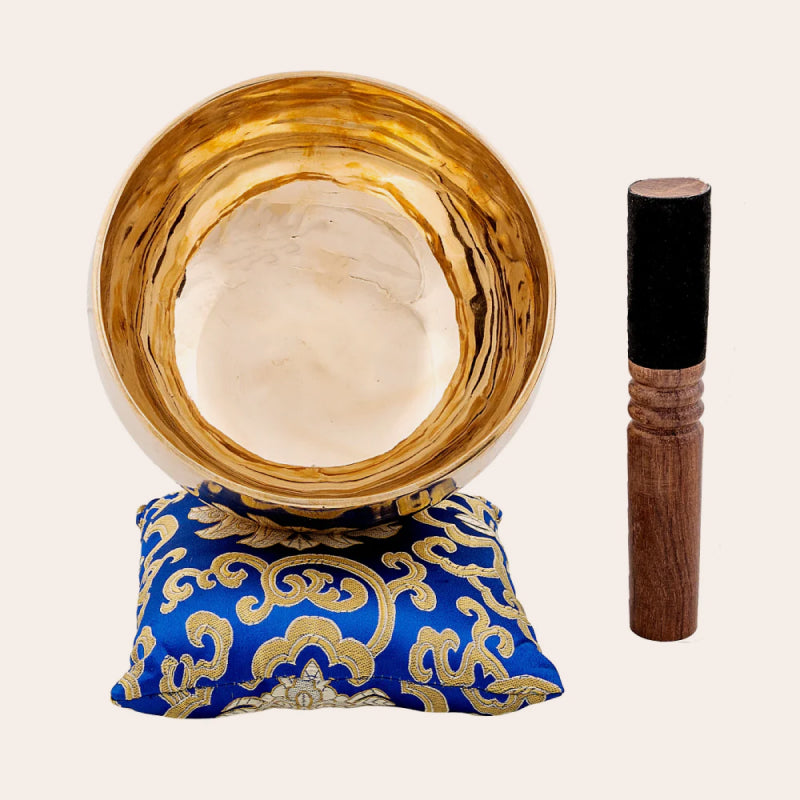
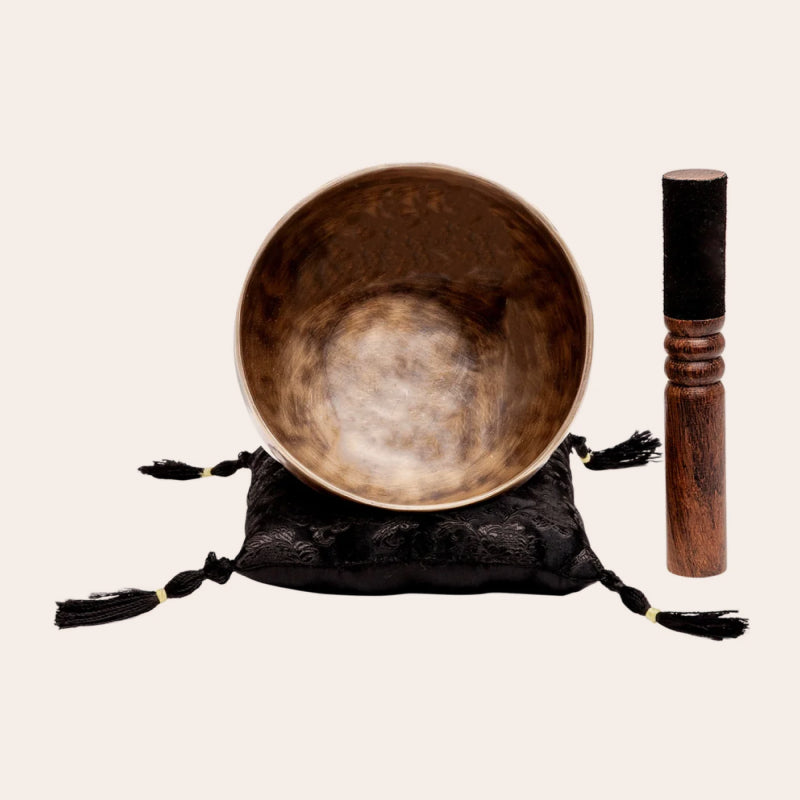
A handmade bronze singing bowl produces a sound that is genuinely difficult to ignore. Not because it is loud, but because it is acoustically complex. When struck, the bowl generates a fundamental frequency plus a dense layering of overtones: secondary vibrations at mathematically related intervals that create a constantly evolving acoustic environment.
Your brain's pattern-recognition systems immediately engage with that complexity. The auditory cortex begins tracking the relationships between the frequencies. The subtle beating patterns created by overlapping overtones give the brain a moving target that it follows automatically, without effort or instruction.
While the brain is doing that, it cannot simultaneously run the mental loops that generate anxiety and rumination. Not because you pushed those loops out. Because the sound gave your brain something more interesting to do. The default mode network goes quiet not through discipline, but through displacement.
The nervous system response
Below the cognitive level, something else is happening. The vagus nerve (the primary channel through which your nervous system regulates between threat and safety states) responds to sustained harmonic sound. The muscles of the middle ear are directly connected to vagal pathways. When those muscles are engaged by the right acoustic signal, a safety message travels directly to the brainstem.
Cortisol drops. Breathing slows. Muscle tension releases. This happens before you decide to feel calm. It happens because a physical signal reached a physiological system that was designed to receive it.
This is the mechanism the app cannot replicate. The app's guided voice can prompt you to breathe slowly. It cannot produce the direct acoustic signal that triggers the vagal response on its own. The bowl produces that signal every time it is struck.
The bowl in action
"This is what calm sounds like." Tori, OHM Store customer
03 / Two Tools, Two Mechanisms
They're not competing. They're complementary.
The most experienced meditators often use both. A singing bowl at the start of a session gives the nervous system a fast, reliable path into a regulated state. Once the nervous system has settled, the deeper attentional work that meditation apps train becomes easier. The bowl creates the conditions that make the discipline-based practice more accessible.
Think of it as a sequence rather than a choice. The bowl gets you to the starting line. The meditation practice takes you further. For people who have struggled to get to the starting line on their own, the bowl is not a shortcut or a substitute. It is the access point that was missing.
That said, many people find that the bowl alone is sufficient for what they need. A five-minute session with a good handmade bowl produces measurable physiological changes: reduced heart rate, slower breathing, decreased cortisol. For someone managing daily stress, that is a complete outcome. They don't need to graduate to anything.
She picked up a bowl without any background in meditation or music. What she found was that the sound did the work she had been trying to do on her own. The busy mind didn't have to be managed. It just had somewhere better to go.
04 / Why Handmade Matters
The mechanism depends on the instrument.
The acoustic complexity described in this article is a function of how the bowl is made. A handmade bronze singing bowl, formed by craftsmen using traditional hammering techniques, produces a sound that no machine-made or cast bowl can replicate. The asymmetries introduced by hand-hammering create the rich overtone structure that gives the brain something to track. A perfectly uniform bowl produces a thinner, simpler sound that decays faster and engages less.
This is not sentimentality about craft. It is acoustics. The irregularities in a handmade bowl are the source of its therapeutic value. Each strike produces a slightly different acoustic environment because the bowl itself is not perfectly symmetrical. The brain cannot habituate to a sound that keeps changing. A machine-made bowl, by contrast, is too consistent. The brain maps it quickly and moves on.
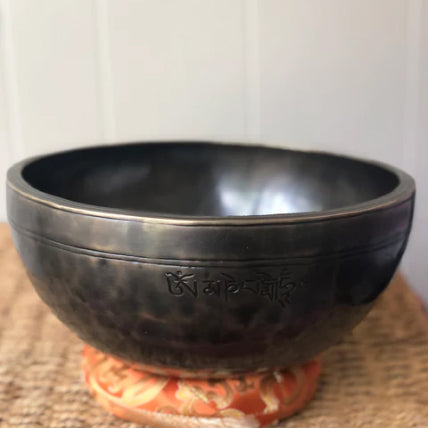
Every bowl The OHM Store ships is handmade by craftsmen in Kathmandu. Not because it sounds better in a marketing sense. Because the physics of handmade bronze is what makes the mechanism work.
Sound can quiet a busy mind
"Sound can quiet a busy mind." Tori
05 / Go Deeper
The full neuroscience is here.
This article covers the mechanism at the level most people need to make a decision. If you want the complete picture: the default mode network, information-density overload, mode splitting in bronze acoustics, and the physics of why sustain length is a therapeutic variable. We wrote that article too.
It is the most detailed explanation of why sound healing works that we know of outside of an academic paper. And it is written for people who want the real science, not a simplified version of it.
The bowl Tori plays. Ready to ship.
Handmade in Kathmandu. Every bowl is acoustically tested before it leaves.
 Best Value
Tibetan Sanctuary Bundle
Two handmade bronze bowls, a 52-lesson course, 1-on-1 coaching, and lifetime guarantee. The complete starting kit. $795.
Shop the Bundle →Your brain has a narrator. A singing bowl silences it.
The Brain Science Article
The full neuroscience behind why singing bowls suppress the default mode network. The most detailed explanation we've written.
Read the Science →This article draws on published research in default mode network neuroscience, polyvagal theory, and the acoustic physics of handmade bronze instruments. The claim that handmade bowl irregularities produce therapeutically superior overtone complexity is grounded in the physics of mode splitting in asymmetric resonant bodies. For the complete citation framework, see the companion article on sound healing brain science.


