





Sound, Animals, and What the Science Actually Says
Your Dog Notices the Bowl Too. Here's What We Actually Know.
A lot of people have noticed their animals go quiet when a singing bowl is played. We wanted to understand why. Here's an honest look at the research, and what it doesn't yet tell us.
We have watched a lot of videos of people playing singing bowls near their dogs. The pattern is consistent enough to be interesting: the dog settles, the breathing slows, the animal goes quiet. It happens often enough that it seems like more than coincidence.
We want to be clear from the start: this article is not going to tell you that singing bowls are proven to heal or calm animals. That claim would require clinical research that doesn't exist yet. What we are going to do is share what the research on sound and animals actually says, explain the biological mechanism that makes these observations plausible, and be honest about where the science ends and the anecdote begins.
That line matters to us. We're not in the business of selling outcomes we can't support.
01 / What The Research Actually Shows
Sound affects animal behavior. That part is documented.
In the early 2000s, psychologist Deborah Wells at Queen's University Belfast conducted a series of studies on shelter dogs and music. The research examined how different genres of audio (human conversation, pop music, classical music, heavy metal, and silence) affected the behavior of kenneled dogs. The results were published in peer-reviewed journals and have been widely cited since.
Classical music produced measurable behavioral changes: dogs spent more time resting, less time standing agitated, and barked less compared to the other conditions. Heavy metal produced near-opposite results. The study was controlled and repeatable. Sound affects dog behavior. That is not a fringe claim. It is documented science.
The "Through a Dog's Ear" research
Separately, sound researcher Joshua Leeds and concert pianist Lisa Spector developed a body of work specifically on psychoacoustics and canine nervous systems. Their project, Through a Dog's Ear, was built on the hypothesis that certain acoustic properties (particularly simple, slow, sustained tones) are more calming to dogs than complex, fast-moving music.
Their work was piloted in clinical veterinary settings and produced observational results consistent with Wells' shelter research. Sustained, harmonically simple sound produced calmer behavioral states in dogs. This work has limitations. It was not double-blind clinical research. But it is grounded in a coherent acoustic hypothesis and produced consistent results across multiple settings.
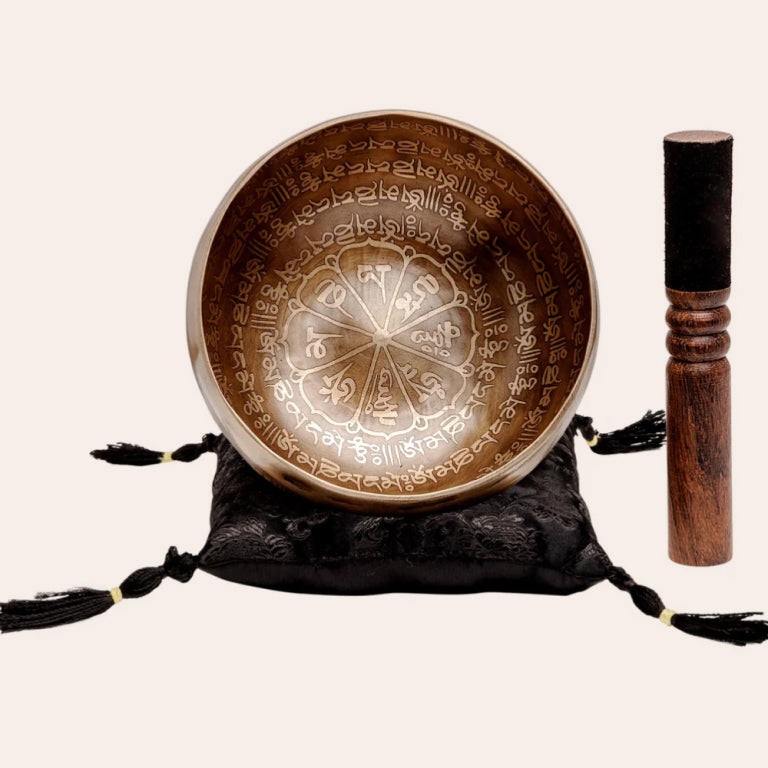
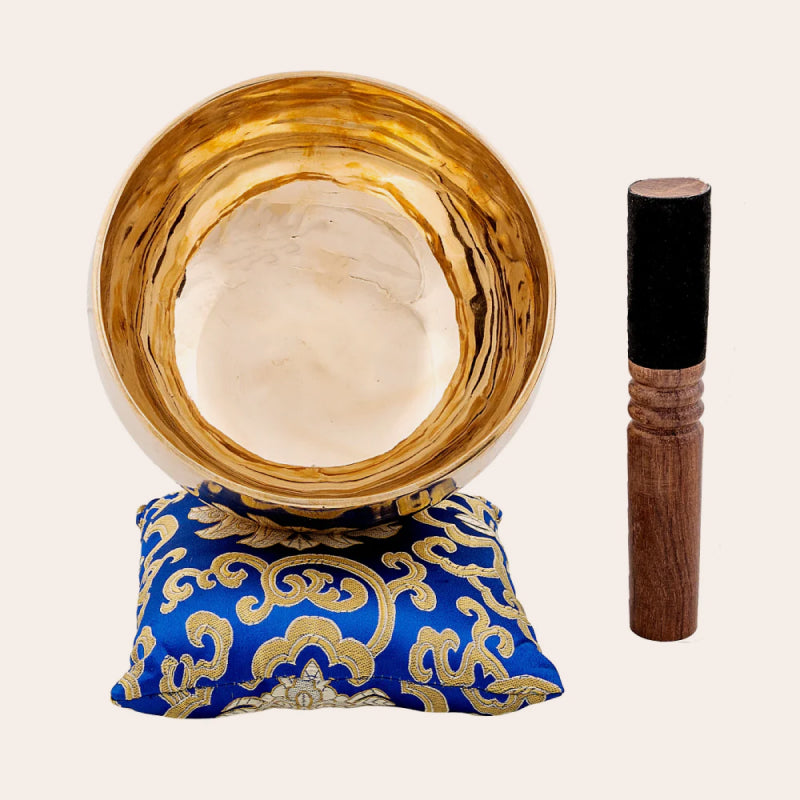
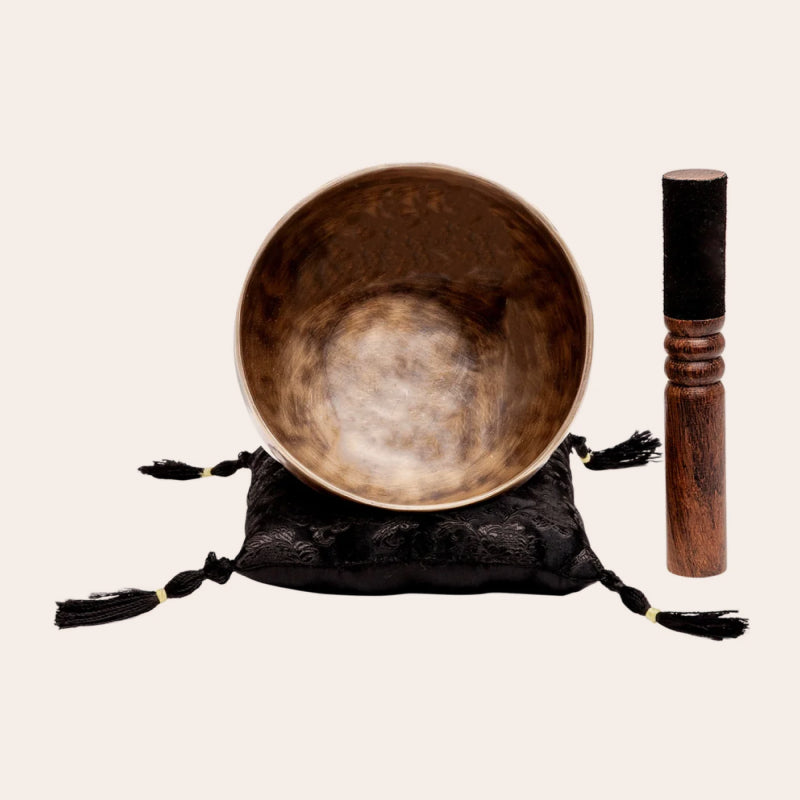
The acoustic properties that calm dogs in documented research (sustained, harmonic, relatively simple tones) overlap meaningfully with the acoustic properties of a well-played singing bowl. That overlap is worth paying attention to, even if it hasn't been studied directly.
02 / The Biological Mechanism
Dogs share the same mammalian nervous system architecture we do.
Polyvagal theory, developed by neuroscientist Stephen Porges, describes how the vagus nerve regulates the mammalian nervous system between threat and safety states. The vagus nerve is not a uniquely human structure. It is present and functionally similar across all mammals, including dogs.
The mechanism by which sound reaches and influences the vagal system involves the muscles of the middle ear (specifically the stapedius and tensor tympani) which are directly connected to vagal pathways. When these muscles are engaged by certain acoustic signals, a safety message travels to the brainstem. The nervous system shifts from a threat-activated state toward a regulated one.
This mechanism is not uniquely human. A dog's middle ear connects to vagal pathways through the same basic architecture. The hypothesis that sustained, harmonic sound produces a similar regulatory response in dogs is biologically grounded. It has not been confirmed in controlled studies specific to singing bowls. But it is not a leap. It is an extrapolation from established mammalian biology.
What a dog actually hears
Dogs hear a broader frequency range than humans: roughly 40 Hz to 65,000 Hz, compared to the human range of approximately 20 Hz to 20,000 Hz. A handmade bronze singing bowl produces a fundamental frequency typically between 100 and 500 Hz, with overtones extending well above that. Dogs are not only hearing what we hear. They are hearing additional layers of the bowl's acoustic output that are entirely inaudible to us.
What that means for their experience of a singing bowl is genuinely unknown. It is one of the most interesting open questions in this space.
Watch what happens
"Your dog feels it too." Tori and her dog, at home with a handmade bronze bowl.
03 / What We Don't Know
We want to be straight with you about the limits here.
No controlled study has examined the specific effect of handmade singing bowls on dogs or other animals. The observations people share (dogs settling, cats approaching, animals appearing calmer in the presence of a bowl being played) are real observations. But observations are not the same as evidence. There are many possible explanations for a dog going calm near a bowl, including the calm energy of the person playing it, familiar routine, and simple habituation to a sound in the environment.
That singing bowls treat anxiety, stress, or any health condition in animals.
That the results are consistent or predictable across different animals.
That what works for one dog will work for another.
That the mechanism in dogs is identical to the mechanism in humans.
That any of the animal observations people share, including Tori's, constitute clinical evidence of anything.
We include that box not to undermine the article but because we think it makes everything else in it more trustworthy. If we were willing to overclaim, you would have no reason to trust the claims we do make.
04 / What People Are Observing
The anecdotal pattern is consistent. That's worth something.
We are not going to pretend that thousands of people independently noticing their animals respond to singing bowls is meaningless just because it hasn't been formally studied. Anecdotal patterns across large numbers of independent observers are often where real science eventually begins. The Wells shelter research started with something similar: a consistent observation that animals seemed affected by music.
What we observe in Tori's video, and in similar videos people share with us regularly, is this: a dog that is relaxed, present, and apparently unbothered by the sound of a bowl being struck nearby. The dog is not startled. It is not distressed. It appears, by behavioral markers, to be in a calm state.
Whether the bowl caused that, contributed to it, or simply did not disturb an already-calm animal is something we genuinely cannot determine from the video. We think that honest uncertainty is more useful to you than a confident claim would be.
The science on sound and animals is real and points in an interesting direction. The specific research on singing bowls and animals does not yet exist. We share what we observe, we explain the biological framework that makes it plausible, and we leave the conclusions where they belong: with you and your animal.
05 / If You Want To Try It
A few things worth knowing before you do.
If you are curious about playing a singing bowl near your dog or other animal, the existing research and basic animal welfare principles suggest a few practical considerations.
Start at a distance. Dogs hear at a much broader frequency range and higher sensitivity than we do. A sound that feels gentle to you may be more intense for them, particularly close up. Begin further away than feels necessary and observe the animal's response before moving closer.
Watch the animal, not the bowl. A relaxed dog will have soft body posture, a loose jaw, and may settle or lie down. A stressed dog will show the opposite: stiffening, lip licking, yawning, trying to leave the space. If you see the latter, stop. The goal is a positive experience, not a completed session.
Never confine an animal during this. The animal should be free to leave at any point. If it stays, that is information. If it leaves, that is also information.
Consult your veterinarian if your animal has a diagnosed anxiety condition or is on medication for behavioral issues. A singing bowl is not a treatment, and it should not be used as a substitute for professional veterinary care.
Sound healing isn't just for humans
"Sound healing isn't just for humans." Tori
Handmade in Kathmandu. Shipped to your door.
If you want to explore what your animal notices, this is where to start.
 Bronze
Tibetan Sanctuary Bundle
Two handmade bronze bowls, a 52-lesson course, 1-on-1 coaching, and lifetime guarantee. The complete starting kit. $795.
Shop the Bundle →Why does a singing bowl affect the nervous system at all?
The Brain Science Article
The full neuroscience of how singing bowls suppress the default mode network and trigger the vagal safety response. The mechanism behind everything in this article.
Read the Science →The Deborah Wells shelter dog music research was published in peer-reviewed journals in the early 2000s and is widely cited in animal behavior literature. The "Through a Dog's Ear" project by Joshua Leeds and Lisa Spector is a separately developed body of work available in book form and has been piloted in veterinary settings. Polyvagal theory was developed by Stephen Porges and is documented extensively in academic and clinical literature. No study has examined the specific effect of handmade singing bowls on animal behavior. The observations in this article are presented as observations, not clinical claims.
If your animal is experiencing anxiety or a behavioral condition, please consult a licensed veterinarian. Read the full neuroscience article here.


