





Neuroscience + Sound
Your Brain Has a Narrator.
A Singing Bowl Silences It.
The neuroscience of why sound healing works, and why it works faster than meditation.
There is a network of brain regions that activates when you're not focused on anything in particular. Its job is to think about you: replaying yesterday's conversations, rehearsing tomorrow's worries, constructing the story of who you are and what you've done wrong.
Neuroscientists call this the Default Mode Network. And in the last decade, quieting it has become the central goal of the most effective therapeutic approaches in mental health research: meditation, psilocybin-assisted therapy, and now, sound.
A singing bowl quiets it too. Through a mechanism that requires no practice, no substance, and no sustained effort. Here's how.
01 / The Default Mode Network
The narrator that won't stop talking
The Default Mode Network (the DMN) isn't a single brain structure. It's a set of interconnected regions that activate together when your mind isn't focused on a specific task. Rather than resting, this network works hard at self-referential processing: your autobiographical story, your social comparisons, your regrets, your anxieties.
For most people, it never fully stops. Hyperactivity in the DMN is now associated with depression, chronic anxiety, rumination, and addictive behavior. The common thread isn't the content of the thoughts. It's the stuckness. The same loops, running the same programs, resistant to any conscious attempt to stop.
That background noise in your head: the second-guessing, the replaying, the worrying about things you can't control. It has a name and a specific neural address. And it can be interrupted.
The most effective modern therapies share one mechanism: they create a window in which the DMN goes quiet, rigid self-referential patterns dissolve, and new neural connections can form. Meditation does this. Psychedelics do this. And so does sound, through a completely different route than either.
02 / Three Routes to Quiet
Sound healing isn't mystical. It's physical.
There are three well-documented methods for suppressing the DMN. The method matters because it determines what you have to do, and what you don't.
Meditation: top-down control
The meditator notices when the mind has drifted into self-referential thought, and redirects attention to an anchor: the breath, a mantra, bodily sensation. Over thousands of repetitions across months and years, the circuits that enable this redirect grow stronger. It works. It takes years.
Psychedelics: pharmacological reset
Psilocybin and similar compounds suppress DMN coherence by binding to serotonin 2A receptors. The effect is rapid and dramatic. The rigid default-mode patterns dissolve, and a window of heightened neuroplasticity opens. Clinical trials show remarkable outcomes for treatment-resistant depression and addiction. But it requires a controlled substance, clinical infrastructure, and careful preparation. It isn't repeatable on a daily basis.
Sound: information-density overload
The DMN activates when the brain's attentional resources are not engaged by external stimuli. It's quite literally what the brain defaults to when there is nothing more interesting to process. A singing bowl with a dense overtone structure (five, six, seven or more simultaneous frequencies, each evolving over time) gives your brain's pattern-recognition systems so much coherent information to process that there's no computational bandwidth left for self-referential narration.
The analytical mind isn't told to stop. It isn't chemically switched off. It simply runs out of capacity. The narrator goes quiet because the sound gave your brain something better to do.
Listen for yourself
"Listen to how long this sustain lasts." Bob Frye, Sound Practitioner
03 / The Mechanism
Why your brain can't tune it out
When you strike a singing bowl, the sound is maximally complex at the moment of impact: all vibration modes active simultaneously. Over the next 45 to 90 seconds, the higher-frequency modes decay faster than the lower ones, and the spectral profile shifts continuously: bright and shimmering at first, deepening and warming as higher tones fall away.
This matters because of how the brain handles repetition. Normally, a constant sound is processed, categorized, and then filtered out. Your brain stops attending to it within seconds. This is why white noise doesn't produce meditative states. The brain habituates and the DMN reasserts.
A singing bowl defeats habituation because the sound is never constant. Every fraction of a second, the spectral profile is different from the previous fraction. The brain's novelty-detection systems remain engaged for the entire sustain. When the sound decays to silence, the practitioner strikes again, and the cycle restarts at maximum complexity.
There's a threshold where the acoustic complexity exceeds what the analytical mind can track. Below it, you notice individual overtones. You're still in control. Above it, the prefrontal cortex stops trying to parse and shifts from analytical processing to open, receptive awareness. The narrator goes quiet. Experienced meditators recognize the state immediately. It's the same quality of spacious, non-narrative awareness they access through practice, arrived at through a different door.
04 / The Comparison
Same destination. Different route.
These are different modalities with different depths and different contexts. What they share is the same neural outcome: a window of DMN suppression and heightened neuroplasticity.
| Meditation | Psilocybin | Sound | |
|---|---|---|---|
| Mechanism | Top-down attention | Pharmacological | Sensory saturation |
| Requires practice? | Yes, years | No | No |
| Substance required? | No | Yes | No |
| Repeatable daily? | Yes | No | Yes |
| Onset time | 5 to 60 min | 30 to 60 min | 5 to 15 minutes |
| Neuroplastic window | Yes (with training) | Yes (significant) | Yes (theta state) |
Sound-induced DMN suppression is not identical to a psilocybin experience. But it accesses the same category of neuroplastic opportunity, that same window where the brain's default patterns become malleable, without a substance, without years of practice, and available in a quiet room with a single instrument.
05 / Instrument Quality
Why the bowl matters
Everything in this article depends on one variable that's often treated as secondary: the acoustic complexity of the instrument itself.
A machine-made bowl with uniform wall thickness vibrates in clean, symmetrical modes. The overtone structure is sparse, two or three audible frequencies at most. The information density is low. The brain parses it quickly, habituates, and the DMN reasserts within seconds. The experience may be pleasant. It is unlikely to produce the state described above.
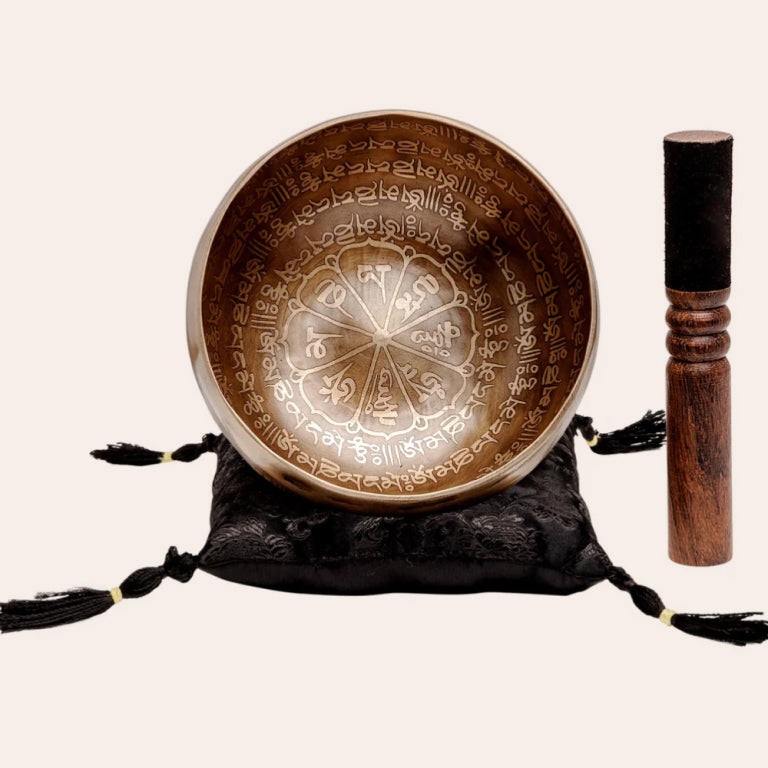
A handmade bronze bowl, forged from traditional bell-metal alloy with the microscopic wall-thickness variations introduced by hand-hammering, vibrates differently. Each mode splits into two closely-spaced frequencies, producing audible beating. The overtone structure is dense. The temporal evolution is complex and extended. The information density is high enough to engage the brain's pattern-recognition systems at or near their parsing capacity.
The wall-thickness variations that produce this effect are measured in fractions of a millimeter. They cannot be replicated by a machine, because a machine produces the uniform symmetry that eliminates the very acoustic complexity the brain needs. Perfection, in this context, is the enemy of therapy.
Still ringing. Still healing.
A handmade OHM Store bowl. Recorded close-miked, no effects.
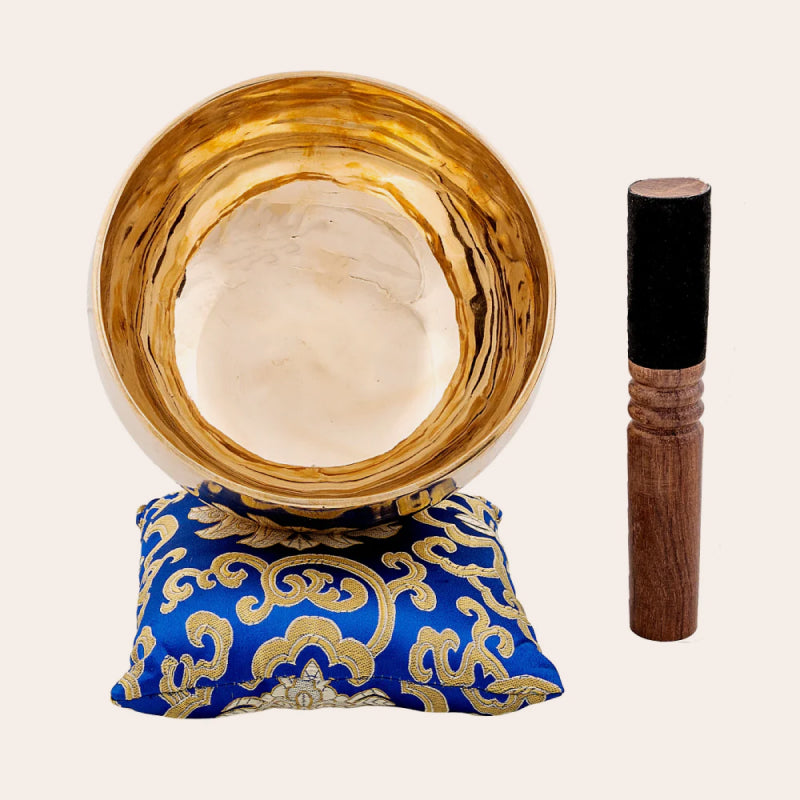
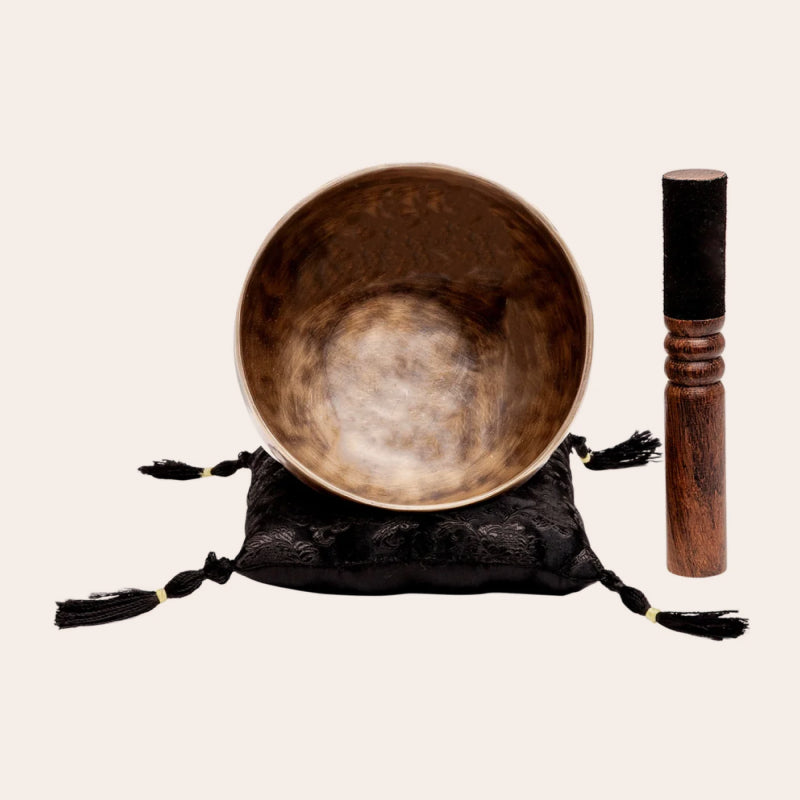
The bowls Bob is recording are below.
Two ways in. Both are right.
Begin with our most beloved set, or find a one-of-a-kind bowl hand-selected for its acoustic profile.
 Bronze
Tibetan Sanctuary Bundle
Our most beloved bronze set. Handmade, hand-tuned, and the starting point for thousands of students. Everything you need to begin a real practice.
Shop the Sanctuary Bundle → One of a Kind
One-of-a-Kind Bowls
Individual bowls hand-selected for their overtone density, sustain, and acoustic character. No two are the same. When they are gone, they are gone.
Find Your Bowl →This article synthesizes published research in default mode network neuroscience, meditation neuroscience, psychedelic therapy, and psychoacoustics. The information-density overload hypothesis as applied specifically to singing bowl acoustics is a mechanistically grounded theoretical model: consistent with established neuroscience, supported by clinical observation, and awaiting direct neuroimaging confirmation. We distinguish clearly between what has been proven and what has been proposed. Read the full research article →


