




Polyvagal Science + Sound
Certain Tones Signal Safety to the Brain.
The neuroscience of why a crystal singing bowl calms your nervous system, and why no musical background is required.
Sound healing has a reputation problem. Most people picture candles, crystals, someone in white linen talking about energy. What they don't picture is a peer-reviewed theory of the nervous system, a physics mechanism rooted in material science, and an instrument anyone can pick up and use correctly in the first five minutes.
That last part matters. Because the single biggest barrier to sound healing isn't the science. It's the assumption that you need some kind of training, talent, or background to benefit from it.
You don't. And the reason why comes down to how a crystal singing bowl works, and what it does to your nervous system when you play it.
01 / What a Crystal Singing Bowl Actually Is
Not a musical instrument. A therapeutic tool.
A crystal singing bowl is made from pure fused quartz: silicon dioxide heated to around 4,000 degrees Fahrenheit until it becomes a homogenous, ultra-dense material. The result is a bowl with properties no metal instrument can replicate: near-perfect internal consistency, extraordinary hardness, and a molecular structure that stores and releases vibrational energy with minimal loss.
When you strike or rim a crystal bowl, the quartz vibrates and produces a tone. But the character of that tone is what separates it from ordinary sound. The fundamental frequency is clear and sustained: a single, unwavering pitch that holds for 30, 60, sometimes 90 seconds or more. Above the fundamental, a set of harmonic overtones ring out in mathematically precise intervals. The sound is simultaneously simple and rich: one central tone you can lock onto immediately, surrounded by a halo of related frequencies that give it depth and resonance.
That combination: a clear, stable fundamental with sustained harmonic support. It is not accidental. It's the acoustic profile that your nervous system responds to most readily. And the reason goes back to a theory developed by a neuroscientist named Stephen Porges.
A crystal bowl produces a tone you can follow with your whole attention. It doesn't require analysis or training to experience. You hear it, and something in your body responds before your brain decides what to think about it.
02 / The Polyvagal Connection
Certain tones signal safety to the brain.
Polyvagal theory holds that your nervous system is constantly scanning the environment for signals of safety or threat. This process (which Porges calls neuroception) happens below the level of conscious awareness. You don't decide to feel safe. Your nervous system decides for you, based on information it's processing from your environment, including the sounds in it.
The vagus nerve is the primary channel for this process. It runs from your brainstem down through your heart, lungs, and digestive system, and it has two modes: a threat-activated state associated with elevated cortisol, shallow breathing, and muscle tension, and a safety-activated state associated with calm, connection, and physiological regulation.
Sound reaches the vagus nerve through the inner ear. Specifically, the stapedius and tensor tympani muscles in the middle ear are directly connected to vagal pathways. When these muscles are engaged by the right kind of acoustic signal, they send a safety message directly to the brainstem. The nervous system receives the signal, reads it as safe, and begins to downregulate.
What the "right kind" of signal looks like
Not all sound activates this pathway. Chaotic noise, harsh frequencies, and irregular rhythms trigger the threat response. What activates the safety response is a specific acoustic profile: sustained, harmonic, tonally clear, with a frequency range that sits within the human vocal register or close to it.
Crystal singing bowls produce exactly this profile. The pure quartz fundamental is stable and sustained. The harmonic overtones are mathematically related to it, not random. The tone doesn't spike or cut out abruptly. It rises, holds, and decays in a smooth arc that the nervous system reads, accurately, as non-threatening.
This is why people feel something physical when they hear a crystal bowl played well. Not because of mysticism. Because their nervous system received a signal it knows how to respond to, and responded.
Watch: the science, in plain language
"Sound healing isn't mystical. It's physical." Lisa, Sound School Graduate
03 / Clarity vs. Complexity
A different mechanism. The same destination.
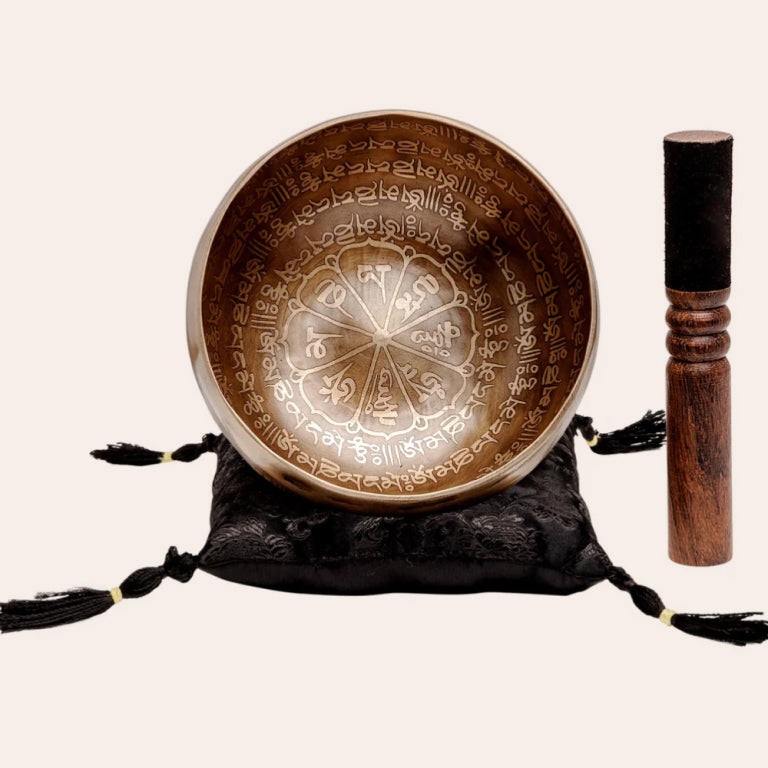
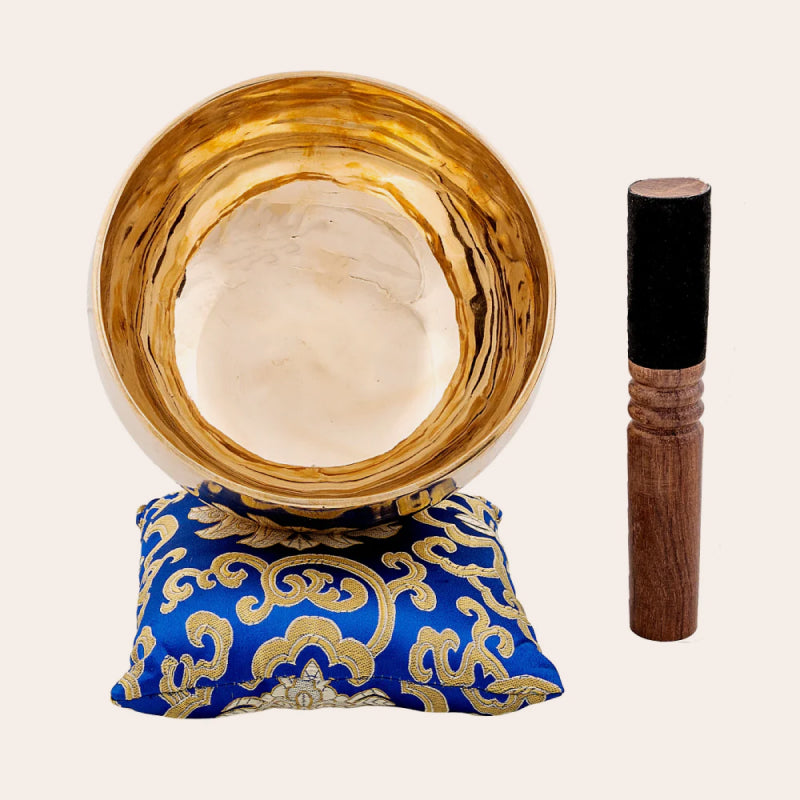
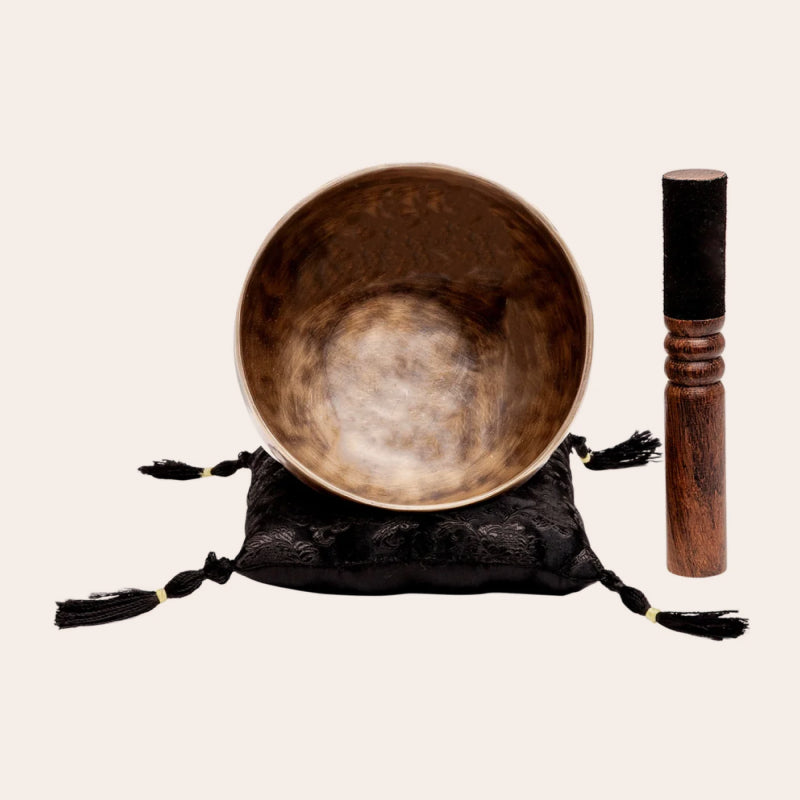
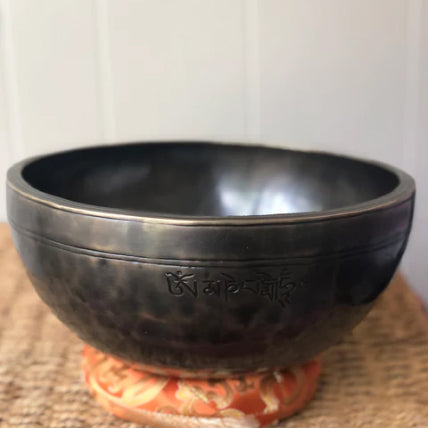
There's more than one way for sound to shift your nervous system. A dense, complex acoustic environment (like a large handmade bronze bowl with many simultaneous overtones) works by saturating your brain's pattern-recognition systems with more information than they can analytically track. The mind stops narrating because it runs out of processing capacity.
A crystal singing bowl works through the opposite mechanism: acoustic clarity as an anchor. Rather than overwhelming the mind with complexity, it gives the mind one clear, beautiful thing to follow. The fundamental tone is stable and unambiguous. There's no effort required to locate it, track it, or make sense of it. The brain settles onto it the way your eyes settle onto a fixed point when you're trying to balance.
That settling is physiologically real. When your auditory cortex locks onto a stable, sustained tone, neural activity in the default mode network (the brain's rumination engine) decreases. The internal monologue runs out of competition for your attention. Not because you forced it out, but because the sound gave you something better to pay attention to.
Bronze bowl complexity overwhelms the analytical mind into silence. Crystal bowl clarity draws the mind into stillness. Both arrive at the same place: a nervous system that has downregulated, a brain that has stopped narrating, and an awareness that is present rather than scattered.
This is why crystal bowls work for people who find dense sound environments overstimulating. The mechanism is gentler, more accessible, and for many nervous systems more immediately effective. You don't have to find the sound. The sound finds you.
04 / No Musical Background Required
The instrument does the work. Your only job is to listen.
Most therapeutic tools ask something of you. Meditation asks for sustained attention. Breathwork asks you to control a process that normally runs on its own. Exercise asks for physical effort and recovery time. Even most musical instruments require months of practice before they produce sounds worth listening to.
A crystal singing bowl requires one motion: strike it, or draw a mallet around the rim. That's it. The bowl produces the tone. The tone does the rest.
There's no correct way to feel during the experience. There's no breathing pattern to maintain, no visualization to hold, no mental state to achieve. You play the bowl. You listen. Your nervous system responds the way it was designed to respond to this kind of acoustic signal.
This is not a simplified version of a more sophisticated practice. It is the practice. The crystal bowl is a complete therapeutic instrument, not a stepping stone to something harder. Many of the most experienced sound healers working today use a single crystal bowl as the anchor of their entire session.
What Lisa found
Lisa had no musical background when she picked up her first crystal bowl. She hadn't played an instrument. She couldn't read music. She started anyway, because the barrier to entry is genuinely as low as it looks.
What she discovered is what most people discover: that the bowl doesn't require your expertise. It requires your presence. And a good crystal bowl makes presence easy, because there's something in the sound worth being present for.
05 / Why the Bowl Matters
Not all crystal bowls are the same.
The mechanism described in this article depends on one variable: the acoustic quality of the bowl itself.
A low-quality crystal bowl produces a thin tone that decays quickly and lacks harmonic depth. The sustained quality that makes the sound therapeutically useful: that long, stable arc that gives the nervous system time to respond. It is absent or compromised in lesser instruments. The experience may be pleasant. It won't produce the physiological shift described here.
A high-quality crystal bowl made from genuine fused quartz produces a tone that is tonally pure, and sustained long enough for the vagal response to complete. The difference is audible immediately. The bowl either rings with that quality of presence, or it doesn't.
The challenge is big, in choosing a frosted crystal singing bowl. There is confusion around "pure quartz 99.9%." This seems to be the main way these bowls are described.
Over the past two years, it's been our mission (after 10 years of specializing in designing and creating bell-metal bronze bowls) to understand frosted crystal singing bowls, and to actually re-engineer them to our specifications -- as opposed to buying groups of bowls that are already made. Becoming the manufacturer and designer of this bowls has lead us to several features that ensures bowls we provide are producing pure-sine wave fundamental notes and easy play rims.
The OHM Store selects every crystal bowl for acoustic quality before it ships. The tone you hear is the tone you get. No surprises.
One bowl. Hear for yourself.
"One bowl. One sound. Total calm." Lisa
Two ways to start. Both are right.
Choose your instrument. Start today.
Crystal if you want tonal clarity and instant accessibility. Bronze if you want harmonic complexity and deep immersion.
 Crystal
The Drone Bowl
272 Hz C# frosted crystal. 13 inches. Engineered for instant playability with zero squeal. One of 20 in this release, already in the US, ships immediately. $595.
Shop The Drone Bowl → Bronze
Tibetan Sanctuary Bundle
Our most beloved handmade bronze set. Want to hear what dense overtone complexity sounds like? This is it. The starting point for thousands of students. $795.
Shop the Bundle →This article draws on published research in polyvagal theory, vagal nerve acoustics, and default mode network neuroscience. The safety signal hypothesis as applied specifically to crystal singing bowl frequency profiles represents a mechanistically grounded framework consistent with established science. We present it as such: well-supported, clinically observed, and awaiting the specific neuroimaging confirmation that would formally close the loop. For the full neuroscience of how sound suppresses the default mode network, read the companion article on bronze bowl acoustics.


