

I want to share a practice with you, that is informed by my own multi-year experimentation with breath-holding and singing bowls as a meditative practice. It's out of the norm, though the breath hold practice is grounded in the real science of free-diving training, and it has become one of my favorite ways to work with a bowl in my own home.
Most meditation traditions ask you to hold your attention on something: the breath, a mantra, a candle flame. When the mind wanders, you return. That is the practice. It works, over time, through repetition.
A singing bowl offers something a little different. Once struck, the tone immediately begins to die. Following it to complete silence asks for exactly the kind of attention that meditation is trying to build: present, active, not grasping. The sound gives you something genuinely worth tracking, and then takes it away. There is something in that structure that we find particularly useful.
The limitation we have noticed, and we say this from years of working with sound healing closely, is that the bowl alone can tip too far toward relaxation. The depth is available. But without something to focus the mind, many practitioners float, drift, or simply fall asleep. The acoustic environment creates a door, and then nothing walks through it.
The missing piece is internal pressure, specifically a breath hold.
A short, safe breath hold, 30 to 45 seconds, done without any prior over-breathing, creates a specific physiological state that pairs with the bowl in a way that genuinely surprised us when we first explored it. Your heart rate drops. Blood flow to the brain increases. Your vagus nerve activates. The building internal sensation of the hold gives the mind something real and present-tense to attend to, right at the same moment the bowl's sound is asking for your attention.
Paired with a fading singing bowl tone, the two work together in a way that is hard to describe until you have felt it. As the outer sound grows quieter, the inner sensation grows stronger. The mind, caught between the two, actually stays.
We call this practice The Resonant Hold. We developed it at The Ohm Store and Sound School by drawing on peer-reviewed research in freediving physiology, respiratory science, and acoustic neuroscience. We are sharing all of it, including the science, because this is a practice that works better when you understand what is happening. When you know what the sensations of a hold actually mean, they stop feeling alarming and start feeling like useful information.
If you have never done anything like this before, that is exactly the right place to start. The holds we are working with are short, safe, and accessible to anyone in good health. The singing bowl you already own is all you need.
Here is the complete practice, and everything behind it.
The Resonant Hold
A Complete Practice for Singing Bowl Meditation and Breath
How CO₂ physiology, the diving reflex, and sonic entrainment work together in a short breath hold practice
The Approach We Are Taking and Why
Before we describe the practice, it helps to understand the specific model we are working from.
There are different schools of breath hold practice, and they work through different mechanisms. Some approaches begin with extended over-breathing before the hold. This lowers carbon dioxide (CO₂) in the blood, a state called hypocapnia, which delays the urge to breathe and allows for a longer hold. That is a legitimate method with its own purpose and its own practitioners.
The Resonant Hold takes a different approach entirely. We begin with slow, nasal coherence breathing and hold from a normal breath state, with CO₂ fully intact. The reason is straightforward: the urge to breathe is triggered primarily by rising CO₂, not by falling oxygen. When CO₂ is pre-lowered before the hold, that rising pressure is suppressed before it can be felt. We are after the opposite. We want to be present for the accumulation, to feel it arrive, and to learn to stay regulated inside it. That is where the practice lives, and it is also where the nervous system training happens.
This approach comes directly from competitive freediving, where CO₂ tolerance training is a foundational discipline. It is safe, well-researched, and built for exactly the short hold durations we are working with.
The goal is not a longer breath hold. The goal is learning to stay present and calm as internal pressure rises. That capacity, trained here with a singing bowl, transfers directly into daily life.
The Real Science: What Is Actually Limiting Your Breath Hold
Here is something the popular breathwork world almost never says clearly: at 30 to 45 seconds, CO₂ is almost certainly not what is stopping you.
Researchers who study breath hold physiology have established a precise architecture for every hold you take. It consists of two phases separated by a specific physiological event.
◈ The Two-Phase Architecture of Every Breath Hold
The Easy Phase is the period from the start of the hold until the first involuntary diaphragm contraction. No genuine emergency is occurring. CO₂ is rising but has not hit the threshold that triggers involuntary muscular response. This phase can last 45 seconds, 90 seconds, or beyond. Most beginners assume it ends much sooner than it does.
The Physiological Breaking Point is the precise moment when CO₂ has accumulated enough to trigger the first involuntary diaphragm contraction, called an Involuntary Breathing Movement (IBM). This is the genuine physiological limit. Not preference, not discomfort, but an involuntary motor event the body initiates on its own.
The Struggle Phase follows the first IBM. Contractions intensify. Trained freedivers spend significant time here. Research confirms that how long you can stay in this phase is governed primarily by psychological factors: tolerance, focus, and willingness to remain present with discomfort.
Sources: Lin 1982; Schagatay et al. 2000; Frontiers in Physiology 2021; PMC 2025.
When most beginners feel a desperate urge to breathe at 25 or 30 seconds, they are almost certainly still inside the easy phase. No involuntary contraction has occurred. The blood gas chemistry has not reached a crisis point. What has happened instead is this: the nervous system has detected an unusual internal state, the absence of breathing, and launched an anticipatory threat response based on pattern recognition rather than physiology. The brain knows that not breathing eventually becomes dangerous, so it fires the alarm early. Sometimes far ahead of any real need.
Research on panic disorder has confirmed exactly this mechanism. People with anxiety terminate breath holds significantly earlier than people without anxiety at identical blood gas levels, because their threat-detection systems are more sensitive to interoceptive signals, not because their physiology is different.
A 2019 study published in Physiological Reports made this even more vivid. Researchers manipulated participants' perception of time during breath holds using a distorted clock. Participants who believed less time had passed did not just choose to hold longer. Their first involuntary diaphragm contractions arrived later. The psychological state changed the physiological breaking point itself.
Most beginners quit a breath hold not because their body has reached a physiological limit. They quit because their threat-detection system fires early, ahead of any genuine physiological need. This is the exact mechanism that drives anxiety. And it is also, precisely, what the practice trains.
What CO₂ Tables Actually Do
The Resonant Hold uses a structure from competitive freediving called a CO₂ table: multiple successive holds with partial recovery between them. Blood gas research from the American Physiological Society (2015) confirms what happens across a session. End-tidal CO₂ rises progressively from approximately 38 mmHg at rest to 47 to 50 mmHg by the second or third hold. Each successive hold starts from an already elevated CO₂ baseline.
This means a complete session delivers two distinct and complementary training stimuli.
Rounds 1 through 3 train psychological calibration. CO₂ is near normal. The discomfort you encounter is largely the anticipatory threat response firing ahead of any physiological reality. Staying present through it, repeatedly, teaches the nervous system to distinguish between the signal of discomfort and the signal of actual danger. This is the same recalibration that clinical anxiety treatment works toward. Breath hold practice delivers it experientially rather than conceptually.
Rounds 4 through 8 deliver genuine chemoreceptor training. CO₂ has accumulated meaningfully across the session. A 30 to 40 second hold in round 5 may now genuinely bring the practitioner to the physiological breaking point. The body encounters the real CO₂ threshold and learns to stay regulated inside it. People who train CO₂ tolerance this way show measurably lower resting anxiety, slower resting breath, and better autonomic regulation in daily life.
What Your Singing Bowl Is Actually Doing to Your Nervous System
A singing bowl is not simply a beautiful instrument. When you understand what it produces acoustically and what that does neurologically, the experience of sitting with one changes permanently.
A quality handmade bronze Himalayan bowl produces a fundamental tone, the pitch you consciously hear, riding above a complex series of overtones that each decay at their own rate. The beating between these competing overtones produces amplitude modulations in the 4 to 12 Hz range, precisely within the theta (4 to 8 Hz) and alpha (8 to 12 Hz) brainwave bands. Theta is the state of deep meditation: reduced internal chatter, emotional memory integration, what meditators describe as the witness state. Alpha is alert, present-moment relaxation. The bowl creates the neurological conditions for both, through a well-documented process called frequency following response. The brain's electrical oscillations entrain toward the frequencies it is continuously exposed to.
Your Ear and the Vagus Nerve
There is a more direct mechanism at work as well. Your ear contains the auricular branch of the vagus nerve, the only place in the body where this nerve surfaces externally. When low-frequency sound physically vibrates the ear canal walls, this branch is directly and mechanically activated. The vagus nerve is the primary conductor of the parasympathetic nervous system: the rest-and-digest state, the mode of calm, repair, and presence.
A 2023 study in Physiology and Behavior (Shukla et al.) confirmed that sustained resonant tone combined with slow breathing measurably increases heart rate variability, the gold-standard marker of vagal tone, compared to slow breathing alone. The bowl is not merely pleasant to hear. It is activating a nerve.
The Sound of Safety
Stephen Porges' Polyvagal Theory adds a third mechanism. The mammalian nervous system evolved with auditory processing integrated into threat assessment. Sustained, harmonically ordered, slowly decaying, predictable sound signals the oldest processing centers in the brain that nothing threatening is occurring. The ventral vagal system, which governs felt safety, social ease, and physiological calm, activates in response to this signal not as a cognitive interpretation but as a direct neural reflex.
A singing bowl produces exactly this acoustic profile. The nervous system recognizes it before you have thought a single thought about it.
Why These Two Practices Were Made for Each Other
Breath hold practice done alone has one central problem: the mind has nothing to do.
As CO₂ rises and the anticipatory alarm fires, the untrained mind collapses into negotiation with the experience. It argues, counts, amplifies the discomfort, manufactures urgency. Without an anchor, most people end the hold early. Not because they have hit a physiological limit, but because they have run out of psychological resources.
Sound bath practice done alone has the opposite problem: the mind drifts. A beautiful singing bowl creates profound relaxation, but without physiological intensity to meet it, the practitioner often floats into pleasant shallowness or falls asleep. The acoustic environment creates the potential for depth, but without something to focus the mind, that depth goes unoccupied.
The breath hold provides the internal pressure that focuses the mind. The singing bowl provides the external anchor that gives the mind somewhere to go. Together, they create a corridor of presence that neither could produce alone.
A Sound That Disappears
In traditional meditation, the practitioner is given a meditation object: the breath, a mantra, a candle flame. Something to return attention to when the mind wanders.
A fading singing bowl tone has one quality that most meditation objects do not: it disappears.
A breath continues. A mantra can be repeated mechanically without real attention. A candle flame is static. But a singing bowl, once struck, produces a tone that immediately begins to die. Following it requires exactly the quality of attention that meditation trains: alert, receptive, forward-leaning, non-grasping. As it grows progressively quieter and more interior, the practitioner must actively track it.
Here is the architectural coherence of the integration. As the bowl sound decays toward silence, CO₂ is simultaneously rising in your blood. The outer world is becoming quieter at exactly the moment the inner world is becoming more intense. You are simultaneously drawn inward by the fading sound and anchored in the present by the building physiological pressure of the hold. These two forces, external fading and internal rising, create a corridor of presence unlike anything else. When the sound reaches silence and the hold releases, you have been escorted to the threshold of silence by sound itself.
There is also a precise neuroscientific reason why the bowl helps with the hardest part of the hold. When the anticipatory alarm fires at 25 seconds, sustained and focused auditory attention activates the auditory cortex. That auditory cortex activation competes directly with the default mode network, the system responsible for self-referential thought, including the internal narrative that sabotages a hold. When you are actively following the bowl's fading resonance, the mental negotiation loses the foreground. Not through willpower, but through displacement.
The Practice: Step by Step
◈ Safety
The Resonant Hold is safe for healthy adults. Holds are short (30 to 45 seconds) and oxygen levels remain well within safe margins at these durations. Never practice in or near water, while driving, or in any unsupervised setting. If you are pregnant, have cardiac arrhythmia, uncontrolled hypertension, epilepsy, or severe panic disorder, consult a physician before beginning.
What You Need
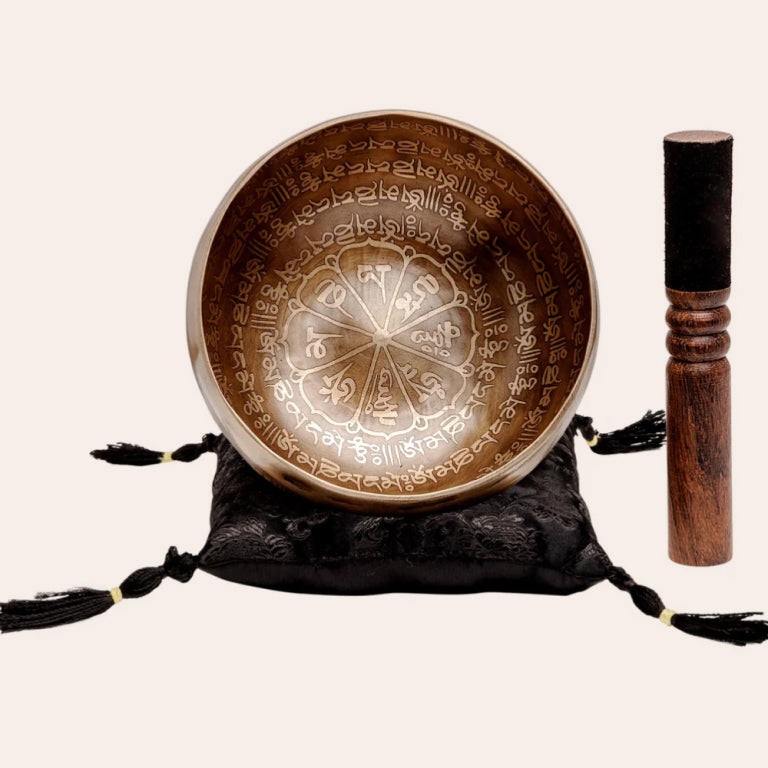
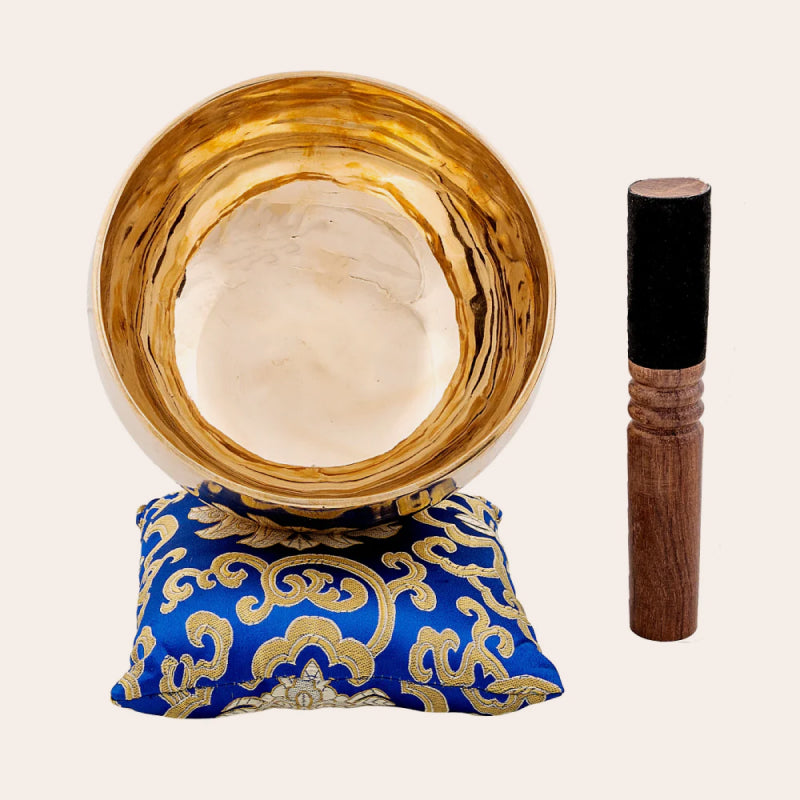
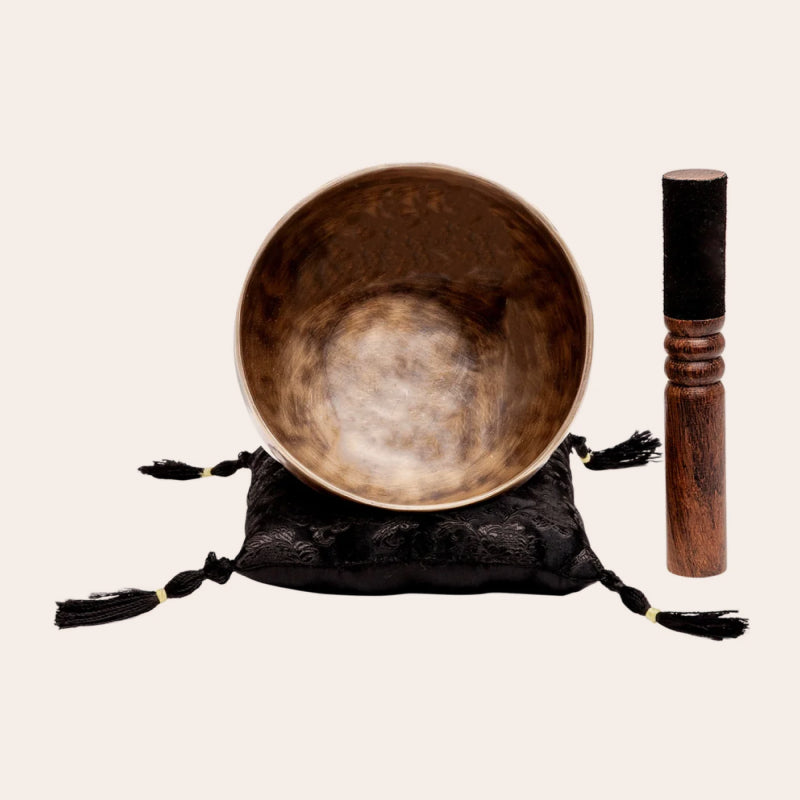
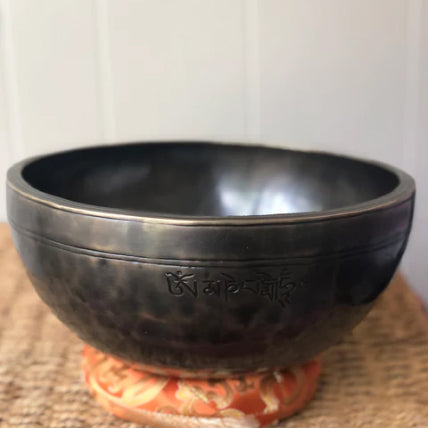
One quality singing bowl with rich, sustained resonance. A hand-hammered bronze Himalayan bowl, 7 to 10 inches, with a warm fundamental tone between 200 and 400 Hz is ideal. The decay time, 20 to 40 seconds for a quality bowl, is not incidental. It is the timer, the anchor, and the meditation object simultaneously. You will also need a padded striker and a quiet space to sit comfortably. Nothing else.
The Complete Protocol
25 to 35 minutes · 3 to 5 sessions per week
Phase 1 — Coherence Breathing (3 minutes)
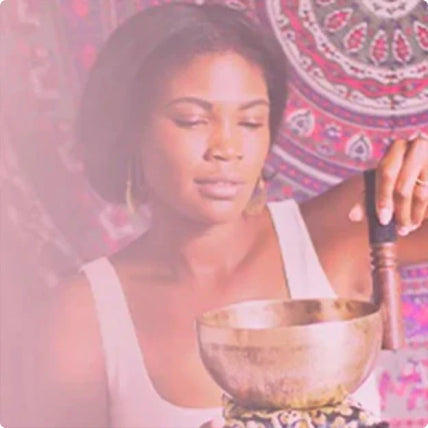
Sit comfortably. Breathe in through your nose for 5 seconds, out through your nose for 5 seconds, continuously and without force. At the start of each exhale, strike your bowl gently. A quality bowl will sustain long enough to overlap with the next strike, creating a nearly continuous resonant environment. You are not performing. You are activating the physiological state, slow breath, vagal dominance, auditory entrainment, that will make the holds meditative rather than effortful.
Phase 2 — The Hold (30 to 45 seconds)
At the end of a natural, comfortable exhale, strike the bowl decisively and hold your breath. No forcing, no extra emptying. Your single task is to follow the sound. Listen actively for the overtones separating within the fundamental, the beating between competing partials, the way the bowl's voice changes as overtones decay at different rates. When the urge to breathe arrives around 20 to 30 seconds, understand what is actually happening: you are most likely still in the easy phase. No involuntary contraction has occurred. What you are feeling is an anticipatory alarm, not a physiological emergency. Redirect your attention to the bowl, find where the sound is now, notice what has faded and what remains, and hold until the sound approaches silence or the hold completes naturally. Then release gently. No gasp.
Phase 3 — Recovery (2 minutes)
Return to coherence breathing, 5 seconds in and 5 seconds out, for a full 2 minutes. The bowl is silent during recovery. This interval is not optional. It allows CO₂ to partially recover before the next hold, creating the progressive training stimulus that makes the later rounds genuinely different from the early ones. Rest in the state the hold created.
Phase 4 — Repeat 6 to 8 Rounds
Hold, recover, hold, recover, for 6 to 8 complete cycles. The first three rounds train psychological calibration: learning that the early alarm is not an emergency. The later rounds, as baseline CO₂ has accumulated across the session, deliver genuine chemoreceptor training. By rounds 5 and 6, most practitioners notice the holds becoming less effortful rather than more. Not because the CO₂ is lower, but because the nervous system has genuinely begun recalibrating its response to the stimulus.
Closing — Integration (5 minutes)
Release all breathing control. Let the breath come and go freely without any rhythm or technique. Strike the bowl one final time and follow its resonance completely to silence. Sit in what remains.
What to Expect
First 1 to 3 sessions: The novelty dominates. The hold at 30 seconds will feel urgent. You will likely release earlier than planned. This is normal and unimportant. Even a 20-second hold in a properly structured session produces real training signal. Between sessions, most practitioners notice their resting breath has slowed slightly. This is the first sign of adaptation: the threshold for triggering the urge-to-breathe signal has shifted upward. Slower resting breath is a quieter nervous system.
Sessions 4 through 10: Most practitioners encounter what we describe as the corridor. It is a quality of interior space that opens during the later rounds of a session. It is the convergence of parasympathetic dominance from the diving reflex, auditory cortex engagement displacing internal chatter, brainwave entrainment from the bowl's beating overtones, and the specific stillness produced when both the inner world (recalibrating threat response) and the outer world (fading sound) have become quiet. What dedicated meditators often describe reaching after months of daily practice, practitioners of The Resonant Hold commonly encounter within two weeks. Not because this is a shortcut, but because it engages the underlying physiology directly rather than working around it.
Beyond 8 weeks: CO₂ tolerance develops through real chemoreceptor adaptation. The comfortable hold extends, not through discipline, but because the physiological threshold has genuinely shifted. Most practitioners find their easy-phase duration extending meaningfully over the first month, with some reaching 60 to 90 second holds within 6 to 8 weeks. At that point, crystal singing bowls, with their longer sustain and cleaner harmonic structure, become valuable companions for extended practice.
An Invitation
This practice asks only one thing of you....When the urge to breathe arrives at 25 seconds and something in your body says this is an emergency, follow the bowl instead.
Not until you are very uncomfortable, just a few seconds further than comfort initially recommends. What you will find on the other side of that choice, reliably and quickly, is a quality of stillness that the ordinary, breathing, narrated mind cannot reach. It is only accessible when the breath stops, the sound fades, and the nervous system arrives at the place it has always been oriented toward.
This article is part of Sound School's ongoing series on the science of sound healing.
Scientific references available upon request.


