
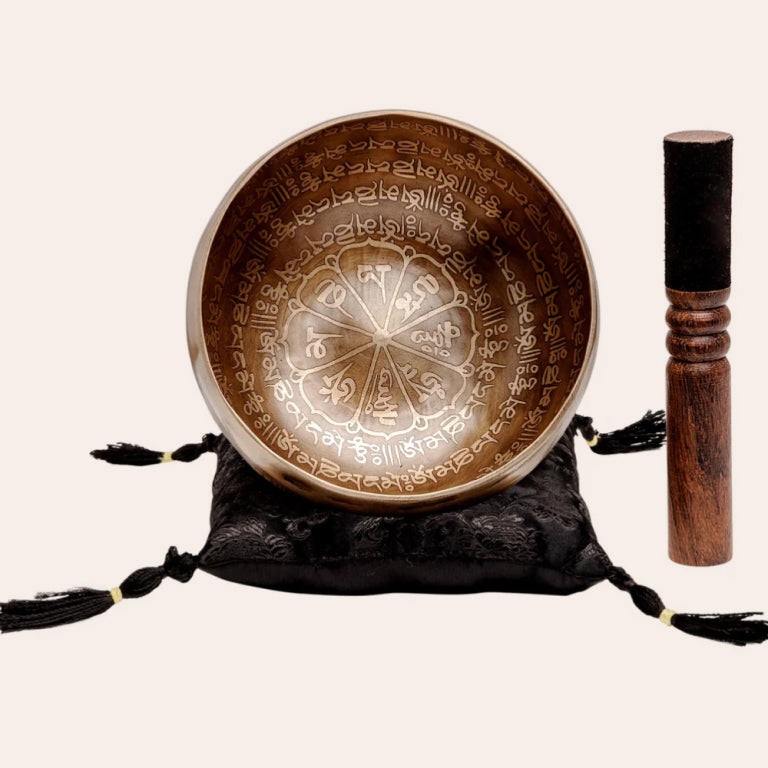
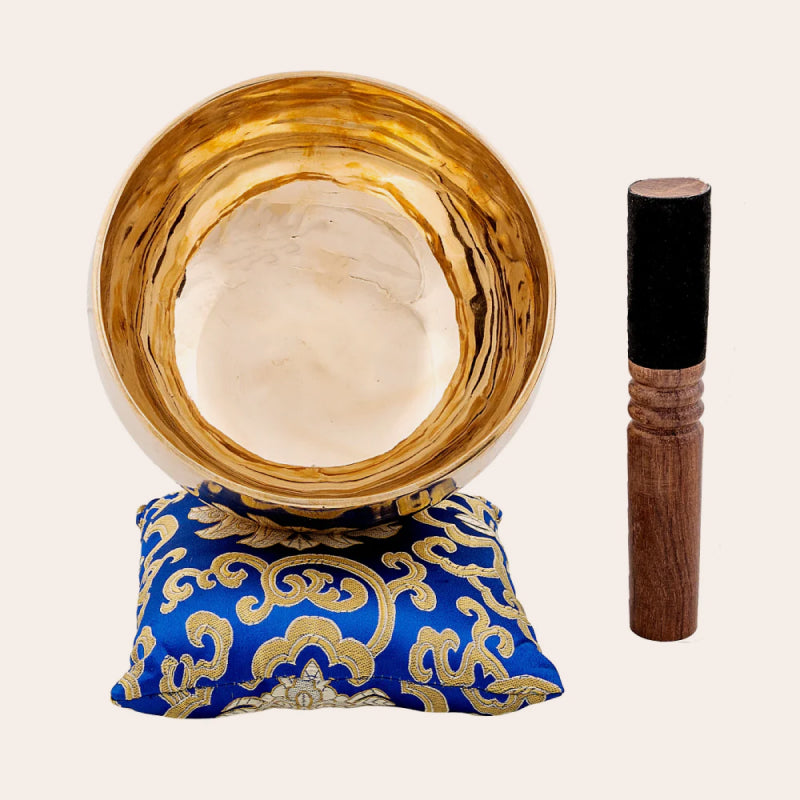
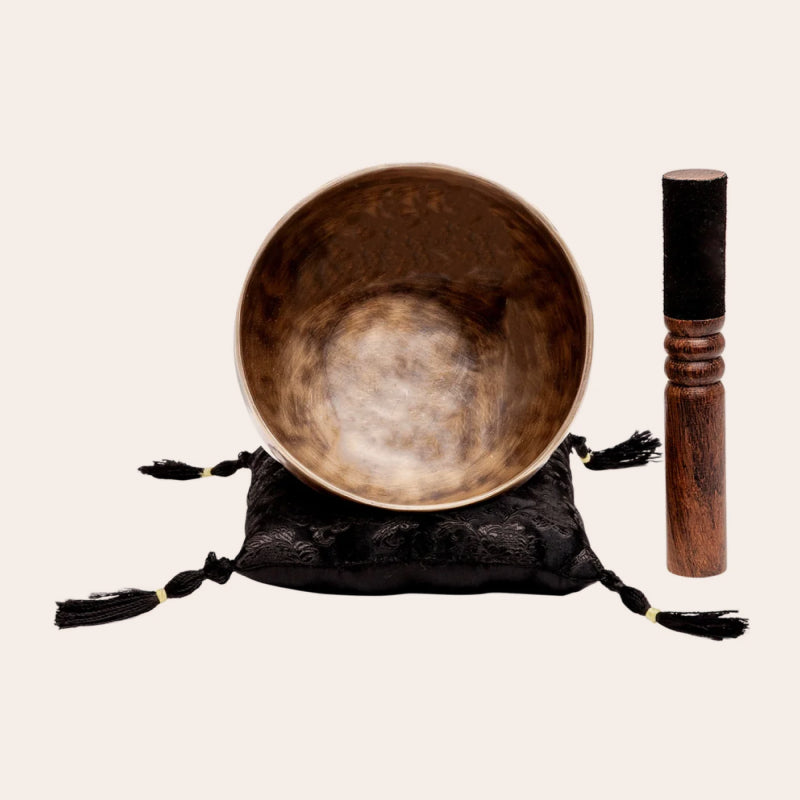
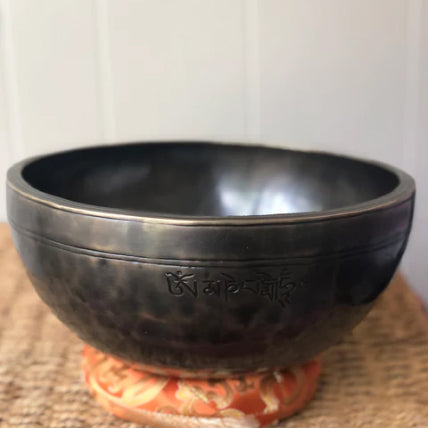




Using a singing bowl can be an incredibly intuitive experience, because of the automatic inharmonic overtones generated by simply inviting the bowl to sing.
The work of hand-hammering the special bronze alloy, and the "perfectly imperfect" asymmetries that result create beat frequencies that cause your ruminating, obsessing brain to surrender to beautiful wall of harmonic complexity.
The bowl sings and you listen and can feel what happens.
But you've only been using half the instrument, and talking about playing the singing bowls on your body isn't something I've widely spoken about.
In this piece, I am going to get you started on how to benefit from playing a singing bowl on your body, today. You'll learn the why, the how and the "what happens," such that you should keep a bowl handy, for immediate use after reading.
You already have benefitted from, and are likely familiar with the audible half of your singing bowl. The other half, the half most people never discover, is what happens when the bowl touches your body.
When a vibrating singing bowl contacts your skin, you become a resonant body. The vibration no longer converts from metal to air to eardrum to signal. It travels directly from metal to skin to tissue to bone, four times faster and with a fraction of the energy lost. Your body conducts vibration better than the air around you, and the things that vibration does inside you, to your nervous system, your connective tissue, your vagus nerve, and your brainwaves, bear no resemblance to what happens when you hear the bowl from across the room.
This is a practical guide. If you own even one singing bowl, you can begin an on-body practice today with no special training and no special equipment: just your bowl, a place to lie down, and twenty minutes. What follows is the why, the how, and the what-you-will-feel, all grounded in acoustic physics and human physiology rather than mythology.
1. Why Placing a Bowl on Your Body Is a Different Experience Entirely
Have you ever noticed the difference between hearing music in a car and feeling the bass shake through the seat? It's the same song but a completely different experience, because one reaches your brain through your ears and the other reaches your brain through your body.
When you play your singing bowl across the room, sound reaches you through one pathway: air. Pressure waves travel from the vibrating bronze to your eardrums, where your cochlea converts them into electrical signals your brain reads as sound. That pathway is powerful because the sound is rich, the beat frequencies shift your brainwaves, and the overtone complexity captures your attention, but it is still a single channel.
Place that same vibrating bowl on your body and you open three additional pathways that only work through physical contact.
The Touch Pathway
Your skin and deeper tissues contain millions of mechanoreceptors, which are specialized nerve endings that detect pressure, vibration, and stretch. The most important here are called Pacinian corpuscles, and they are exquisitely sensitive to vibration between 30 and 1,000 Hz, which is precisely the frequency range of a singing bowl.
When the bowl vibrates against your body, these receptors fire rapidly and send signals through fast-conducting nerve fibers directly to your brainstem, where they modulate your vagus nerve. The vagus is the master regulator of your body's rest-and-repair system, and when it activates, heart rate slows, blood pressure drops, digestion turns on, and muscles release. This pathway works independently of hearing, which means that even a person who cannot hear would receive the full benefit.
The Fascial Pathway
Fascia is a continuous web of connective tissue enveloping every muscle, organ, nerve, and bone in your body, and it is not passive wrapping but an active signaling network. When vibration enters the fascia at any single point, it propagates through the entire system because fascia operates as a tensegrity structure where moving one part causes the whole web to respond.
This is why people consistently report feeling a bowl on their belly as a sensation in their throat or the base of their skull. The vibration traveled through tissue, not through air. And because fascia generates tiny electrical signals when it's mechanically stressed, the vibration contributes to your body's deep internal awareness of itself. The bowl doesn't just relax muscles; it helps your body remember what relaxed feels like.
The Bone Pathway
Sound travels through bone at 3,000 to 4,000 meters per second, which is roughly ten times faster than through air. When a bowl vibrates against a bony surface like your sternum or sacrum, vibrational energy enters the skeletal system and conducts to distant structures. A bowl on your sternum delivers energy through your ribcage to your spine, through your clavicles to your shoulders, and through the manubrium toward your neck.
This reaches places that no hands can touch: deep viscera, nerve plexuses, the peritoneum, and the muscles running along the deepest part of the spine. A massage therapist can reach two or three inches into tissue, but a vibrating bowl placed on your abdomen delivers mechanical energy through the full depth of the abdominal cavity.
The Simple Version:
Listening to your bowl is like standing near a campfire and feeling the warmth on your face. Placing the bowl on your body is like lying down next to the fire and letting the heat soak into your bones. It's the same fire but a completely different experience, because the warmth reaches deeper, spreads further, and changes something at a level that standing nearby never could.
2. What Happens Inside You
Your Nervous System Shifts Gears
Your autonomic nervous system runs two modes. The sympathetic mode is fight-or-flight: elevated heart rate, shallow breathing, tight muscles, and digestion shut down. The parasympathetic mode is rest-and-repair: slow heart rate, deep breathing, muscles released, and digestion alive. Most of us spend the majority of our waking hours stuck somewhere in sympathetic activation, which is the chronic, low-grade hum of modern stress.
On-body bowl vibration shifts you into parasympathetic through the vagus nerve, and it does this through five pathways at once: the sound you hear, the vibration you feel, the slowing of your breath, the weight of the bowl's presence on your body, and the specific frequency content in the vocal range that your nervous system reads as "safe." Five lanes open at once, not one, which is why the shift can feel so fast and so complete. Your body is receiving a multi-channel calm-down signal that no single technique can match.
Your Brainwaves Slow Down
Every handmade singing bowl produces a characteristic pulsation, a rhythmic swelling and fading you hear as a gentle "wah...wah...wah." This is the beat frequency, and it is produced by a phenomenon called mode splitting: tiny irregularities from hand-hammering cause each vibration pattern to split into two closely-spaced frequencies that interfere with each other and create the pulse.
When this pulse happens four to eight times per second, it matches the speed of your theta brainwaves, which is the brainwave band associated with deep meditation, vivid imagery, the border between waking and sleep, and heightened neuroplasticity. Your brain tends to synchronize with steady rhythmic stimuli, and when the bowl's pulsation reaches you through both your ears and through direct physical vibration in your tissue, the entrainment signal is far stronger than from sound alone because two channels are delivering the same rhythmic message simultaneously.
This is why people who have meditated for years often say their first on-body singing bowl session took them to a place that normally requires 30 or 45 minutes of seated practice. The bowl does acoustically and vibrationally what the meditator usually has to do cognitively, which is quiet the thinking mind by giving the brain something so rich and rhythmic that internal chatter simply cannot compete.
Your Thinking Mind Goes Quiet
Your brain has a network called the Default Mode Network, and it is the system that narrates your life: who you are, what happened yesterday, what might happen tomorrow, what you should worry about. It's a useful network, but when it's overactive, it produces anxiety, rumination, and the feeling that you can't turn your own thoughts off.
A singing bowl produces sound so acoustically complex, with so many simultaneous frequencies each carrying their own pulsation and each evolving differently over time, that your narrative brain cannot process it into a story. It is like trying to count the stars, and the network simply releases its grip. What opens up is a wider, quieter, more spacious awareness. When this complexity arrives through your body as well as your ears, the effect compounds because you feel vibration, warmth, pulsation, and movement all at once. There is so much to notice that the narrating mind has nothing to do, and it gets quiet not because you forced it to but because it got absorbed in something more interesting. That quiet is where the real work happens.
The Simple Version:
Your brain has a storytelling machine that never shuts up. The bowl's vibration on your body gives your brain something so interesting and complex to feel that the storytelling machine goes quiet, not because you forced it to but because it got absorbed in something more interesting. That quiet is where the real work happens.
3. Before You Begin
You don't need much, and if you're reading this, you probably have everything already.
Your Bowl
Any handmade metal singing bowl will work. Larger bowls, eight inches and up, are better for body placement because they have lower fundamentals that you'll feel more deeply in your tissue, heavier mass that creates stronger contact vibration, and wider bases that sit more stably on your body. But even a six-inch bowl can be profoundly effective when placed on the sternum.
What matters most is that your bowl produces a clear, smooth pulsation when struck. Strike it and listen for a steady "wah...wah...wah," a rhythmic swelling and fading. That pulsation is the therapeutic signal. If your bowl rings with a smooth and steady pulse, it will work beautifully.
Important: Do not place a singing bowl on your body if you have a pacemaker, are pregnant, have had recent surgery near the placement area, have a seizure disorder triggered by rhythmic stimuli, or have metal implants near the placement site. Consult your physician if you have any doubt.
Your Mallet
Use the softest mallet you have, ideally felt-covered or fabric-covered. A soft mallet produces a gentler, deeper strike that emphasizes the fundamental and minimizes harsh attack, which is exactly what you want for on-body work. If you only have a wooden or leather mallet, that's fine, just use it gently. On-body work uses much less force than you're accustomed to because you're not trying to fill a room; you're trying to vibrate tissue.
Your Space
You need a quiet room and a yoga mat, a bed, or any surface you can lie flat on comfortably, with a small pillow for your head. If you have a bolster or a rolled blanket, place it under your knees. This releases your lower back and, more importantly, releases the psoas muscle, the body's primary fight-or-flight muscle. When the psoas releases, your nervous system registers it as a safety signal before a single sound has been made. Have a thin blanket nearby if the room is cool, and wear loose, comfortable clothing with no zippers or buttons where the bowl will sit.
Your Time
Fifteen to twenty minutes is enough to produce a measurable shift in your nervous system. You don't need an hour and you don't need a ceremony; you need a quiet room and your bowl.
4. Your First On-Body Session
Read this through once, then do it. Don't worry about memorizing every detail because the important thing is simply to begin.
1 Warm Your Bowl
Your bowl is probably at room temperature, around 68 to 72 degrees, and that will feel cold against your skin. Cold triggers a subtle stress response, which is the opposite of what we want.
Warm it first. Hold it in your hands for two to three minutes, or run warm water over the outside and dry it thoroughly. You want the metal to feel neutral or slightly warm against your skin. This small step matters more than you'd expect because when the warm bronze contacts your body, your nervous system reads it as care and safety rather than alerting to a cold object.
2 Lie Down and Settle
Lie on your back with a pillow under your head and a bolster or rolled blanket under your knees. Let your arms rest at your sides or on your lower ribs, and close your eyes or soften your gaze toward the ceiling.
Take three slow breaths, inhaling through your nose for four counts and exhaling through your mouth for six. The longer exhale activates your parasympathetic system. You're not trying to relax yet, you're just arriving. Notice how your body feels against the surface beneath you: the weight of your head, your shoulders, your hips. This takes about sixty seconds.
3 Place the Bowl
For your first session, place the bowl on your lower abdomen, below your navel and above your pubic bone. This is the ideal starting position for three reasons. The tissue here is soft and deep, so the vibration travels far. The surface is broad and relatively flat, so the bowl sits stably. And this region houses the enteric nervous system (your "second brain," with over 500 million neurons) and the abdominal branch of the vagus nerve.
Set the bowl down gently, feel its weight settle into you, and let the contact happen slowly. Adjust the position until the bowl feels stable and comfortable. You should feel the weight but not pain or sharp pressure.
If you have a larger bowl, ten inches or more, this is the ideal placement. If your bowl is smaller, six to eight inches, you may prefer the sternum, which is the center of the chest directly over the breastbone.
4 Be Still for Thirty Seconds
Before you strike, do nothing. Let your body adjust to the weight and presence of the bowl, and feel your breathing move it. The bowl rises slightly with each inhale and settles with each exhale.
This isn't wasted time. Your mechanoreceptors are already responding to the static pressure of the bowl's weight, and your nervous system is registering the contact. You are crossing a threshold from the external world to the internal one, and the silence before the first sound is part of the practice.
5 The First Strike
This is the moment that changes everything.
Hold your mallet in your dominant hand and bring it to the bowl's outer wall, about one-third of the way down from the rim. Strike gently, much more gently than you would if the bowl were on a cushion across the room. You don't need volume; you need vibration. Let the weight of the mallet do the work, and think of it as touching the bowl with the mallet and letting it bounce away rather than hitting it.
And then feel what happens. The bowl comes alive against your body, and the vibration radiates outward from the contact point, into your belly, through your lower back, and along your hip bones. You will feel it in places far from where the bowl sits. The sound enters your ears, but the vibration enters your tissue. They are the same event experienced through two completely different sensory systems at once, and the combination is something you have never felt before.
6 Listen and Feel Through the Full Sustain
Do not strike again immediately. This is the single most important instruction in this entire article.
Let the sound and vibration sustain for their full duration, which will be thirty to ninety seconds depending on your bowl. Follow the pulsation with your attention and feel it in your body. Notice how the sound changes over time: it starts complex and bright with many overtones, then gradually simplifies to a deep, pure hum as the higher frequencies fade. This arc from complexity to simplicity mirrors the journey from mental activity to stillness, and a single strike contains a complete passage from stimulation to rest.
Then notice the silence after the sound fades. That silence is not empty; your nervous system is still riding the wave, and neural inertia keeps the entrained rhythm going for several seconds after the sound has stopped. The pause after sustain is as important as the sound itself, so sit in it and feel what your body is doing in the quiet.
7 Strike Again, Timed to Your Exhale
When the silence feels complete, strike again, and time your strike to the beginning of your exhale.
This is not arbitrary. Exhalation activates the parasympathetic nervous system, which is why sighing feels relieving. When the bowl's vibration arrives at the same moment your body is already moving toward relaxation, the two signals compound, and the bowl and your breath become partners.
Continue this pattern of strike, sustain, silence, breathe, and strike. Each cycle takes 45 to 90 seconds, and in a fifteen-minute session you'll complete ten to twenty cycles.
The Breathing Pattern
Inhale (4 counts, through your nose): Feel your belly rise, lifting the bowl slightly as it rises with you.
Exhale (6 counts, through your nose or mouth): Feel the bowl settle as your belly falls, and strike the bowl at the very start of the exhale.
Sustain (let the breath find its own rhythm): As the bowl rings, stop counting and let your breathing become natural. Your exhale will tend to lengthen on its own because the vibration is doing the work.
Silence (one full breath cycle in quiet): Inhale, exhale, and feel the stillness, then strike again on the next exhale.
Don't force this rhythm because it will become intuitive within three or four cycles. Your body already knows what to do; it's been responding to rhythm since before you were born, when your mother's heartbeat was the first sound you ever heard.
5. What You Will Feel: An Honest Map
Everyone's experience is different, but after guiding over 3,000 people through their first sound experiences, certain patterns show up again and again. Here is what to expect, mapped across time.
You'll notice the bowl's weight, the novelty of the sensation, and your own mind still chattering. The vibration may feel strange, neither quite sound nor quite touch but something in between. Your attention will bounce between the physical sensation and your thoughts, and this is completely normal. You are not doing it wrong.
Your breathing will slow without you trying, and you'll begin to notice the pulsation more distinctly as a rhythmic swelling in your abdomen or chest that seems to breathe with you. Your jaw may unclench and your shoulders may drop. The thinking mind gets quieter, not silent but more distant, like a television playing in another room. The vibration starts to feel less like something on you and more like something in you.
Something shifts. You may feel warmth spreading outward from the contact point, and your hands may feel heavy or tingly. The boundary between your body and the bowl becomes less distinct, and you might notice sensations in unexpected places like your throat, your feet, or the base of your skull as vibration propagates through your fascial network. Your thinking slows further, and thoughts still arise but feel less urgent, more like clouds passing. You're entering alpha or theta brainwave territory.
This is the point where people often say "something happened." The quality of your awareness changes. You're not asleep, but you're not awake in the ordinary sense either. There's a spaciousness, a feeling that the room has expanded or that you've become very still while something else moves through you. Some people see colors behind closed eyes, some feel emotional release like sadness, relief, or a tenderness that arrives without a story attached, and some simply feel a deep physical heaviness that is profoundly comfortable. Whatever arises, let it be. You don't need to name it or understand it because your nervous system is reorganizing.
As you approach the end, let the strikes become further apart and eventually stop striking altogether. Leave the bowl on your body in silence for one to two minutes. This is not optional because this is where the work consolidates. Your nervous system needs time without input to integrate the shift, and you can think of it as the pause after a deep exhale, the moment where the body finds its new baseline.
Gently lift the bowl off your body and set it aside. Don't sit up immediately; instead, wiggle your fingers and toes, turn your head side to side, take three slow breaths, then open your eyes and sit up slowly. You may feel deeply relaxed, slightly disoriented in a pleasant way, emotionally open, or simply very quiet. Drink a glass of water and give yourself five minutes before you return to the ordinary world. The effects continue for twenty to sixty minutes after the session ends.
What if nothing dramatic happens?
That's perfectly fine. Some people cry, some people see colors, and some people just feel slightly calmer. All of it is valid. The physiological changes, including heart rate variability improvement, brainwave shifts, and cortisol reduction, happen whether you perceive them dramatically or not. The first session is a first meeting, not a wedding, so give it three sessions before you decide how it works for you. The nervous system often needs a few exposures before it fully trusts a new stimulus and surrenders into it.
6. Three Placements, Three Experiences
Once you've done a few sessions on the lower abdomen, explore these two additional placements. Each one produces a distinctly different experience because the tissue, the bones, and the nerves underneath are different.
Placement 1: Lower Abdomen (Your Starting Point)
What's underneath: Deep soft tissue, the intestines, the enteric nervous system with its 500+ million neurons, the abdominal branch of the vagus nerve, the aortic plexus, and behind it all, the lumbar spine.
What it feels like: Deep, rolling, and whole-body. The vibration seems to fill your entire torso, and the "second brain" in your gut responds powerfully. People often report gurgling, warmth, and a feeling of emotional release centered in the belly. This is the placement for grounding, for calming a racing mind, and for anyone who carries stress in their gut.
Best with: Your largest bowl, because the deeper the fundamental, the more you'll feel it here.
Placement 2: Sternum (Center of the Chest)
What's underneath: The breastbone, the ribcage, the heart, the lungs, and the cardiac branch of the vagus nerve. There is very little soft tissue here because the bone sits almost directly under the skin.
What it feels like: Immediate and intimate. Because the sternum is bone, the vibration conducts rapidly through the entire ribcage, and you feel it in your back, your shoulders, and your collarbones. Many people feel their heartbeat begin to align with the bowl's pulsation. This placement often produces emotional response, a feeling of openness, tenderness, and relief in the chest. The frequency range of a medium bowl (seven to ten inches) places the sound squarely in the human vocal range, which your nervous system is wired to associate with social safety and connection.
Best with: A medium bowl of seven to ten inches, and keep the weight moderate because you need to breathe freely. If the bowl feels heavy on your chest, use a smaller one.
A note on breathing: The bowl will rise and fall with every breath, and this is a feature rather than a problem. The slight resistance of the bowl's weight as you inhale provides a gentle form of resistance breathing training that naturally lengthens and deepens your breath cycle without conscious effort.
Placement 3: Sacrum (Lower Back, Lying Face Down or on Your Side)
What's underneath: The sacral bone, which is the triangular plate at the base of your spine, along with the sacral nerve plexus that governs pelvic organs and lower extremities. Through bone conduction, this placement also connects to the entire spinal column.
What it feels like: Grounding in a way the other placements cannot match. The sacrum is the foundation of the spine, and vibration placed here conducts upward through every vertebra. People consistently report feeling the vibration travel up their spine to the base of the skull. This placement addresses the psoas and pelvic floor, muscles that store chronic stress and trauma, through gentle oscillatory vibration that the body doesn't resist the way it resists firm pressure.
How to position: Lie face down with a pillow under your hips, or lie on your side with the bowl placed against your sacrum and a small pillow behind it for support. You'll need someone to strike the bowl for you, or you can strike it, place it, and let it sustain.
Best with: Your largest and deepest-toned bowl.
7. How to Think During Your Practice (Or Rather, How Not To)
The most common question people ask is "what should I be thinking about?" and the answer is nothing. That is not a spiritual instruction but a practical one.
Your thinking mind, the part that plans, analyzes, worries, and narrates, is the Default Mode Network, and it is exactly what the bowl's vibration is designed to quiet. If you give it a job during the session like "focus on your breath" or "visualize white light" or "repeat a mantra," you keep the network engaged. You're asking the very system you're trying to quiet to stay busy.
Instead, follow sensation. Not thoughts about sensation but the sensation itself: the pulsation, the warmth, where the vibration travels. When thoughts arise, and they will, notice them the way you'd notice a car passing on a street outside your window. You don't chase it or argue with it; it simply passes, and you return to feeling.
This isn't traditional meditation, and you aren't training concentration. The bowl is doing the work, and your only job is to get out of the way by paying attention to what your body feels rather than what your mind thinks.
Over time, often within three to five sessions, most people find that the getting-out-of-the-way happens on its own. The vibration is interesting enough, complex enough, and physically engaging enough that the mind stops competing. You don't learn to quiet your thoughts; you discover the bowl has already done it for you.
The analogy:
Imagine lying on a warm beach with waves washing over your feet. Nobody has to tell you to "focus on the waves" because you feel them. Your mind wanders, and then a wave comes and you feel it, and you're back. The bowl is the wave and your body is the beach, and your only job is to be there.
8. Building a Daily Practice
Consistency matters more than duration, and ten minutes daily produces more cumulative benefit than sixty minutes once a week. The research on brainwave entrainment and vagal toning supports this, and here is a practice you can sustain.
The 12-Minute Daily Practice
Minutes 0–1: Lie down, take three deep breaths, and place your warmed bowl on your lower abdomen or sternum.
Minutes 1–2: Stillness. Feel the bowl's weight and let your breathing settle.
Minutes 2–10: Strike the bowl on each exhale and let each strike sustain fully before striking again. You'll complete eight to twelve strikes total, and you should follow sensation rather than thoughts.
Minutes 10–12: Silence with the bowl still on your body and no more strikes. Feel the residual stillness, then remove the bowl, take three breaths, and open your eyes.
That is twelve minutes. Do this daily for two weeks and you will notice changes in your baseline stress level, your sleep quality, and your ability to access calm when you need it. These are not speculative claims; they follow directly from the physiology of vagal toning, which is cumulative and progressive.
When to Practice
Morning, before the day's momentum takes over. This sets a parasympathetic baseline for the day, and you'll find you're more patient, more present, and less reactive in the hours that follow.
Evening, thirty to sixty minutes before bed. This shifts your nervous system out of the day's residual activation and into the state that precedes restful sleep, and if you struggle with a racing mind at bedtime, this is your practice.
After stress, whether that's a difficult conversation, a long commute, or a day that ran you over. Even five minutes of on-body vibration can interrupt the cortisol cascade of a stress response and bring your nervous system back to baseline faster than it would on its own.
9. What Most People Get Wrong
Striking too hard.
On-body work requires less force than off-body work because the bowl is in direct contact with your tissue and doesn't need to project sound across a room. A gentle strike that you barely hear in the air produces a vibration you feel deeply in your body, and if the initial impact feels like a thud rather than a bloom, you're hitting too hard.
Striking too often.
The silence between strikes is where the nervous system consolidates the shift. If you strike every ten seconds you're interrupting the process, like waking someone up every time they start to fall asleep. Let the full sustain play out, wait in the silence, and then strike again. The principle is simple: fewer strikes and more space between them.
Trying to make something happen.
You don't have to visualize anything, you don't have to "send energy" anywhere, and you don't have to feel a specific thing. The physics of vibration and the physiology of your nervous system are doing the work, and your only job is to lie there, feel what you feel, and let the bowl do what it does. Effort is counterproductive because the less you try, the more happens.
Using a bowl that's too small or too light.
For body work, bigger and heavier genuinely matters, not for status but for physics. Mass determines how much vibrational energy transfers into your tissue, and a heavier bowl pushes more vibration deeper into your body. If your bowl is under six inches it will still work, especially placed on the sternum where bone is close to the surface, but if on-body practice becomes central to your life (and for many people it does), your next bowl should be a large one chosen specifically for how it feels on your body rather than how it sounds across the room.
10. Where This Goes from Here
What you've read here is a starting point, a self-practice protocol that anyone with a singing bowl can begin today.
More is coming, and we'll have a great deal to share with you soon.
But for now, go lie down, warm up your bowl, place it on your belly, strike it gently, and feel what happens. Your body already knows what to do with the vibration. It's been waiting for you to ask.


