



The Vagus Nerve and Sound: How Vibration Activates Your Body's Master Reset Switch
Five pathways to one nerve. The most complete explanation of why sound changes your physiology.
There is a nerve that runs from your brainstem to your gut. It branches into your heart, your lungs, your throat, your ears, and your digestive tract. It regulates your heart rate. It controls your breathing depth. It governs your digestion. It modulates your immune response. It determines whether your body is in a state of stress or a state of repair.
It is the longest cranial nerve in your body. It is called the vagus nerve, from the Latin vagus, meaning "wandering." It is, without exaggeration, the single most important nerve in your autonomic nervous system.
If you have ever played a singing bowl and felt your breathing slow, that was your vagus nerve responding. If you have ever been in a sound bath and felt your heart rate drop, your shoulders release, your digestion suddenly activate, that was vagal activation. If you have ever felt a wave of calm wash through your body during a gong wash and wondered what just happened, the answer, at the physiological level, is almost certainly vagal.
The vagus nerve has become one of the most talked-about topics in health and wellness. And yet, in the sound healing world, where we have arguably the most powerful vagal activation tool in existence, almost nobody has explained the connection with any rigor.
This article is meant to serve as that explanation.
1. What the Vagus Nerve Is
The vagus nerve is the tenth cranial nerve, designated CN X. It exits the brainstem at the medulla oblongata and descends through the neck, chest, and abdomen, innervating the pharynx, larynx, heart, lungs, stomach, intestines, liver, and spleen along the way. No other cranial nerve has this reach. It is the primary conduit of the parasympathetic nervous system , which is the the branch of your autonomic nervous system responsible for rest, digestion, repair, and recovery.
Approximately 80% of vagal fibers are afferent, meaning they carry information from the body to the brain. This is a fact that surprises most people and has profound implications for sound healing. The vagus nerve is not primarily a top-down command nerve telling your organs what to do. It is primarily a bottom-up sensory nerve, reporting to your brain about the state of your body. When sound activates vagal afferent fibers, the signal travels upward to the brainstem, where it modulates your entire autonomic state.
The practical implication: you do not have to think yourself calm.
You do not have to believe in anything. If the right kind of sensory stimulus reaches vagal afferent fibers, the brainstem responds by shifting your autonomic balance toward parasympathetic dominance. Heart rate slows. Blood pressure decreases. Respiratory rate drops. Digestion activates. Cortisol production diminishes. Inflammatory markers decrease. Immune function improves.
This is not relaxation in the colloquial sense of "feeling nice." It is a measurable physiological state change that affects every organ system in your body. And sound, it turns out, activates this nerve through more simultaneous pathways than almost any other intervention.
In Plain Language: The vagus nerve is a long nerve that connects your brain to most of your major organs. Its main job is to shift your body from "stress mode" into "repair mode." About 80% of its signals travel upward — from body to brain — which means physical sensations (like vibration) can change your brain's stress response without you having to do anything mentally. Sound activates this nerve through five different pathways at once. That is unusual. Most interventions activate one, maybe two.
2. The Polyvagal Framework: Why Not All Sound Is "Healing"
To understand how sound interacts with the vagus nerve, we need the framework developed by neuroscientist Stephen Porges: Polyvagal Theory. This theory identifies three hierarchically organized neural circuits that govern your stress response and social behavior. Each circuit corresponds to a distinct physiological state, and sound interacts with each one differently.
The Ventral Vagal Complex: Safety and Connection
The evolutionarily newest circuit. When this system is active, you feel safe, connected, present, and open. Your facial muscles are animated. Your voice has melodic variation (what Porges calls "prosody"). Your middle ear muscles are tuned to the human vocal range. You can listen, you can engage, you can heal. This is the only state in which deep therapeutic work is possible.
The Sympathetic Nervous System: Mobilization
The fight-or-flight system. Activated by perceived threat. Heart rate increases, breathing becomes shallow and rapid, muscles tense, digestion halts, attention narrows. Many people walk around in a chronic low-grade version of this state. Their vagal tone, the strength of their parasympathetic brake, is low.
The Dorsal Vagal Complex: Immobilization
The most primitive circuit. Activated by overwhelming threat. Produces freeze, shutdown, dissociation, numbness, collapse. Heart rate drops, breathing becomes barely perceptible, and the person "checks out." This is the body's last-resort survival strategy. People with significant trauma history often live partially in this state.
Sound does not have a single effect on the nervous system. The same singing bowl, played the same way, will produce different physiological responses depending on which neural circuit is dominant in the listener at that moment. A person in ventral vagal will experience the sound as deeply pleasurable and integrative. A person in sympathetic activation may experience the same sound as initially agitating before it becomes calming — the nervous system has to be brought into ventral vagal before it can use the sound therapeutically. A person in dorsal vagal shutdown may barely register the sound at all, or may need gentle, predictable, rhythmic sound to slowly mobilize out of freeze.
This is why sound baths are not one-size-fits-all. The practitioner's skill lies in recognizing which state the listener inhabits and selecting the appropriate sound to meet them there.
Porges' research demonstrated something remarkable about the middle ear. The tiny muscles of the middle ear, the stapedius and tensor tympani, are innervated by cranial nerves that are part of the ventral vagal complex. When these muscles are properly toned, they filter background noise and amplify the frequency range of the human voice (roughly 1,000–4,000 Hz). When a person is stressed or traumatized, these muscles lose tone, and the person becomes hypersensitive to low-frequency sounds (which the nervous system reads as predatory threat) while simultaneously losing the ability to track human speech in noisy environments.
This is why traumatized people often say they can't follow conversations in restaurants. It is not an attention problem. It is a middle ear muscle problem, reflecting a vagal tone problem.
The prosodic range of singing bowl harmonics — the frequencies that fall in the 1,000–4,000 Hz band — engages these middle ear muscles in the same way that a warm, melodic human voice does. The bowl sounds exercise the very muscles that the nervous system uses to assess safety.
3. Five Pathways: How Sound Activates the Vagus Nerve
No other single therapeutic intervention activates the vagus nerve through as many simultaneous pathways as a singing bowl session with body placement. Here they are, one by one.
Pathway 1: The Auricular Branch — Sound in the Ear Canal
The auricular branch of the vagus nerve (also called Arnold's nerve) innervates a small but significant region of the ear canal and the outer ear. When sound waves enter the ear canal, they create pressure changes that stimulate this branch directly. The signal travels along vagal afferent fibers to the nucleus tractus solitarius (NTS) in the brainstem — the primary relay station for vagal input — which then modulates autonomic output.
This pathway is so reliable that it has been developed into an FDA-cleared medical technology: transcutaneous auricular vagus nerve stimulation (taVNS), which delivers gentle electrical pulses to this same ear region to treat depression and epilepsy. Sound is the original, non-electronic version of this same mechanism. When the complex, harmonically rich sound of a singing bowl fills the ear canal, it provides a broad-spectrum stimulus to the auricular branch that a narrow electrical pulse cannot replicate.
Active during: Any singing bowl session — the listener does not need to be in physical contact with the bowl. This pathway operates whenever sound reaches the ear canal.
Pathway 2: The Middle Ear Pathway — Exercising the Muscles of Safety
The stapedius muscle, innervated by the facial nerve (CN VII), and the tensor tympani muscle, innervated by the trigeminal nerve (CN V), are both functionally integrated with the ventral vagal complex. Porges calls this the Social Engagement System. When these muscles are engaged, they modulate the impedance of the middle ear, filtering low-frequency background noise and amplifying the prosodic frequencies that signal human social connection (roughly 1,000–4,000 Hz).
A singing bowl with a rich overtone structure produces harmonics that span this prosodic range. The overtones exercise the middle ear muscles in a way that is remarkably similar to listening to warm, melodic speech — the acoustic signature of safety. Porges' own Safe and Sound Protocol (SSP) uses algorithmically filtered music targeting this frequency range to improve vagal tone in children and adults with auditory processing difficulties, anxiety, and trauma. A high-quality singing bowl delivers a naturally produced version of this stimulus.
Active during: Any session with a harmonically complex instrument. Bronze bowls, with their dense overtone structure spanning multiple octaves, engage this pathway more completely than instruments with fewer harmonics.
Pathway 3: The Respiratory Pathway — Breathing Entrained to Sound
The vagus nerve is the primary neural conduit for respiratory sinus arrhythmia (RSA) — the natural increase in heart rate during inhalation and decrease during exhalation. When you slow your breathing, particularly by extending the exhale, you increase vagal output. This is why every relaxation technique in the world emphasizes slow, deep breathing. It is the simplest way to activate the parasympathetic branch.
A singing bowl struck at a steady rhythm — once every 8 to 12 seconds — creates an external temporal reference that the respiratory system naturally synchronizes with. The listener's breathing begins to slow and deepen without conscious effort. This is respiratory entrainment: the same principle by which pendulum clocks on the same wall synchronize, first documented by Christiaan Huygens in 1665. The bowl provides the rhythm. The autonomic nervous system follows.
Specifically: a bowl with a long sustain (45–90 seconds) struck once per exhalation cycle creates a continuous auditory cue for the parasympathetic breath pattern. The extended exhale driven by this entrainment increases vagal brake activity, measured as increased high-frequency heart rate variability (HF-HRV). This is one of the most reliable, measurable vagal activation effects of sound healing.
Active during: Any session with rhythmic, sustained sound. Particularly effective when the practitioner times strikes to the client's observed breath cycle — striking at the onset of exhalation.
Pathway 4: The Vibrotactile Pathway — Vibration Through Tissue
This pathway is exclusive to on-body work. It does not activate when you listen to a bowl from across the room.
When a vibrating singing bowl is placed directly on the body, the oscillating bronze wall transmits mechanical vibration through the contact surface into skin, subcutaneous tissue, muscle, fascia, and bone. The most important receptors activated are Pacinian corpuscles — pressure-sensitive mechanoreceptors embedded in deep tissue that are most responsive to vibration between 30 and 1,000 Hz. This is precisely the frequency range of a singing bowl.
Pacinian corpuscles transmit signals through myelinated Aβ nerve fibers — fast-conducting fibers that relay to the somatosensory cortex and, critically, to brainstem nuclei governing autonomic regulation. The signal modulates vagal output directly. Heart rate slows. Blood pressure drops. The autonomic balance shifts toward parasympathetic dominance.
This pathway operates independently of hearing. A deaf person would receive full benefit. The vibration does not need to be perceived as "sound" by the auditory system — it reaches the vagal regulatory centers through a completely separate neural route. This is why on-body singing bowl work produces physiological effects that are qualitatively different from listening to a bowl across the room. You are accessing a pathway that air-conducted sound cannot reach.
The fascia — the continuous web of connective tissue enveloping every muscle, organ, and nerve in the body — propagates this vibration far beyond the contact point. A bowl placed on the abdomen sends vibrational energy through the fascial network into the diaphragm, the spinal extensors, and the base of the skull. Clients routinely report feeling the vibration in body regions far from the bowl's location. This is fascial tensegrity at work, distributing mechanical force globally through a continuous tissue network.
Active during: On-body work only. Requires physical contact between the vibrating instrument and the client's body. The larger and heavier the bowl, and the more surface area in contact with the body, the greater the vibrotactile activation.
Pathway 5: The Pharyngeal-Laryngeal Pathway — The Voice as Vagal Activator
The vagus nerve innervates the muscles of the pharynx and larynx. When a person hums, chants, or tones — particularly the extended "om" or low vocal drone — the laryngeal muscles contract rhythmically, sending afferent signals through the vagus to the brainstem. This is the mechanism behind the physiological benefits of chanting documented across contemplative traditions for thousands of years, and it is why vocal toning is so frequently paired with singing bowl practice.
When a client hums along with a resonating bowl — whether consciously or as the involuntary humming that many people produce during deep sound immersion — they activate this fifth pathway. The vocal fold vibration stimulates the recurrent laryngeal nerve (a branch of the vagus), which sends afferent signals to the NTS, which modulates parasympathetic tone.
Some practitioners intuitively use their own voice during sessions — speaking slowly, with warm prosody, or toning alongside the instruments. Whether they know the neuroscience or not, they are activating the listener's pharyngeal-laryngeal vagal pathway through co-regulation. The practitioner's vocal quality cues the listener's Social Engagement System, which mediates ventral vagal activation.
Active during: Sessions that incorporate vocal toning, humming, or guided verbal cues from the practitioner. Also activated spontaneously when clients begin humming along with the instruments — a reliable sign of deep relaxation and ventral vagal engagement.
4. The Convergence Effect: Simultaneous Activation Makes A Difference
You might reasonably ask: does it matter that five pathways are activated simultaneously, rather than one at a time?
The evidence strongly suggests that it does.
Each vagal afferent pathway converges on the same brainstem structure — the nucleus tractus solitarius (NTS). The NTS integrates incoming signals from all vagal branches and modulates autonomic output accordingly. Multiple simultaneous inputs create a convergent signal that is more robust, more sustained, and more difficult for the sympathetic nervous system to override than any single input alone.
Think of it this way. Slow breathing alone activates vagal tone — this is well established. But if you are breathing slowly while also receiving vibrotactile input from a bowl on your body, while also hearing harmonically complex sound that exercises your middle ear muscles, while also receiving auricular vagal stimulation from the sound pressure in your ear canals — the brainstem receives a unanimous signal from multiple sensory systems: you are safe. Shift into repair mode.
This convergence is why experienced practitioners and their clients report effects from singing bowl sessions that seem disproportionate to what "just listening to a bowl" should produce. It is not one mechanism working hard. It is five mechanisms working together. The nervous system receives safety signals from the skin, the ears, the respiratory rhythm, the middle ear muscles, and the larynx — all simultaneously, all converging on the same brainstem nucleus, all saying the same thing.
This is also why a recorded singing bowl played through speakers, while pleasant, produces a qualitatively different physiological experience than a live bowl in the room — and why a live bowl on the body produces yet another order of effect entirely. Each step closer to the body activates additional pathways. Speakers deliver Pathways 1 and 2 (partially). A live bowl in the room delivers Pathways 1, 2, and 3. A live bowl on the body delivers all five.
If you are a practitioner, this framework gives you a clear hierarchy of intervention intensity. Ambient sound (bowls in the room, not on the body) is your gentlest intervention — appropriate for initial sessions, group sound baths, and clients in acute sympathetic activation who may not yet tolerate touch. On-body placement is your most powerful intervention — appropriate for established clients in ventral vagal, where the additional mechanoreceptor and fascial pathways can be engaged safely. Adding vocal toning or guided verbal cues activates the fifth pathway. You are not guessing about "what feels right." You are making a clinical decision about how many vagal pathways to engage based on the client's nervous system state.
5. Measuring It: Vagal Tone and Heart Rate Variability
Everything described above produces effects that are measurable with consumer-grade technology.
The gold-standard proxy for vagal tone is heart rate variability (HRV) — specifically, the high-frequency component of HRV (HF-HRV), which reflects respiratory sinus arrhythmia and is directly mediated by vagal output. Higher HRV indicates stronger vagal tone and greater parasympathetic resilience. Lower HRV is associated with chronic stress, anxiety, depression, cardiovascular disease, and all-cause mortality.
HRV can be measured with a chest strap heart rate monitor (such as a Polar H10) paired with a smartphone app (such as Elite HRV or HRV4Training), or with some consumer wearables. This means that every claim in this article is, in principle, verifiable in your own practice.
Pilot studies and observational data on singing bowl sessions consistently show increases in HRV during and after sessions, decreases in heart rate, decreases in respiratory rate, and shifts in autonomic balance toward parasympathetic dominance. Multiple studies have documented improvements in mood, reductions in anxiety scores, and decreases in perceived pain following singing bowl exposure. While large-scale randomized controlled trials specific to singing bowls remain limited, the constituent mechanisms — respiratory entrainment increasing vagal tone, vibrotactile stimulation modulating autonomic output, auricular vagal nerve stimulation — are individually well-established in the peer-reviewed literature.
What the evidence supports
Established: Respiratory sinus arrhythmia as a vagal mechanism. Mechanoreceptor activation modulating autonomic state. Auricular vagus nerve stimulation affecting mood and autonomic balance. Middle ear muscle function as a component of the Social Engagement System. Laryngeal vagal activation through vocalization.
Supported by converging evidence: Singing bowl sessions producing measurable physiological changes (heart rate, blood pressure, HRV, mood scores). Brainwave entrainment via auditory beat stimulation. Benefits of on-body vibration for pain and anxiety.
Mechanistically plausible, not yet tested as a combined protocol: The specific claim that all five pathways activated simultaneously produce a synergistic effect greater than any single pathway alone. This is the frontier — and it is where formal research is most needed.
Our commitment is to distinguish clearly between what is established, what is supported by evidence, and what remains to be proven. The individual mechanisms are not speculative. Their convergence during a singing bowl session is the hypothesis — and it is a hypothesis that every practitioner with an HRV monitor can begin testing today.
6. Why Bronze Bowls Are Particularly Effective Vagal Activators
Not all sound sources are equally effective at engaging these five pathways. The material composition, construction method, and acoustic properties of the instrument matter — and they matter for specific, mechanistic reasons.
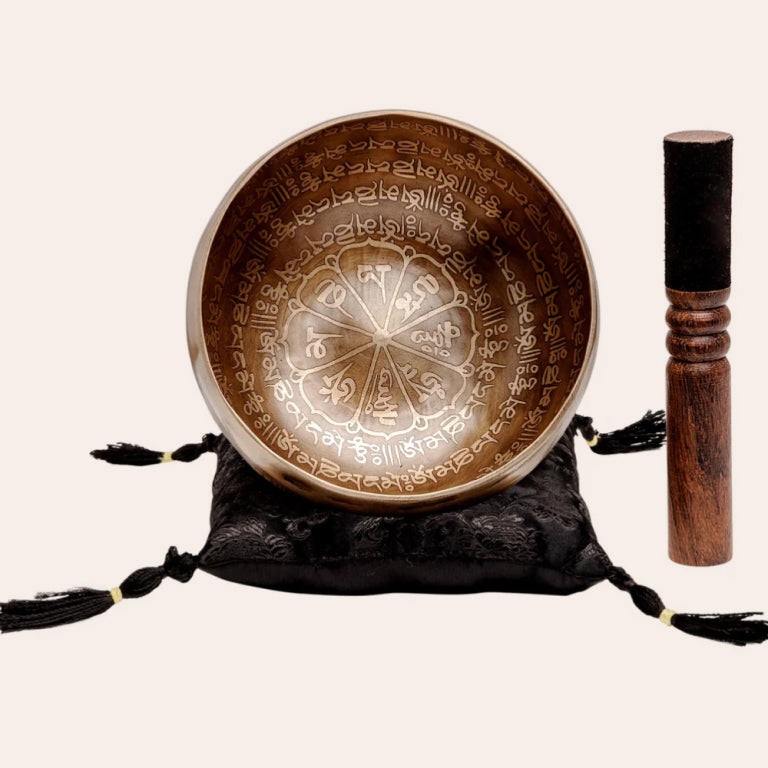
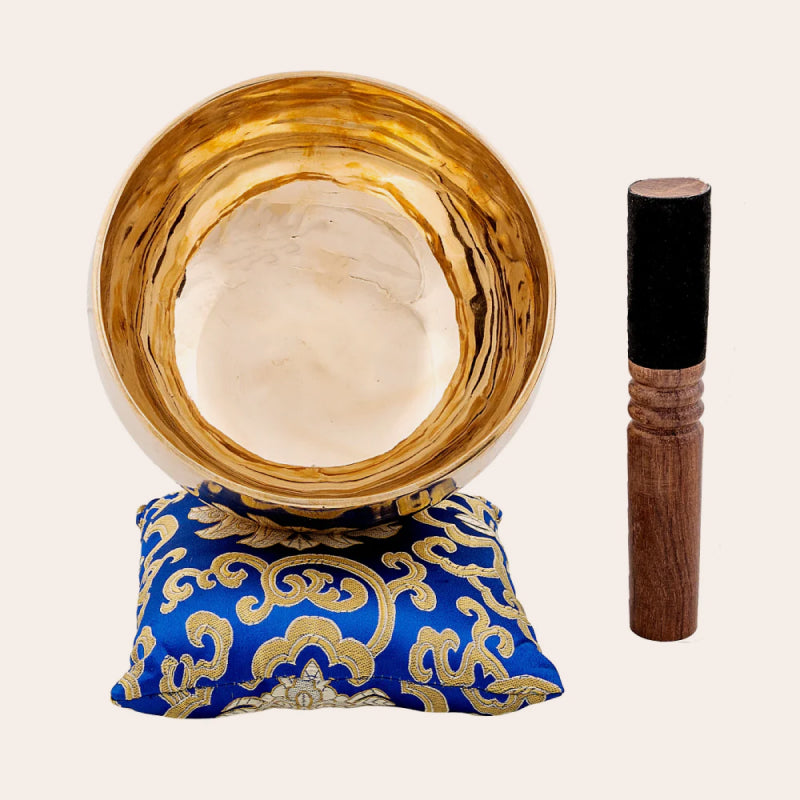
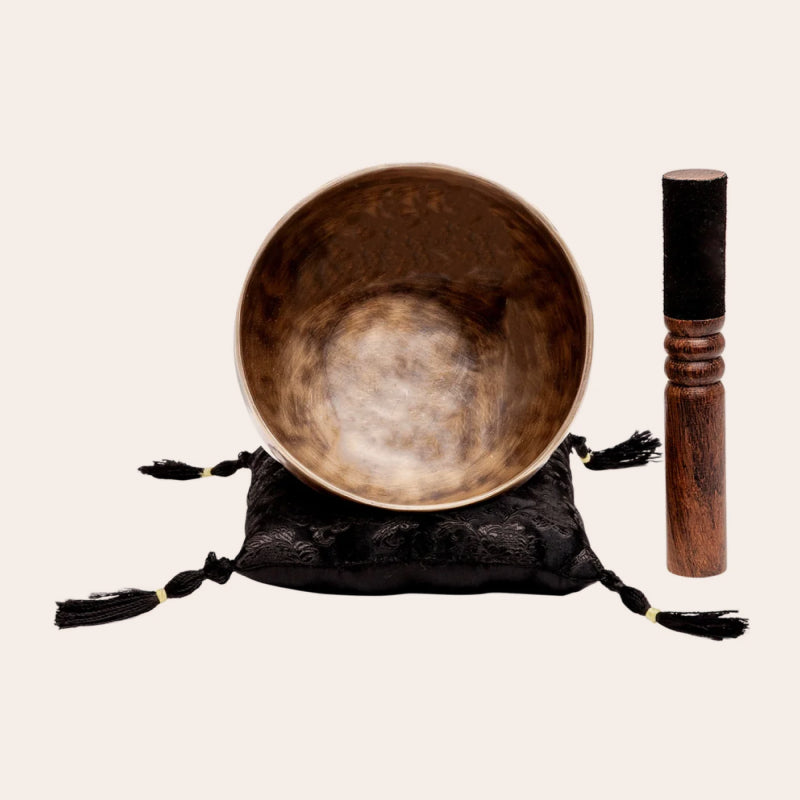
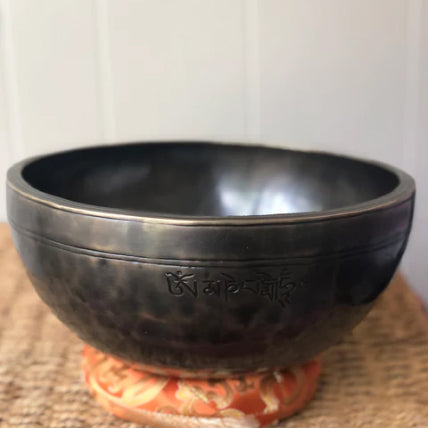
A high-quality handmade bronze singing bowl (the traditional bell-metal alloy of approximately 78% copper and 22% tin) produces several acoustic features that are directly relevant to vagal activation:
Rich overtone structure spanning the prosodic range. The hand-hammering process introduces microscopic asymmetries in the bowl's walls, creating a dense ecosystem of overtones — typically five to seven or more simultaneously audible frequencies per strike. Many of these overtones fall in the 1,000–4,000 Hz range that Porges identifies as the Social Engagement frequency band. This exercises the middle ear muscles (Pathway 2) with a complexity and naturalness that pure-tone instruments cannot match.
Beat frequencies in the brainwave entrainment range. The same hand-hammered asymmetries cause each vibration mode to split into two closely spaced frequencies — a phenomenon called mode splitting, first documented in detail by MIT researchers. The interaction between these split frequencies produces audible pulsation (beating) typically in the 4–12 Hz range: precisely the alpha and theta brainwave bands associated with relaxation, meditation, and parasympathetic dominance. These beats drive respiratory entrainment (Pathway 3) because listeners unconsciously synchronize their breathing to the perceived pulse.
Exceptional sustain. A well-made bronze bowl sustains for 45 to 90 seconds after a single strike. This extended sustain provides a continuous vagal stimulus — continuous sound entering the ear canal (Pathway 1), continuous middle ear muscle engagement (Pathway 2), continuous respiratory entrainment cue (Pathway 3), and, in on-body work, continuous mechanoreceptor activation (Pathway 4). A short sustain means the vagal stimulus stops and must be re-initiated with each strike. Long sustain means uninterrupted activation.
Broad-spectrum vibrotactile output. The complex modal vibrations of a bronze bowl produce mechanical oscillation across a wide frequency band when placed on the body — from the low fundamental (which activates deep tissue mechanoreceptors) through multiple overtones (which activate superficial receptors in different frequency ranges). The body receives a spectrum of vibrational input, not a single frequency. This broad-spectrum stimulus engages a wider population of mechanoreceptors, producing a more complete vagal afferent signal.
7. The Co-Regulation Dimension: Practitioner as Vagal Cue
There is a sixth element in a practitioner-delivered session that does not come from the instruments at all. It comes from the practitioner's own nervous system.
Porges' Social Engagement System operates through neuroception — a subconscious process by which the nervous system evaluates safety through environmental cues. Among the most powerful cues are the prosody, facial expression, and postural quality of another human being. A practitioner who is themselves in a ventral vagal state — calm, present, regulated — provides a co-regulatory signal to the client's nervous system that is processed below conscious awareness.
This is why the same instruments, played with the same technique, can produce profoundly different effects depending on who is playing. A dysregulated practitioner — one who is anxious, distracted, or performing — transmits sympathetic cues through their vocal quality, their movements, and their breath pattern. The client's nervous system detects these cues through neuroception and remains guarded, reducing the effectiveness of every vagal pathway the instruments activate.
A regulated practitioner — one who has centered themselves before the session, whose breathing is slow and diaphragmatic, whose movements are deliberate and unhurried, whose voice (when used) carries warm prosody — provides a safety signal that primes the client's nervous system for the vagal activation that the instruments then deliver.
The practitioner is not merely a technician operating instruments. The practitioner's nervous system state is the container within which the client's nervous system feels safe enough to shift. This is not metaphor. It is polyvagal neuroscience. And it is the reason why practitioner training that focuses only on technique — which bowls to play when — misses the most important variable: the person holding the bowl.
8. Practical Implications: For Practitioners, for Self-Practice, for Choosing Your Instruments
For practitioners
Understanding vagal pathways transforms session design from intuitive guesswork into informed clinical reasoning. You now have a framework for answering the question "what should I do next?" during a session. If the client is in sympathetic activation (elevated breathing, tension, restlessness), prioritize Pathways 1–3: ambient sound in the room, rhythmic striking timed to their exhale cycle, harmonically rich instruments that engage the middle ear. Do not place bowls on the body until you observe signs of ventral vagal engagement — slower breathing, facial softening, muscular release. Once ventral vagal is established, introduce on-body placement (Pathway 4) and, if appropriate, vocal toning or guided verbal cues (Pathway 5). You are titrating vagal activation to the client's capacity.
If the client is in dorsal vagal shutdown (flat affect, barely audible breathing, dissociation), your first task is mobilization — gently activating the sympathetic system enough to bring them out of freeze before guiding them into ventral vagal. Gentle, rhythmic, predictable sound with slight increases in tempo or volume can accomplish this. On-body work may be too much too soon. Meet the nervous system where it is.
For self-practice
If you own a singing bowl and want to maximize vagal activation in your personal practice, the evidence points to three priorities. First, place the bowl on your body rather than playing it at a distance — this adds the vibrotactile pathway that ambient listening cannot access. The abdomen and sternum are particularly effective placement sites because of their proximity to the vagal trunk and its major branches. Second, time your strikes to the beginning of your exhale, and allow the full sustain to ring out before striking again. This synchronizes the bowl's rhythm with your respiratory vagal activation, reinforcing both Pathway 3 and the breath-mediated component of HRV. Third, if it arises naturally, allow yourself to hum or tone along with the bowl. This activates Pathway 5 and produces a remarkable sensation of the voice and the bronze vibrating together — a felt experience of physiological coherence.
For choosing instruments
Vagal activation is not a function of price, appearance, or marketing claims. It is a function of acoustic properties that you can evaluate. Look for overtone complexity (strike the bowl and listen for multiple distinct tones interweaving), sustain duration (a well-made bowl should ring for at least 30 seconds from a moderate strike), audible beating (the pulsation produced by mode splitting — this is the rhythmic throb you hear as the tone develops), and, for on-body work, sufficient mass and diameter to maintain vibration when coupled to body tissue (smaller, lighter bowls lose energy more quickly when placed on the body). A bowl that sounds beautiful from across the room but stops vibrating within seconds of being placed on your abdomen is an airborne instrument, not a body instrument.
9. Where This Goes: The Frontier
The individual mechanisms described in this article are established science. Auricular vagal stimulation is FDA-cleared for clinical use. Respiratory sinus arrhythmia is a textbook parasympathetic mechanism. Mechanoreceptor activation modulating autonomic state is documented in the vibrotactile therapy literature. Middle ear muscle function within the Social Engagement System is Porges' life's work, supported by decades of research. Laryngeal vagal activation through vocalization is established in the chanting and breathwork literature.
What has not yet been studied is the convergence — the specific physiological effect of activating all five pathways simultaneously through a singing bowl session, compared to activating each pathway in isolation. This is the research frontier. And it is the research that would, if the convergence hypothesis is confirmed, establish sound healing as one of the most physiologically comprehensive vagal activation modalities available.
We believe this research will be conducted. The instruments exist. The measurement technology exists. The theoretical framework exists. The clinical observations from thousands of practitioners and millions of sessions worldwide provide the empirical foundation. What remains is the formal validation that translates practitioner knowledge into evidence that the broader medical and therapeutic communities can integrate.
In the meantime, every practitioner with an HRV monitor can begin contributing data. Measure your client's HRV before and after sessions. Track the variables: which instruments, which placements, which techniques produce the largest HRV shifts. Accumulate the observations. The science of sound and the vagus nerve is not waiting for someone else to validate what you already feel working in your sessions. It is asking you to measure it.
The Bottom Line
The vagus nerve is your body's master reset switch. A singing bowl session — particularly one with on-body placement — activates it through five simultaneous pathways that no other single intervention replicates. This is not mysticism. It is anatomy, neuroscience, and measurable physiology. And it is the reason that what happens during a sound healing session is not imagination, not placebo, and not "just relaxation." It is a specific, multi-pathway activation of the most important nerve in your autonomic nervous system.
Now you know which nerve. Now you know which pathways. Now you know why it works.
Related Reading
You've Been Listening to Your Singing Bowl. You Haven't Felt It Yet. — A complete guide to on-body practice, step by step.
How a Singing Bowl Produces Sound — The physics of modal vibration, mode splitting, overtones, and why handmade irregularity creates medicine.
Crystal vs. Metal Singing Bowls — Spectral analysis of 14 instruments, with actual data.
The Physics of Transformation — Brainwave entrainment, the science of how frequency changes your brain.


