


The Real Difference Between Singing Bowls
Bronze. Frosted crystal. Clear crystal. Alchemy crystal. They share a name and a shape. Acoustically, physiologically, therapeutically, they are almost entirely different instruments. Here is what the science actually shows.
Bronze. Frosted crystal. Clear crystal. Alchemy crystal. They share a name and a shape. Acoustically, physiologically, therapeutically, they are almost entirely different instruments.
The Question
A customer asked a question about the effectiveness of various bowl types, and I thought it deserved a very thorough answer.
This deserved a deeper breakdown. An explanation based on the materials used in making each type of bowl, the way each bowl is made, and then the resulting sound quality and character that is produced. There is audio analysis of 14 total singing bowls (5 bronze bowls, 3 frosted crystal bowls, 3 clear crystal bowls, and 3 alchemy singing bowls). We used Fast Fourier Transform, Hilbert envelope extraction, and beat frequency decomposition. Every chart in this article is generated from the actual recordings of bowls.
If those terms don't mean anything to you yet, don't worry. We'll explain each one as we go. The short version: we used the same tools acoustic engineers use to analyze audio, and we pointed them at singing bowls instead of speakers.
Part I: How Each Bowl Type Actually Works
Before we get into the data, here is what is physically happening inside each type of bowl when you strike it or run a mallet around it.
Bronze Singing Bowls
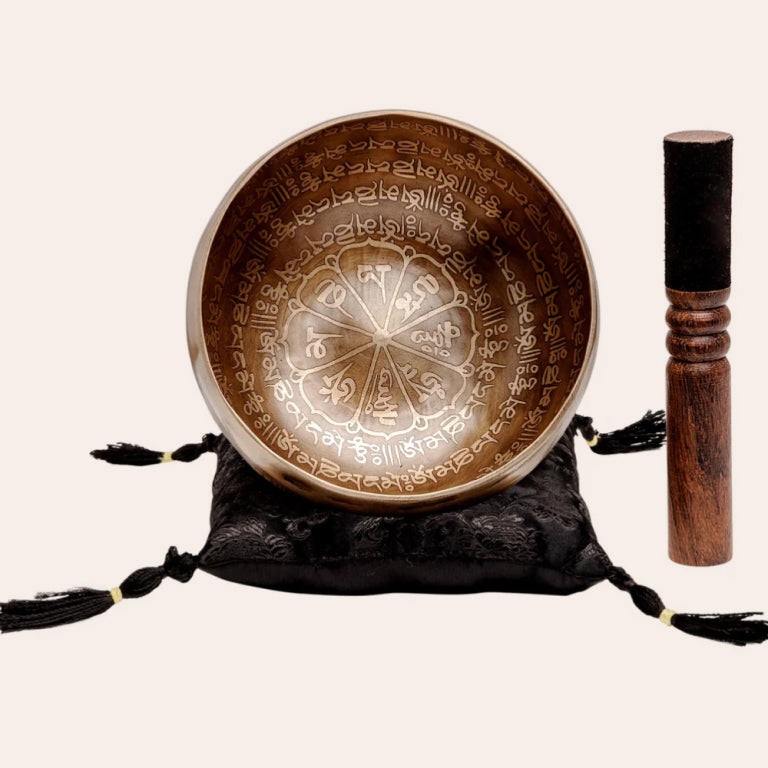
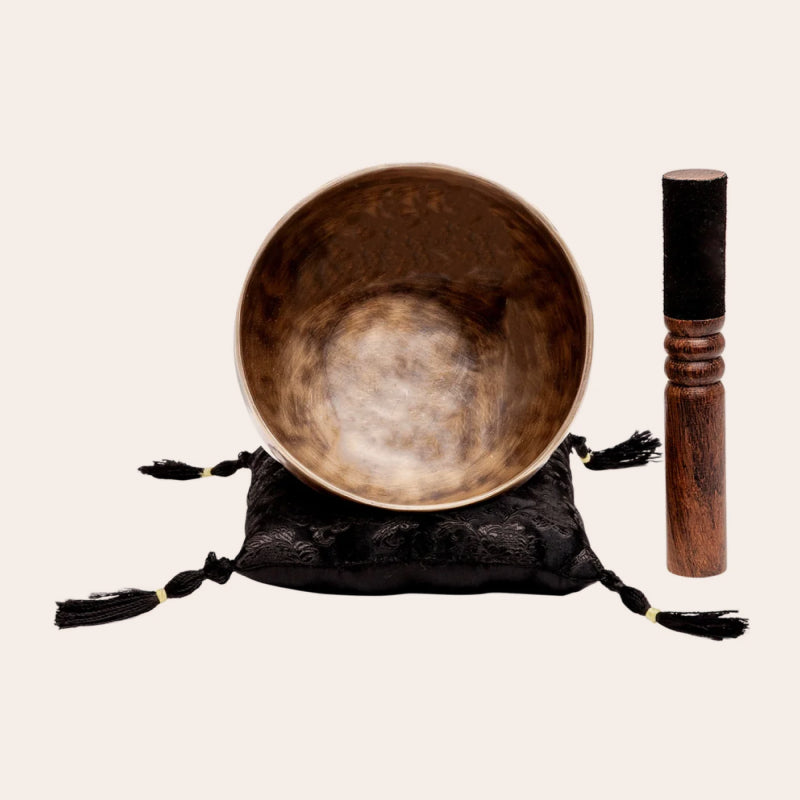
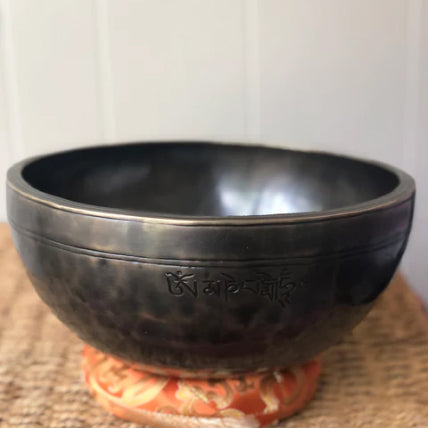
A hand-hammered bronze singing bowl is made from a copper-tin alloy shaped by repeated hammer strikes. The hammering introduces asymmetries into the bowl wall: slight thickness variations, subtle deviations from perfect roundness. These are not defects. They are the entire mechanism of action.
In a perfectly circular ring, each vibrational mode would be "degenerate," meaning two orthogonal vibration patterns would ring at exactly the same frequency. When you break the symmetry through hammering, those pairs split into two slightly different frequencies. Physicists call this mode splitting, and it shows up in the research literature on bell acoustics going back decades.
What this means in practice: a single bronze singing bowl, struck once, generates its own beat frequencies internally. The pulsation you hear, the wah-wah-wah, is not something someone designed into the bowl. It is an inevitable consequence of the physics. No second bowl is needed. No headphones. No stereo separation. The beats are monaural (they exist in the air as physical amplitude modulations) and they come from the shape of the bowl itself.
Across our five bronze bowls, we measured anywhere from 4 to 31 distinct frequency partials per bowl, with modulation depths (how strongly the sound pulsates) of 91-183%.
Frosted Crystal Singing Bowls
Frosted crystal singing bowls are made from high-purity quartz sand, heated until it fuses into an amorphous silica structure and formed into a bowl shape. The exterior is sandblasted to create the frosted texture.
The material is homogeneous and isotropic, which means its mechanical properties are essentially identical in every direction. Because the material is so uniform, there is almost no mode splitting. Each vibrational mode produces one frequency, not a pair. The result: frosted crystal bowls produce 2-3 significant frequency partials. That is not a limitation. It is the defining characteristic. These bowls are some of the purest tone generators you can find outside of a laboratory.
Across our three frosted crystal bowls, not a single one produced detectable internal beat frequencies. Zero. The sound is a stable, unwavering tone.
Clear Crystal Singing Bowls
Clear crystal bowls are made from the same quartz as frosted bowls. The difference is surface treatment. No sandblasting. The smooth, glassy surface couples differently with the mallet and with air, which allows more efficient energy transfer to higher-order vibrational modes. You get more overtone content than frosted bowls: our three clear crystal bowls showed 3-8 partials, compared to 2-3 for frosted.
Clear bowls also showed modest internal beat activity in some specimens. Our C4 clear bowl produced a 1.8 Hz beat (in the delta brainwave range). The other two showed no detectable beats. Clear crystal sits between frosted and alchemy in spectral complexity.
Alchemy Crystal Singing Bowls
Alchemy bowls are a category of crystal singing bowl marketed with various precious metals, gemstones, and minerals. We have no opinion on the manufacturing claims. What we can do is record the sound and look at what comes out.
What the analysis shows is that alchemy bowls behave differently from pure quartz bowls in consistent, measurable ways. Their spectra show more partials, broader energy spread around each peak, and amplitude modulation patterns that pure crystal bowls do not produce. We see partial mode splitting. Not the dramatic 4-12 Hz splits of a hand-hammered bronze bowl, but gentle 0.5-3 Hz separations that produce slow, clean beating patterns.
Our three alchemy bowls showed 10-12 partials each, with modulation depths ranging from 44% to 106%. Two of the three produced detectable delta-range beats.
Part II: The Data
For each recording, we identified the optimal steady-state window (after the initial attack, before significant decay) and ran identical analysis on all 14 bowls.
Here is a quick explanation of the three analysis tools we used:
Fast Fourier Transform (FFT) takes a recording and breaks it down into every individual frequency present in the sound, and how loud each one is. Think of it as an X-ray of the sound. The charts below with spikes at different frequencies are FFT spectra.
Hilbert envelope extraction traces the outer shape of the waveform over time. If a sound gets louder and quieter in a pulsing pattern, the Hilbert envelope shows that pulse. The red curves on the waveform charts are Hilbert envelopes.
Beat frequency decomposition takes that pulsing pattern and runs another FFT on it to figure out exactly how fast the sound is pulsing. If a bowl's volume rises and falls 2 times per second, the beat frequency is 2 Hz. This is how we measure whether a bowl produces beats in the delta, theta, or alpha brainwave ranges.
Frequency Spectra: All 14 Bowls

The visual difference is immediate. The bronze spectra are dense walls of frequency content, especially below 1000 Hz. Every one of those peaks is a vibrational mode of the bowl, and many come in closely-spaced pairs (the split modes that generate beats). The frosted crystal spectra are the polar opposite: one or two needle-thin spikes and silence everywhere else. Acoustically closer to a tuning fork than to the bronze bowl above it.
The clear crystal bowls add shimmer with additional partials, particularly strong 2nd harmonics. And the alchemy bowls show the characteristic crystal spike pattern but with more peaks and broader pedestals around each one.
Waveform and Beat Spectrum: How Each Bowl Pulses

Look at the contrast. The bronze bowl envelopes are tight, fast, and complex. Dozens of mode pairs interfering simultaneously, creating multi-layered pulsation. The frosted crystal envelopes are flat. No pulsation visible. And the alchemy bowls show something different from either: slow, symmetrical swelling and receding. The sound breathes.
The right column tells you exactly how fast each bowl is pulsing, and maps that to brainwave frequency bands. The colored bands behind each chart correspond to delta (0.5-4 Hz, deep sleep and restorative states), theta (4-8 Hz, deep meditation), alpha (8-13 Hz, relaxed alertness), and beta (13+ Hz, active thinking). Where a bowl has a peak in one of those bands, it means the bowl is producing amplitude modulation at that rate.
The 14-Bowl Data Summary

| Bowl | Type | Fundamental | Partials | Mod Depth | Dominant Beat |
|---|---|---|---|---|---|
| Jupiter | Bronze | 102 Hz | 31 | 120% | 2.2 Hz (delta) |
| BigF | Bronze | 261 Hz | 4 | 91% | 1.2 Hz (delta) |
| Purity | Bronze | 220 Hz | 15 | 122% | 8.2 Hz (alpha) |
| Tiger | Bronze | 1505 Hz | 26 | 183% | 0.8 Hz (delta) |
| Aether | Bronze | 532 Hz | 9 | 114% | 1.0 Hz (delta) |
| 272 Hz | Frosted | 274 Hz | 3 | 84% | None |
| E4 | Frosted | 323 Hz | 2 | 97% | None |
| G4 | Frosted | 385 Hz | 2 | 88% | None |
| C4 Clear | Clear | 262 Hz | 8 | 88% | 1.8 Hz (delta) |
| B3 Smoke | Clear | 246 Hz | 3 | 50% | None |
| D3 Glacier | Clear | 156 Hz | 7 | 89% | None |
| Alchemy 1 | Alchemy | 86 Hz | 12 | 44% | 2.5 Hz (delta) |
| Alchemy 6 | Alchemy | 263 Hz | 10 | 70% | None |
| Alchemy 8 | Alchemy | 193 Hz | 11 | 106% | 0.8 Hz (delta) |
What the Numbers Tell Us
Bronze bowls are in a class by themselves for spectral complexity. Four to thirty-one partials per bowl, averaging 17. Modulation depths from 91% to 183%, averaging 126%. Every single one of our five bronze bowls generated measurable internal beats. Four out of five produced beats in the delta range (0.5-4 Hz). One (Purity) produced beats in the alpha range (8-13 Hz). These are acoustically dense instruments.
Frosted crystal bowls are the acoustic opposite. Two to three partials. No internal beats across all three specimens. The modulation depth numbers (84-97%) look high, but that is driven by the slow natural ring-down of the bowl, not by beating. The actual sound is a steady, unwavering tone.
Clear crystal bowls add complexity but usually not beating. Three to eight partials, a step up from frosted. But only one of three produced detectable beats (the C4 at 1.8 Hz). The additional partials add overtone shimmer but they are typically spaced too far apart in frequency to create audible interference patterns.
Alchemy bowls occupy their own acoustic space. Ten to twelve partials, consistently more than clear crystal, consistently fewer than bronze. Modulation depths of 44-106%. Two of three produced delta-range beats. The sound has the clean pitch of crystal with additional partials that create slow, organic pulsation. Not crystal, not bronze. A distinct category with characteristics of both.
Part III: What This Means for the Person Listening
The acoustic differences are interesting on their own. But the original question was about healing, not acoustics. So what do these spectral differences actually do to the person sitting in front of the bowl?
Brainwave Entrainment: Three Different Delivery Systems
Brainwave entrainment is the tendency of neural oscillations to synchronize with periodic external stimuli. Your brain hears a rhythm and starts to match it. There are different ways to deliver that rhythm, and each bowl type does it differently.
Bronze bowls deliver monaural beats across a wide range. Because dozens of mode pairs split by different amounts, a single bronze bowl can generate simultaneous beats from delta through alpha. The beat frequencies are physically present in the air: they are amplitude modulations that your auditory system processes directly. No setup required. Strike the bowl.
Frosted crystal bowls deliver no beats by themselves. This is not a weakness. A single frosted crystal bowl provides a stable tonal anchor. For brainwave entrainment, you need two frosted bowls tuned to frequencies separated by the desired beat rate. Playing a 256 Hz bowl and a 260 Hz bowl simultaneously creates a 4 Hz theta beat. This gives the practitioner precise control over the beat frequency, but requires multiple instruments and deliberate tuning.
Alchemy bowls deliver slow, clean monaural beats from a single bowl. Their mode splitting creates delta-range beating (0.5-3 Hz in most of our specimens) without the multi-layered complexity of bronze. The sound swells and recedes with a slow rhythm. This combines the tonal clarity of crystal (few partials, identifiable pitch) with gentle pulsation that pure crystal does not produce on its own.
Default Mode Network Disruption
The Default Mode Network (DMN) is your brain's autopilot. It is the neural circuitry that is most active during mind-wandering, self-referential thought, and rumination. When your mind is racing and you can't turn it off, that is your DMN running. Excessive DMN activity correlates with anxiety and depression.
One way sound therapy appears to work is through DMN disruption: giving the auditory cortex something so complex to process that it pulls resources away from the default mode. Your brain gets busy analyzing the sound and has less bandwidth for the anxious narrative.
This is where spectral complexity matters. A frosted crystal bowl, with its 1-3 partials, is easy for the auditory cortex to parse. Single pitch, stable amplitude, done. A bronze bowl with 10-30+ simultaneous, inharmonically-related, continuously-shifting partials is computationally expensive to process. The brain cannot easily categorize it, so it keeps allocating attention. This may be part of why people in singing bowl sessions consistently report that their mind quiets down: the analytical mind is busy processing the sound instead of generating its usual chatter.
Alchemy bowls fall between: more complex than crystal, less than bronze. A gentler version of the same disruption, which may be better for people who find the intensity of bronze overwhelming.
Vibrotactile Transmission: The Body Channel
Bronze singing bowls placed directly on the body transmit vibration through physical contact. This is not acoustic. It is mechanical. The vibrations activate mechanoreceptors in skin, fascia, and bone at frequencies below the conscious hearing threshold. You feel it before you hear it.
Crystal bowls (all types) are acoustic-only instruments. They are not placed on the body. The pathway is purely through air-conducted sound to the auditory system. This is not better or worse, it is a different mechanism entirely. A bronze bowl on the sternum creates a dual-channel experience: acoustic input to the ears plus vibrotactile input through the body. A crystal bowl creates a single-channel acoustic experience. This means body-contact work is fundamentally a bronze-bowl modality.
The Temporal Arc
Bronze bowls have a built-in progression from complexity to simplicity. Immediately after a strike, all vibrational modes are active: maximum spectral density, maximum beating, maximum auditory complexity. Higher modes decay faster than lower modes. Over 10-30 seconds, the spectrum simplifies naturally. The brain rides this arc from disorientation (many simultaneous frequencies) toward resolution (a few lingering tones). Each strike creates a micro-journey from complexity to calm.
Crystal bowls (especially clear and alchemy) have long sustain: 60-180+ seconds of stable tone from a single strike. They do not simplify over time the way bronze does. The experience is steady-state rather than arc-shaped. This makes them better suited for sustained tonal environments, while bronze excels at rhythmic, evolving soundscapes.
Part IV: Answering the Original Questions
"If healing depends on beats from mode splitting, what is the therapeutic value of crystal bowls?"
Crystal bowls do not depend on mode splitting for their therapeutic effect. They work through different mechanisms: stable tonal anchoring, sustained acoustic environments for extended focus and meditation, and (when used in pairs) precisely controllable beat generation. Their value is not diminished by the absence of internal beats. It is different from the value of bronze.
The frosted crystal bowls in our study produced the purest tones we measured: 1-3 partials, no internal beats, no amplitude modulation. That acoustic purity is itself a therapeutic mechanism. It gives the nervous system a single, unwavering reference point. For people in states of sensory overload, anxiety, or hyperarousal, this simplicity may be exactly what is needed.
"Is there something unique about what metal bowls do that you can't get from other instruments?"
Yes. The specific combination of: (1) self-generated monaural beats from mode splitting, (2) inharmonic overtone complexity for DMN disruption, (3) direct vibrotactile transmission when placed on the body, and (4) a built-in temporal arc from spectral complexity to simplicity in every single strike. This combination is unique to handmade bell-metal bronze singing bowls.
Individual elements exist elsewhere. A harp produces overtones. A tuning fork transmits vibration. A drum produces rhythmic entrainment. But no other single instrument combines all four in one self-contained action.
"Do crystal bowls heal differently, or use a different mode to heal?"
Yes. Metal bowls are disruptors: they overwhelm the analytical mind, activate the body through vibration, and create entrainment through physically-generated beats. Crystal bowls are stabilizers: they anchor attention, create spatial acoustic environments, and deliver entrainment when properly configured in pairs.
Alchemy bowls sit between the two: crystal instruments that borrow some behavior from bronze. They breathe because their spectra contain just enough mode splitting to create interference patterns that neither pure crystal nor dense bronze produces. The question is never "which is better?" but "which mechanism does this person need right now?"
Part V: The Continuum
What this analysis shows is not a hierarchy of better and worse. It is a continuum of acoustic behavior determined by one underlying variable: the degree of structural asymmetry in the bowl wall.
At one extreme: Frosted Crystal
Maximum symmetry. Minimum mode splitting. Near-sine-wave output. The bowl is an anchor. It gives the nervous system a fixed tonal reference point. Pure, stable, unwavering.
Moving inward: Clear Crystal
Same symmetry, but the smooth surface sustains more overtones. Gentle shimmer emerges. Slightly more complexity. Still fundamentally a crystal instrument: stable pitch, clean spectrum.
The bridge: Alchemy Crystal
Mode splitting that pure crystal does not produce. The sound breathes. Slow, clean delta-range beating in most bowls. Crystal tonal clarity combined with bronze-like pulsation. A distinct acoustic category.
At the other extreme: Hand-Hammered Bronze
Maximum asymmetry. Every mode splits. Dozens of partials fill the spectrum. Dense, layered, continuously shifting pulsation. The bowl is a disruptor. It overwhelms analytical processing with more simultaneous information than the auditory cortex can parse.
The most skilled practitioners move clients along this continuum within a single session. Crystal to settle. Bronze to disrupt. Alchemy to integrate. Crystal to return. Not because tradition says so, because the physics supports every transition.
Part VI: How to Use This Information
The data suggests specific, practical applications for each bowl type.
When someone is anxious, overstimulated, or in sensory overload: Start with frosted crystal. The single-frequency anchor gives the nervous system one thing to hold onto. No complexity, no beating, no challenge. Stability.
When someone is stuck in ruminative loops, overthinking, can't quiet the mind: Bronze. The spectral complexity forces the auditory cortex to reallocate processing resources. The DMN gets less bandwidth. The internal monologue quiets because the brain is busy elsewhere. Place the bowl on the body for dual-channel (acoustic + vibrotactile) input.
When someone needs to go deep but gently: Alchemy. The slow delta-range breathing creates entrainment toward deep, restorative states without the sensory intensity of bronze. Good for people who find bronze overwhelming, or for longer sessions where sustained gentle entrainment is the goal.
When building a sustained acoustic environment for group work: Clear crystal. The extended sustain (60-180+ seconds) and moderate overtone content create a shimmering, evolving soundscape without the rhythmic pulsation of bronze. Use multiple bowls tuned to specific intervals for controlled beat generation.
In a session arc: Frosted crystal (settle) → bronze (disrupt) → alchemy (integrate) → frosted crystal (return). This moves the client from stability through productive disruption and back to calm.
Part VII: What We Know, What We Don't, and What Is Marketing
Well-established
The acoustics of metal singing bowls (mode splitting, inharmonic overtone structure, beat frequency generation) are documented in peer-reviewed physics literature. The physiology of mechanoreceptor response to vibration is established textbook neuroscience. Brainwave entrainment via auditory beat stimulation is supported by converging evidence, though methodology is still being standardized. Multiple studies document mood and well-being improvements from singing bowl exposure.
Plausible but not yet proven
DMN disruption specifically from singing bowls has not been directly measured via fMRI during bowl exposure. The therapeutic superiority of monaural beats over binaural beats for any specific outcome hasn't been tested head-to-head. The fascia stimulation hypothesis is mechanistically plausible but lacks controlled trials.
Marketing, not science
The chakra-note association (C = root, D = sacral, etc.) is a modern Western marketing construct with no basis in traditional texts or empirical evidence. Claims that specific minerals produce specific healing effects are unsupported by acoustic or physiological research. The claim that quartz piezoelectricity creates therapeutically relevant electrical fields during normal playing has not been measured at clinically relevant amplitudes. And the claim that any one bowl type is universally superior to another is not supported by evidence: they operate through different mechanisms with different strengths.
We sell both bronze and crystal singing bowls. We have financial incentive to promote both. The analysis in this article was conducted to answer a genuine question, and the data says what it says. Bronze bowls are acoustically more complex. Crystal bowls are acoustically purer. Neither property is inherently "better." The right choice depends on the practitioner's intent, the client's needs, and the specific therapeutic context.
The Bottom Line
Listen with your body, not your tuner. The instrument that makes your shoulders drop and your breathing slow within the first 30 seconds is a therapeutic instrument. The one that makes you think "that's an interesting note" is a musical instrument. They are not the same thing.
Now you know why.


