




The first time you hear a gong being skillfully played, it can be a surprising experience. Most of us have been introduced the gong in the "bang and crash," method. The over-amplified loud attack that's nearly painful to hear. The gong, though, is an incredible tonal generator. One can marvel at the dynamics, the 1,000+ frequency range of tones that create a wall of energy. The handmade nature of them. Their history as one of the oldest style of percussive instruments continually in regular use. They can be played with subtly, nuance and precision such that an experience with one can be transcendent. This guide is about the the major types, of gongs what each is made of, how it is built, and what it actually does when it is played.
These pages are written for people new to the world of gongs. They cover the major types you are likely to encounter, what each is made of, how that metal becomes an instrument, and what you should actually expect to hear when one is played. We begin with the two traditions that you will encounter most often — and that we teach in Gong School — the Chinese bronze lineage and the European silver-nickel lineage, and then cover the other categories you will encounter as your knowledge deepens.
Bronze Gongs from China (The Gongs You've Probably Seen With The "Bullseye)
High-Tin Bronze: The Alloy
Allow me to acknowledge something up front. Regarding certain items or specialty instruments, the designation "Made In China," comes with a stigma of lesser quality.
This is not the case regarding these gongs. China is the birthplace of the bronze gong, and the location of the current living masters of the Chau and Wind Style instruments. "Made in China," is a gold badge in this category.
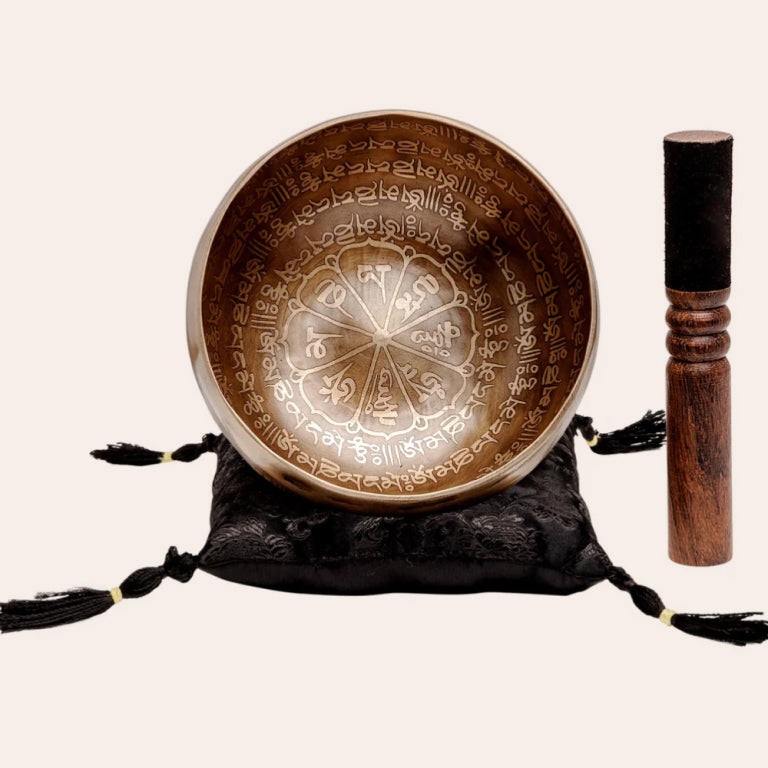
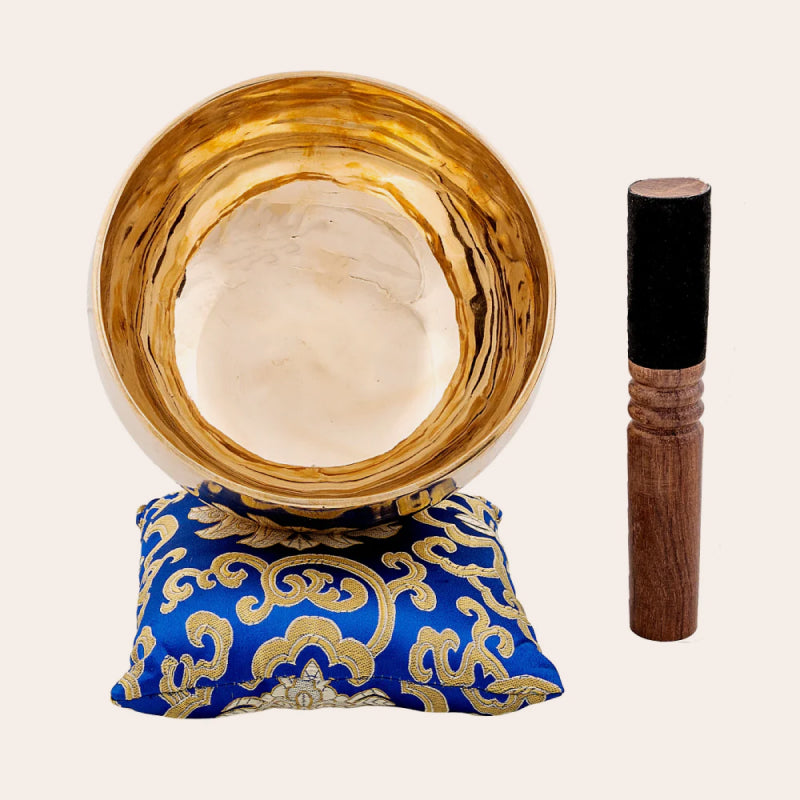
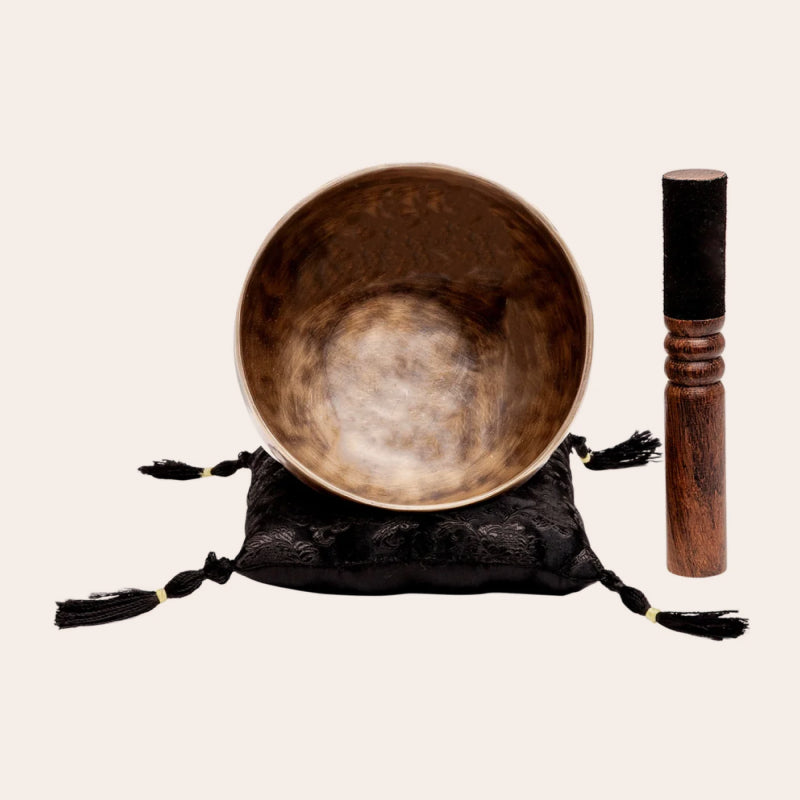
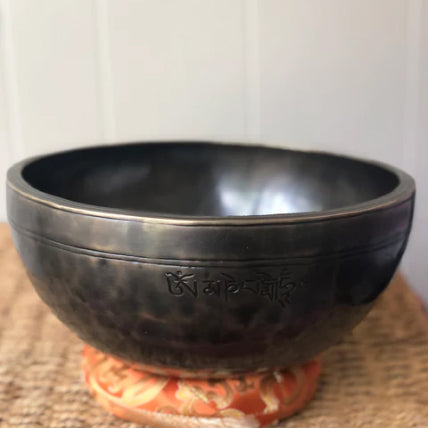
Chinese gongs, like Ohm Store's singing bowls, begins with the alloy: high-tin bronze, running roughly 20 to 23 parts tin combined with 77 to 80 parts copper, with possible trace amounts of other elements depending on the workshop. This alloy is sometimes called bell metal, as it's the same material used in church bells, cast bronze cymbals, and handmade singing bowls. The elevated tin content produces exceptional acoustic behavior: more complex vibration modes, higher internal damping in certain frequency ranges, and a characteristic warmth that copper-zinc alloys simply cannot replicate.
Gongs like this are not cut from a plate, but are work-hardened through multiple rounds of heating, hammering and cooling. The work hardening must be done just so, and the gong-maker (like the eventual skilled player) is having a conversation with the metal as it responds. We are capturing tension, skillfully. The trapped crystalline instability is part of what makes high-tin bronze gongs sound the way they do.
When a finished high-tin bronze gong is struck, the energy propagates through a crystal lattice that is not perfectly at rest, with different micro-zones across the surface vibrating at slightly different frequencies. The result is a wide spectral wash of inter-modulating frequencies that evolve against each other over time, and in a well-made instrument, that complexity is precisely the point. It's a wall of complex sound.
How Chinese Gongs Are Made
Traditional workshops follow a sequence that has not fundamentally changed in centuries, even in facilities that have adopted some mechanized steps.
A casting of the alloy is poured and flattened. Craftsmen hammer the disc to shape the profile: the slight concavity of the playing surface, the turned-up rim on certain types, and critically the thickness gradient from the center outward, which is intentionally uneven. Different areas of the disc receive different numbers of strikes at different angles and forces, and those variations are what create the layered acoustic complexity of a well-made Chinese gong. One master gong maker has described working the rim alone as a three-person operation, one hammering while two hold and slowly rotate the disc, requiring upward of four to five thousand strikes over a full day to produce a single correct arc.
After the shaping, selected areas of the surface are worked on a lathe. The lathing removes the black copper oxide that forms on the metal surface during heating, exposing the raw bronze beneath. On certain gong types, the pattern of lathed and unlathed areas defines where the metal has been further compressed, directly shaping the harmonic structure.
The final stage is tuning, and it is the most demanding. The maker hangs the completed gong, strikes different areas, and listens, making adjustments through additional targeted hammering that compresses or stretches specific zones to shift their vibrational modes. For a large gong, this process can consume an entire day, and the outcome depends entirely on the maker's ear.
The Chau

The Ohm Store 40-inch Chau Gong. High-tin bronze, handmade in China. The dark oxidized center and rim, and the polished lathed band between them, are each acoustically distinct zones, not visual treatments.
The Chau gong is the instrument most people picture when they think of a gong: large, flat, dark in the center, with a polished ring around the middle and a turned-up rim. They range from 7 inches to well over 80 inches in diameter.
The most visible feature of a Chau, the dark oxidized center surrounded by a polished lathed band, is acoustic in origin. The dark center retains the copper oxide from the heating process, meaning it was not lathed and not additionally compressed. The polished ring was lathed, and during that process the metal was further work-hardened. The turned-up rim creates physical tension across the playing surface in the same way a drum head is tensioned by a shell. These three zones, the boss region, the polished field, and the rim, each vibrate with different modal characteristics, and the interaction between them is the source of the Chau's sound complexity.
When you strike a Chau gong in the center (we prefer off center, the exact middle is acoustically dull) with a soft mallet, the sound does not peak immediately but builds over several seconds, with different frequency layers activating in sequence as the vibration propagates outward through the rim. Practitioners call this the bloom, and it is a direct result of the gong's physical structure. The sound then sustains through a long, evolving decay in which the spectral character continues to shift, certain overtones dying faster than others, until a low residual hum remains. A well-made large Chau can sustain audibly for 60 seconds or more.
Spectrally, a Chau gong is a broadband instrument. It produces a dense spread of energy across a wide frequency range, with peaks that are broad and somewhat diffuse rather than sharp and defined, and that broadband wash is exactly what makes large Chau gongs so effective in immersive sound applications, where the sound surrounds rather than leads.
The words that come up repeatedly in describing a well-made Chau are: mysterious, powerful, somber, majestic, and alive. The sound moves and evolves in ways that cannot be entirely predicted from strike to strike, which is a direct consequence of the hand-hammering producing subtle thickness variations across the entire surface. No two Chau gongs are acoustically identical, which is the natural and expected outcome of hand-work in this alloy.
The Wind Gong

A Wind gong (Feng gong). Flat, rimless, and fully lathed on both sides. Same high-tin bronze as the Chau, but structurally its opposite in almost every respect.
The Wind gong, sometimes called a Feng gong or Lion gong, is made from the same high-tin bronze as the Chau, but the construction departs from it in almost every structural respect. Where the Chau has a turned-up rim and differential surface treatment, the Wind gong is essentially flat and rimless, fully lathed on both sides and lighter than a Chau of comparable diameter.
Because there is no rim creating cross-surface tension and the metal is thinner and more uniformly treated, a Wind gong responds to a strike almost instantly, with none of the slow bloom that defines the Chau. When played with a large soft mallet, the sound opens into a shimmering, expansive crash, full and wide in the first second, then sustaining through a long bright decay. The high overtones persist longer on a Wind gong than on a Chau of similar size, and there is less of the dark, mid-heavy character that defines the Chau's evolution over time.
Across traditions, Wind gongs are consistently described as bright, airy, and expansive. Played gently, they can produce a sustained shimmer that is almost orchestral; played forcefully, the full-body crash can fill a large room. Where the Chau withholds and builds, the Wind gong gives you everything at once, then lets it spread and fade. Practitioners across multiple centuries arrived at the name independently; the texture of the overtone structure in a well-made Wind gong really does evoke air moving through a large space.
A Note on Other Chinese Gong Types
The Chinese tradition produced many other gong forms worth knowing. The Bao gong, or Nipple gong, features a raised central dome that focuses the vibration into a much more defined pitch than either the Chau or Wind gong can produce, and these instruments have historically been used in temple contexts precisely because of that tonal focus. Opera gongs are small, high-pitched instruments engineered to produce a pitch bend after being struck, either rising or descending in pitch, and they are designed for rhythmic punctuation and dramatic signaling rather than sustained resonance.
Silver-Nickel Gongs — The European Tradition

The Spirit Gong, silver-nickel alloy, handcrafted by master gong-smith José Antonio Álvarez in an exclusive collaboration with The Ohm Store. The hammered surface, burned edge, and geometric center are each integral to the instrument's acoustic character.
The European gong tradition grew from a different metallurgical starting point. The primary alloy is what the industry calls nickel silver or German silver, a copper-nickel alloy containing no actual silver whatsoever; the name comes from its color. Our silver-nickel gongs (currently sold out) are made from a high-purity formulation of approximately 88% copper and 12% nickel, a simpler and cleaner composition that produces a distinct acoustic character.
Understanding why this alloy sounds different from high-tin bronze comes down to one physical fact: copper and nickel are fully miscible (capable of being mixed together without separating) metals. They dissolve into each other at the atomic level and form a completely homogeneous crystalline structure, with no phase boundaries, no trapped instability, and no competing crystalline zones. The material is uniform from one edge to the other. When this alloy is struck, the vibration propagates through a consistent medium, producing fewer and cleaner vibrational modes, with more energy concentrated in distinct and stable partials rather than distributed across a broad spectral wash.
High-tin bronze produces complexity through internal heterogeneity; nickel silver produces clarity through internal uniformity.
How Silver-Nickel Gongs Are Made
The European tradition, centered historically in Switzerland and Germany (but ours are made by a boutique specialist in Spain) with names like Paiste defining the category for decades, approaches gong making with different goals than the Chinese tradition. Wuhan craftsmen embrace controlled inconsistency to produce complex, evolving sound; European makers work toward predictable, controlled, musically legible overtone structures.
Silver-nickel gongs are worked from sheet stock rather than cast, hammered and shaped, then scraped and treated to refine the surface and tune the vibrational modes. Because nickel silver does not require the quench cycle that high-tin bronze demands, the working process is more straightforwardly mechanical, though no less demanding in skill. The surface treatments on these gongs, the hammered textures, the burned edges, the precisely placed geometric patterns, are each acoustic decisions: scraping work-hardens the surface and introduces slight directional stiffness that shifts the vibrational modes in targeted ways, and every mark on the instrument reflects an intentional choice about sound.
The Sound of Silver-Nickel Gongs
When you hear a silver-nickel gong for the first time after spending time with Chinese bronze gongs, the most immediate thing you notice is the some more immediate brightness. The sound is long, spreading, and full, with a defined tonal quality that a broadband bronze crash does not offer.
The sustain on a quality silver-nickel gong is exceptional, over 40 seconds from a single strike in the instruments we have analyzed. Crucially, the character of that sustain is more uniform than a Chau gong's decay. A Chau evolves dramatically as different frequency layers die at different rates, while a silver-nickel gong sustains more evenly because fewer intermodulating overtones are interfering with and damping each other.
The sound is consistently described as luminous, spherical, long, and singing. The European tradition also tends to assign musical pitches to these gongs: Paiste's Planet Gong series maps specific instruments to frequencies derived from planetary orbital calculations, a practice with legitimate acoustic rationale, since a gong with a clear enough fundamental can be meaningfully related to a musical reference pitch. Silver-nickel construction makes this possible in a way that the broader spectral wash of traditional Chinese bronze does not consistently allow.
Other Gong Families
Stainless Steel Gongs

A 36-inch stainless steel alloy gong. The mirror-polished center and hand-hammered dimple field are characteristic of this category, as is the chrome-bright finish that reads immediately as something different from bronze. Still in active development as an instrument category.
A newer and still-developing category is gongs made from steel alloys, primarily 304 stainless steel, an alloy of iron with approximately 18% chromium and 8% nickel. The chrome-bright mirror finish reads immediately as something categorically different from bronze, and the acoustic behavior follows from that material difference.
Stainless steel gongs have a lower fundamental frequency relative to their size than bronze gongs of similar diameter, driven by steel's higher density. A 36-inch stainless gong we analyzed shows a sub-bass fundamental around 57 Hz, with a low-register cluster of partials from 68 Hz to 106 Hz and a spread of mid-register partials through the 300 to 500 Hz range. The 57 Hz body registers in the chest before the ear fully processes it, a physical sensation distinct from anything even a large bronze gong produces.
When played with a friction mallet, stainless gongs reveal a second character entirely: a singing, sustained tone in the 300 to 415 Hz range that behaves more like a large singing bowl being bowed than a gong being struck. That duality makes stainless gongs genuinely interesting instruments, though the category is still in active development and craftsperson quality varies widely.
Gamelan and Boss Gongs

A boss gong. The raised central dome focuses vibrational energy into localized modes, producing a much more defined pitch than any flat-disc gong achieves.
The Gamelan orchestras of Java and Bali use gongs that are fundamentally different in design from Chinese flat-disc gongs. Gamelan gongs are made from bronze, but they feature a prominent raised central boss, a dome sometimes several inches tall, that serves as both the primary strike point and the primary vibrating node. The boss constrains and focuses the vibration in ways a flat disc cannot, producing a much more defined and stable fundamental pitch that allows Gamelan gongs to function as melodic instruments within a precisely tuned ensemble.
The boss is an acoustic focusing device built into the instrument's geometry, and the same principle operates in the Chinese Bao gong and in more experimental modern designs that use multiple raised zones to create several distinct tonal regions within a single instrument. Thicker metal in the center concentrates vibrational energy into localized modes, producing something closer to a pitched bell-tone than to a broadband crash.
Gamelan gongs, particularly the large Gong Ageng that anchors the ensemble, have their own deep acoustic beauty, though they are purpose-built instruments within a specific musical system, and their sustained, pitched tones serve a structural role within Gamelan music that differs entirely from how Chau or silver-nickel gongs are used in contemporary sound practice.
Listening for the Differences
The most useful thing a new gong practitioner or enthusiast can do is build a vocabulary for what they are actually hearing. How quickly does the sound open? How long does it sustain? How much does the character shift during the decay? Is there a tonal center or a wash? How does it fill the room?
When you hear a bronze Chau, track the attack-to-peak time; a well-made Chau takes time to fully open, and listening for that bloom is the entry point. When you hear a Wind gong, notice how instantly it gives you everything it has. When you hear a silver-nickel gong, listen for the tonal center within the wash, the discernible pitch reference that persists even as the overtones spread outward around it.
Those questions will teach you more about gong types than any description can.
This article is part of The Ohm Store's ongoing Sound Education series. Gong School, our 7-week virtual mentorship program led by master percussionist Ben Irons, explores these instruments in depth, their acoustic properties, playing technique, and application in therapeutic and ceremonial contexts.


