




The Harmonic Architecture
of a Gong
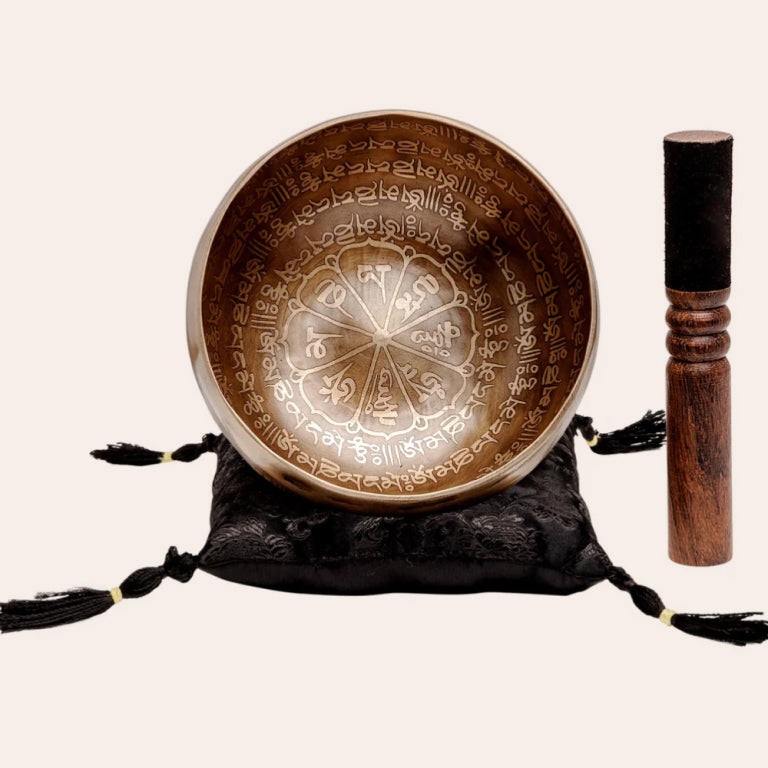
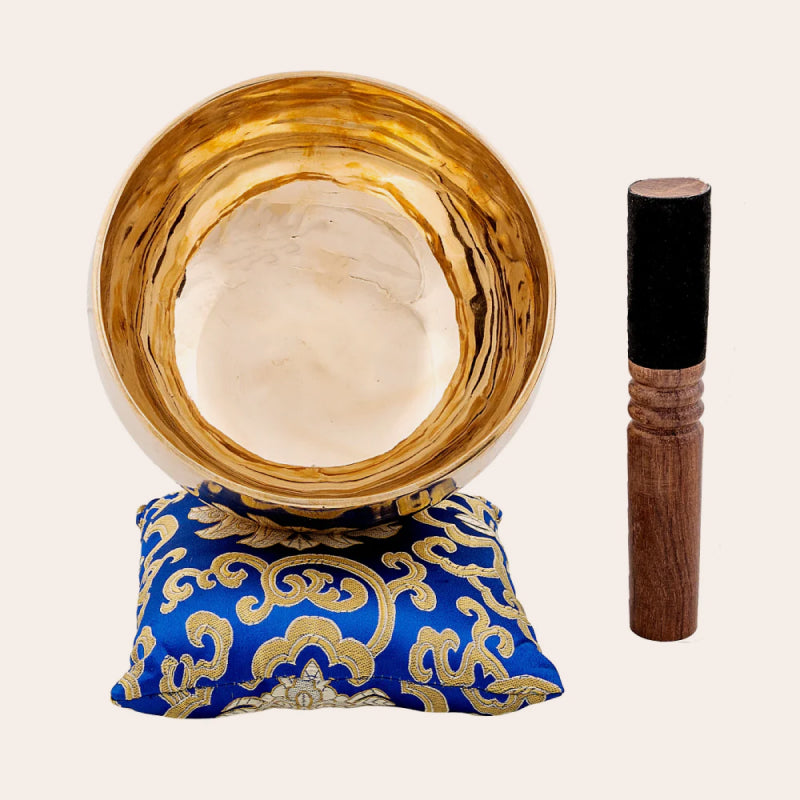
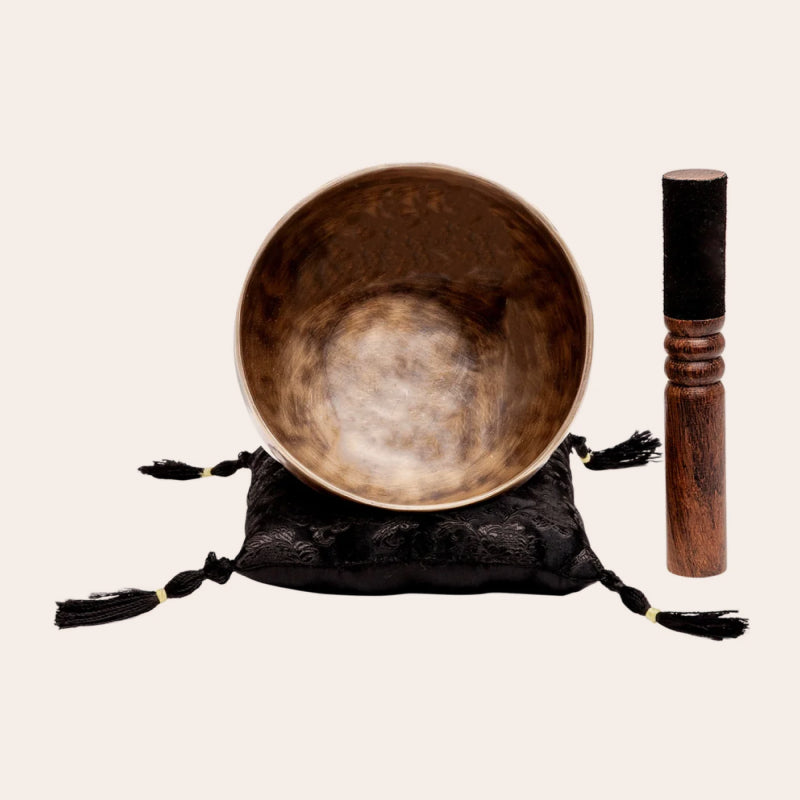
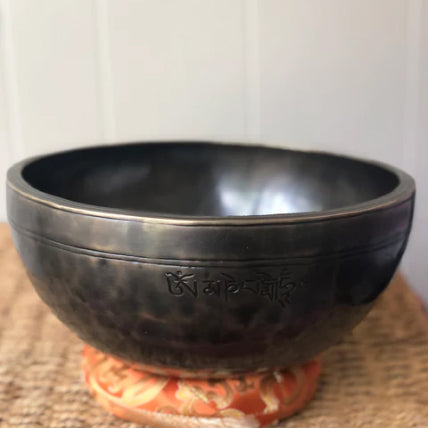
A quality Himalayan singing bowl is already an acoustically complex object. Strike the rim of a well-made bell bronze bowl and you are not hearing a single frequency, but several inharmonic tones generate by the flexural vibration of the curved bronze walls. What a gong maker does is take that same principle and solve it at a scale, and with an internal coherence, that redefines what a single instrument can contain.
Part OneWhat a Singing Bowl Actually Produces
The vibration modes of a struck singing bowl are split, as the walls of the singing bowl flex in and out to create vibration (heard as sound). Each mode radiates at its own frequency, its own amplitude, and its own decay rate. A spectral analysis of a singing bowl reveals these as discrete peaks rising above the noise floor: the fundamental seated at the base, and above it, a column of overtones that are characteristically inharmonic, meaning their frequency ratios do not follow the neat integer multiples of a vibrating string.
They are something more complex, more organic, and more alive than that. The partials of a bronze bowl bend away from simple mathematical relationships in ways that are determined by the bowl's geometry, its wall thickness distribution, the specific alloy composition, and the work-hardening state of the metal at every point along the surface. No two hand-hammered bowls are alike in this regard. The fundamental is only one tiny data point, amongst a sea of over data points that are "vibrations and sound."
This is why two singing bowls sharing the same fundamental note can sound completely different. Their fundamental note is one one of several audio tones generated when the bowl is invited to sing.
Anyone who has spent serious time curating a collection of Himalayan singing bowls understands this aspect of bowl collections well. Finding two bowls whose partials genuinely cohere is not simply a matter of choosing bowls according to their chakra notes. Add a third bowl, a fourth, a fifth, and the combinatorial complexity of achieving pitch coherence across all those independent overtone series grows faster than most practitioners expect. The bowls may share a key. They do not automatically share a voice. (and this is not to worry you in any way, as the therapeutic nature of singing bowls and gongs transcends specific musical harmony)
The Alloy as Acoustic Foundation
Consider now what a gong maker does over the course of producing a 40-inch high-tin bronze Chau Tam Tam, and why the process begins not with the hammer but with the metal itself.
Bell Bronze bronze, at roughly 80% copper and 20% tin (close to this variant for gongs), is one of the most acoustically distinguished alloys in the history of instrument making. The elevated tin content raises the hardness of the material while simultaneously producing a crystalline microstructure that manages internal damping with unusual precision. The result is a metal that rings with exceptional sustain, carrying its decay across many seconds without collapsing into noise, while the damping coefficient remains high enough to prevent the ringing from becoming indefinite or indistinct. The metal wants to resonate. The maker's entire task is to decide exactly how.
Composition: Approximately 80% copper, 20% tin, trace elements variable by foundry and tradition.
Acoustic relevance: High tin content increases elastic modulus and produces a finer grain structure than lower-tin bronzes, extending sustain and refining partial definition. The same alloy is used in the finest concert cymbals and bell bronzes across multiple centuries of instrument-making tradition.
Damping behavior: Internal damping in B20 sits at a value that balances sustain against clarity. Low enough to allow the long decay characteristic of masterwork gongs. High enough to prevent partials from blurring into one another during the bloom.
The Hammer as Acoustic Instrument
Every hammer strike during the shaping of a gong is a "mechanical intervention" in the modal geometry of the plate. The curvature of the surface, the distribution of thickness across the face, the tension state of the metal at every point. These hammer strikes have significant acoustic impact.
The maker is subtly relocating mass and tension in a way that shifts the natural frequencies of the low-order vibrational modes, pulling the dominant partials of the instrument into the relationships the maker intends. When they planish the rim, working it to a specific thickness and curvature, they are tuning the higher-order modes that will produce the instrument's shimmer and upper harmonic content.
The entire surface is a system that works together.
This is the work that cannot be fully specified in advance, which is why the traditional method requires years of apprenticeship and thousands of hours of practice. A maker who has internalized the acoustic behavior of the bronze realizes what the instrument is becoming as it forms, and drive it toward internal coherence through the same iterative, responsive process that a musician uses when improvising: listening, responding, adjusting.
By the time the instrument is finished, what sounds like one voice is actually twenty to fifty distinct pitch layers that were made to cohere from the beginning, on a single surface, by a single set of hands.
Reading the Bloom: What Spectral Analysis Reveals
A spectral analysis of a quality Chau gong, taken at four distinct moments after the strike, produces four meaningfully different pictures of the same instrument. The early transient, the one-second mark, the five-second mark, and the fifteen-second mark each reveal a different aspect of the gong's harmonic architecture, because the modes of the instrument decay at different rates and the energy balance between them shifts continuously across the sustain.
| Time Point | Spectral Character | What You Are Hearing |
|---|---|---|
| Strike transient (0–200ms) |
Broadband energy spike, high-frequency dominant | The impact excitation distributing energy across dozens of modes simultaneously. The initial brightness, the crack or wash of the attack. |
| Early sustain (1 second) |
Dense harmonic content, full spectrum populated | The bloom. All major modes present simultaneously. This is the moment of maximum harmonic complexity, where the full architecture of the instrument is audible at once. |
| Mid sustain (5 seconds) |
Upper partials receding, low-order modes dominant | The shimmer fading as high-frequency modes exhaust their energy faster than low-frequency ones. The sound deepens and narrows. |
| Late sustain (15+ seconds) |
Fundamental and nearest partials only | The long tail. The deepest, slowest modes still radiating long after the upper content has dissolved. The sound you feel more than you hear. |
In that bloom, at the one-second mark, spectral analysis of masterwork Chau gongs consistently reveals anywhere from 20 to more than 50 distinct audible overtones, depending on the instrument, the strike, and the depth of the maker's work. Each one is a distinct pitch, a distinct character, a distinct point of harmonic content radiating outward from the same struck surface. This is what the instrument is. Not a note. A chord that evolves.
One Voice That Was Always Many Things at Once
This is not a statement about which instrument is greater (gongs and singing bowls are incredible and we make both!)
A curated collection of Himalayan singing bowls can produce a soundscape of extraordinary breadth and layered complexity. The bowls speak individually and collectively. They reward the kind of deep listening and careful selection that can take years to develop. They are, each one, a complete acoustic world in themselves.
What the gong offers is different in nature.
The harmonic integration that a practitioner might spend a couple years pursuing across a collection, the alignment of overtone profiles, the coherence of partials, the sense that the instruments are speaking in a single language, a great gong maker solves that problem inside a single object, through weeks of work at the surface of a single plate of bronze. (it's no coincidence that a well made gong will cost the same as full set of singing bowls. They are harmonically producing incredible complexity)
When you strike a gong and the bloom expands outward into the room, you are hearing a wall of sound whose complexity was designed into it from the beginning, whose partials were driven toward coherence by the same hands that shaped the metal, and whose decay carries you from the dense, shimmering upper register all the way down to frequencies you feel in your chest long after the upper harmonics have gone quiet.
It is not the sum of many voices learned to work together. It is a single voice that was always many things at once.
That is what a master-made gong is. That is what it has always been. It's the sibling to the set of singing bowls.
Want to go deeper down this path? Join us in our Ohm Store Gong School.
Explore Ohm Store Chau Tam Tams and Gongs Here.


