




WATCH FIRST
Listen before you read. Headphones recommended.
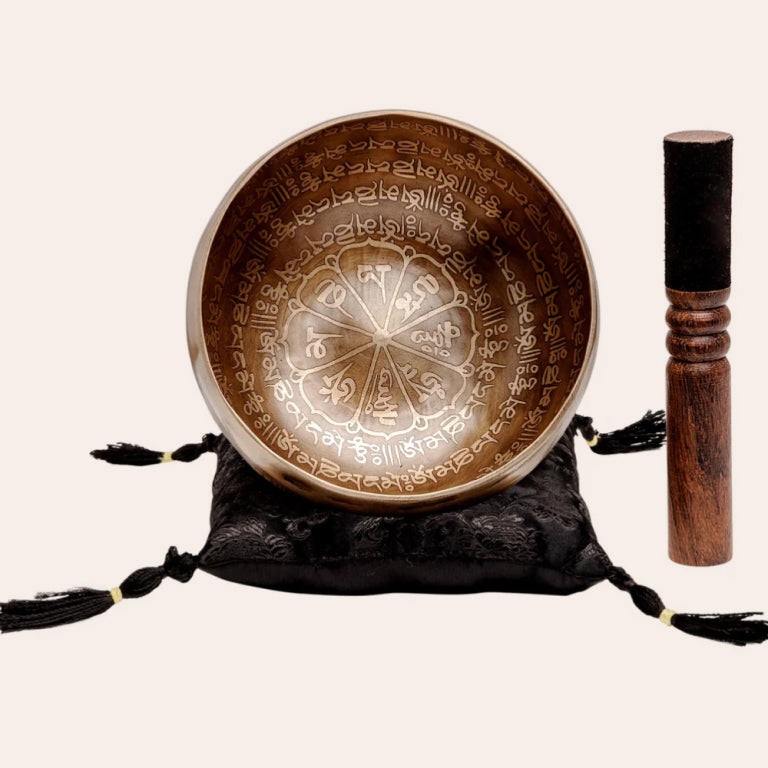
Above, you can see a 40-second video of Tori playing a handmade bronze singing bowl. She strikes the bowl on its side. Then speaks softly some words, and then runs a mallet around the rim. When I received this video, I was struck by the power of 40 seconds of light singing bowl played, paired with some intention words and a calming voice.
This article, is an exploration of why something seemingly so simple, can have such a profound impact. You already know this is a beautifully, sweetly meditative video. Let's explore the details of why that's so.
The bowl has two theta beat frequencies!
A handmade bronze bowl is not perfectly symmetrical. That asymmetry causes each vibrational mode to split, to break into two frequencies that aren't identical.
When two close frequencies sound together, they interfere and produce a rhythmic pulsing called beating, or beat frequencies, as you've heard me refer to them...The rate of that pulsing equals the difference between the two frequencies.
This particular bowl's prominent notes splits at 538.5 Hz and 543.2 Hz, producing a beat of 4.7 Hz.
Its dominant overtone splits at 1,511 Hz and 1,518 Hz, producing a beat of 6.2 Hz. Both land in the theta brainwave band (4–8 Hz), associated with deep meditation and the transition between waking and sleep.
This is a lot of information, but in the video, you're hearing them as the "wah wah wah" oscillations.
Two simultaneous theta beats
4.7 Hz + 6.2 Hz
Multi-channel theta entrainment. Your auditory cortex tracks both beat frequencies at once, across different carrier frequencies.
The upper partials at 2,785 Hz and 4,302 Hz beat faster (16–17 Hz, beta range), contributing the shimmering quality in the upper register without harshness.
| Partial | Mode A | Mode B | Beat | Band |
|---|---|---|---|---|
| 1 (fund.) | 538.5 Hz | 543.2 Hz | 4.7 Hz | Theta |
| 2 (dom.) | 1,511 Hz | 1,518 Hz | 6.2 Hz | Theta |
| 3 | 2,777 Hz | 2,793 Hz | 16.3 Hz | Beta |
| 4 | 4,293 Hz | 4,310 Hz | 17.0 Hz | Beta |
Inharmonic partials: why you keep listening
The harmonic ratios are 1x, 2.8x, 5.15x, 7.95x. These are not perfect.
They are not integer multiples of one another. They aren't "special" Solfeggio frequencies, or related to a particular western chakric note systems.
They are "inharmonic." Or more simply, they don't resolve. They aren't a musical scale. They're just incredible frequencies.
This is why a singing bowl holds your attention without effort. You are never bored by it, but you are also never startled. It sits in a processing sweet spot between predictable and novel.
Tori's voice is warm and even
Tori's spectral flatness measures at essentially zero. That metric runs from 0.0 (pure tone) to 1.0 (white noise). Most conversational speech lands between 0.01 and 0.05 from the turbulent airflow that comes with normal speaking.
Hers is as close to a pure resonant source as a speaking voice gets. No breathiness. No air noise between words. It's just straight, sweet talking with a neutral register.
She speaks in long, stable plateaus, primarily around 302 Hz (D4), and moves between pitches in smooth descending glides that settle at 189 Hz (F#3) at phrase endings.
Rising intonation is sympathetically activating. Falling intonation signals safety. Each descending phrase ending resets the listener's autonomic baseline a little further toward parasympathetic dominance.
It's just a wonderful voice. The singing bowls lower fundamenatls AND Tori's voice are squarely in the range of human hearing, and what our ears are attuned to notice. They pair wonderfully together.
| Pitch | Note | Role |
|---|---|---|
| ~378 Hz | F#4 | High register, emphasis |
| ~302 Hz | D4 | Primary speaking pitch |
| ~253 Hz | C4 | Descriptive content |
| ~216 Hz | A3 | Transitional |
| ~189 Hz | F#3 | Settling, phrase endings |
The playing around the rim with the wooden side of the mallet
First, I should note that "there is no right side" to the mallet, which is a common misconception. The wooden end and suede wrapped end can create difference sound dynamics, and so if you have one of these at home, experiment with both.
The acoustic physics change completely when Tori plays the wooden side, after striking the bowl with the suede wrapped side.
A subharmonic appears: approximately 137 Hz (E3), which is the bowl's fundamental divided by four. It emerges from the nonlinear dynamics of the mallet-rim interaction and was not present during the strike. That frequency sits within 1 Hz of 136.1 Hz. You feel it more than you hear it. Incredible.
During rim play, the perceived pitch also "wobbles" by approximately ±8 Hz in a slow sinusoidal pattern. This is the beat frequency expressing itself as pitch modulation rather than just amplitude pulsing. You are getting theta-rate modulation in two perceptual dimensions simultaneously.
Rim subharmonic
~137 Hz (E3)
Fundamental ÷ 4. Emerges only during rim play. Within 1 Hz of 136.1 Hz.
Why it compounds and works together
None of these elements operate alone, it's a layered and textured experience unfolding in just 40 seconds.
Tori's voice enters first and acclimates your auditory system to tonal, warm, low-centroid sound in a descending parasympathetic contour. Then the bowl takes the foreground with its own warm energy, adding theta-rate beating across multiple frequency channels. The voice settles, and then the bowls frequencies cause you to settle even deeper.
The combined information density is high enough to occupy the auditory cortex's predictive processing resources. You can simply surrender.
The calm you feel is real. Beautiful. And now you can understand more of why.
Explore handmade bronze singing bowls


