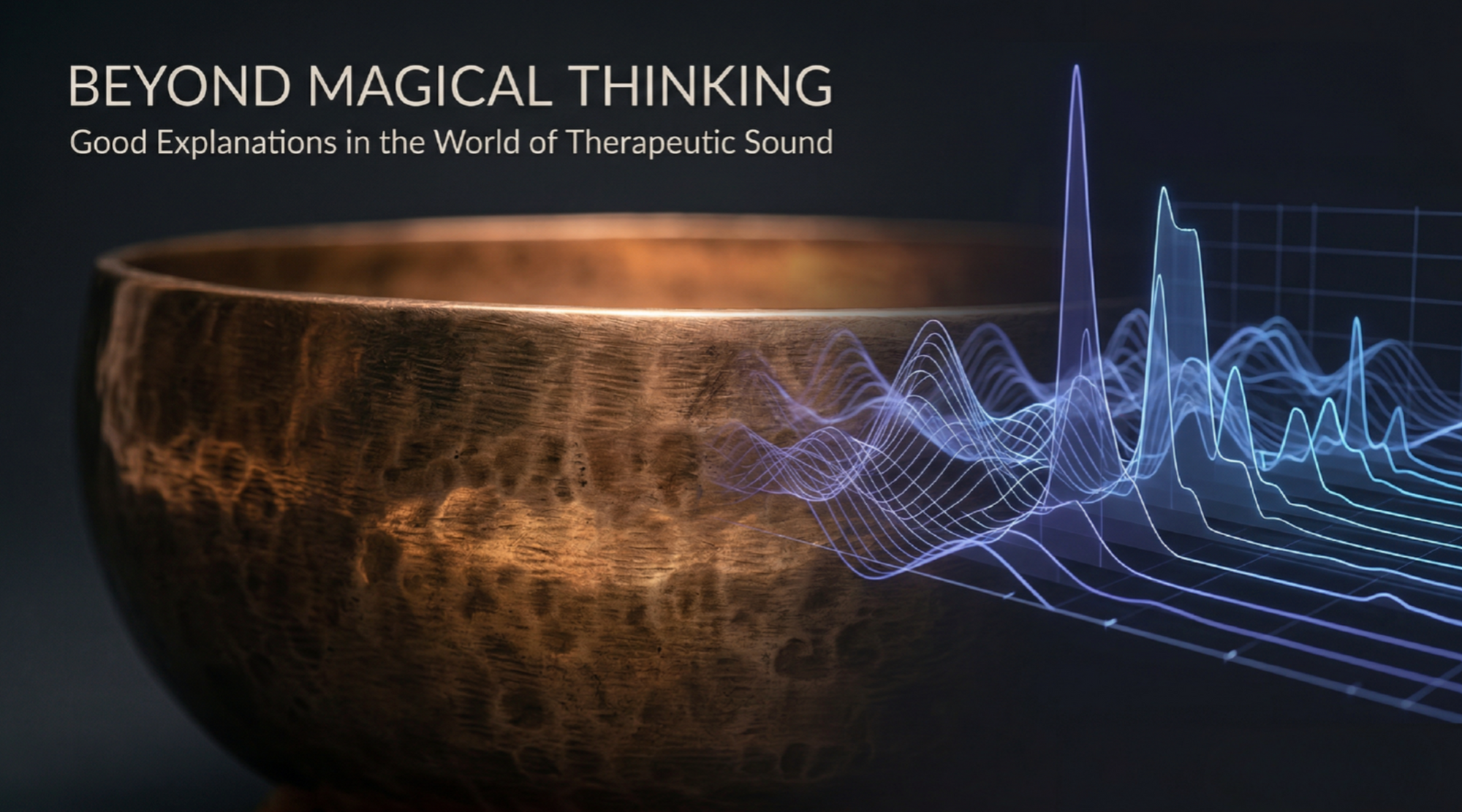
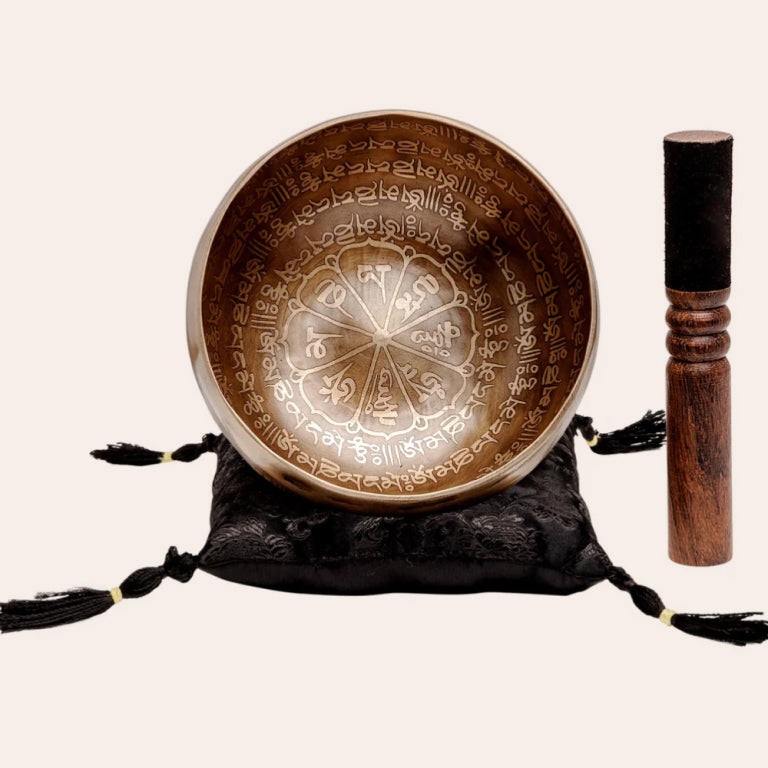
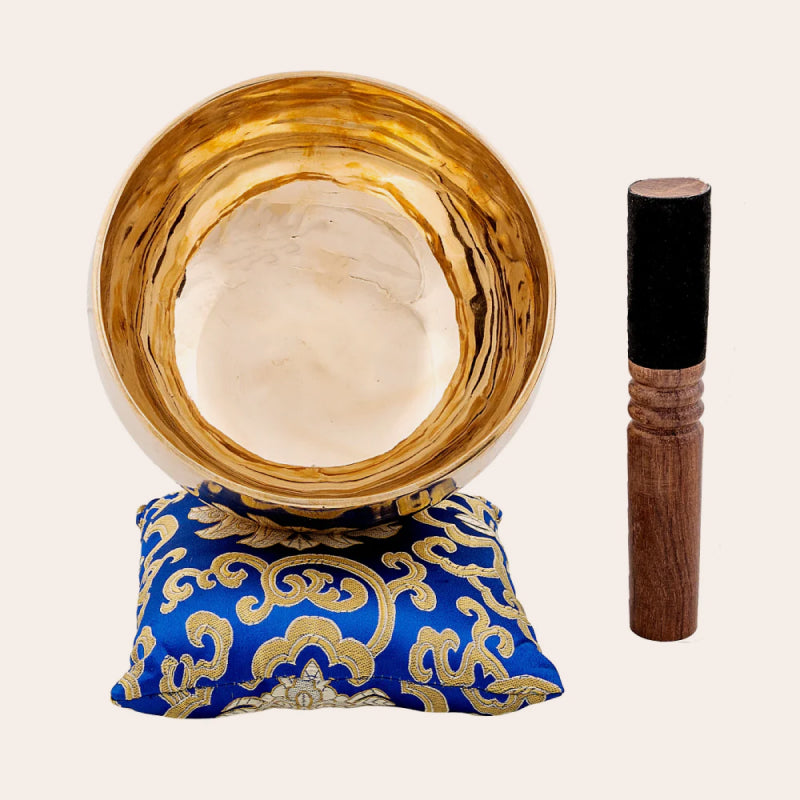
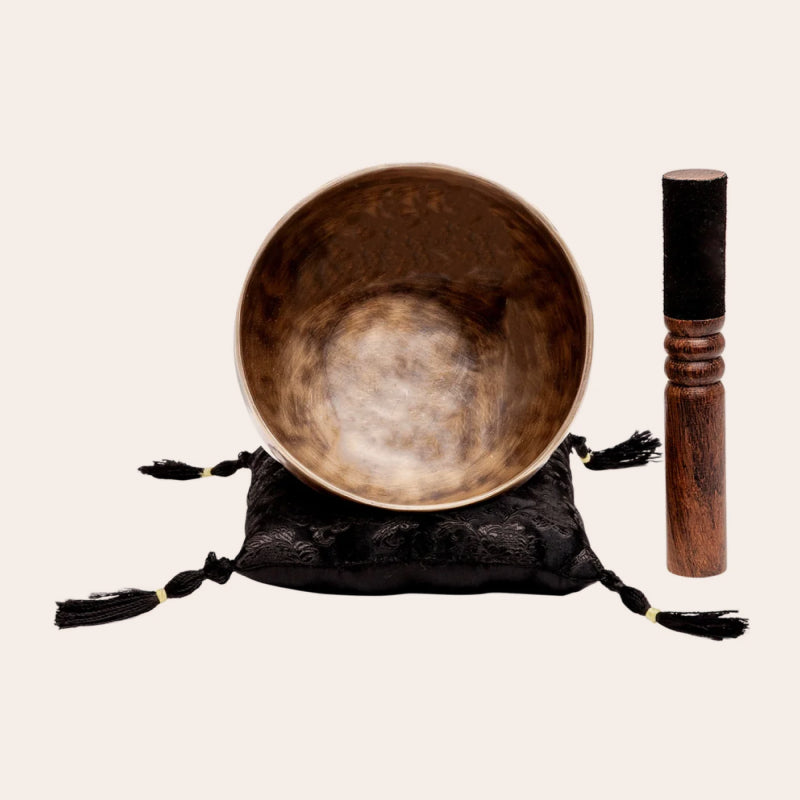
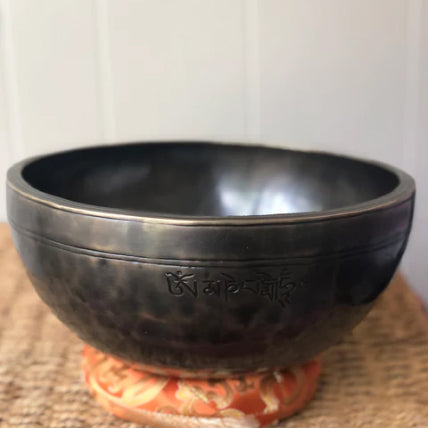




Handmade bronze singing bowls aren't tuned the way you'd expect from a piano, guitar, or even a frosted crystal singing bowl. They're work-hardened through a hand hammering process, starting from a single ingot of specialty bronze alloy, and through that imperfect hammering they develop a unique acoustic character that is therapeutically impactful to the human brain and body in ways that most people — including most practitioners — have never fully understood.
For The Universe Set — the Jupiter (12"), Saturn (9"), and Tiger (6") bowls — these three bowls are not musically selected. Rather, we pair them for their dynamic range and their beat frequencies. I ran full sound spectrum analysis on each recording so I can explain with exactness what is happening inside each bowl, and how it gives a set like this the ability to transform your meditation and listening practice.
Here is all three bowls playing together, I overlaid the sound. Listen to this and get a feel for what we'll be talking about here.
The Jupiter, Saturn & Tiger bowls overlaid — nine beat frequencies across four brainwave states, simultaneously.
Why Singing Bowls Don't Work the Way You Think
Before the data, you need to understand what kind of physical object a singing bowl actually is. It's different and distinct from other instruments...
When you pluck a guitar string, it vibrates in a predictable way. The root note, then exact integer multiples above it. There's a formula. That's why Western music theory works: it was built around string instruments, and the math between notes and overtones is clean.
A bronze singing bowl does not work that way. It's a curved, three-dimensional shell of metal, and when it vibrates, its overtones are not neat multiples of the fundamental. They're determined by the diameter of the bowl, the thickness of the walls, the curvature, the density of the alloy, and every single hammer strike that shaped it. Unpredictable until measured, no matter the skill of the craftsmen making the bowl (a lot of the work of excellence in this field is the curation process).
And because each bowl was hammered by hand, it's not perfectly symmetrical. No hand-hammered bowl is. Wall thickness varies by fractions of a millimeter, or even more. The metal density shifts from one spot to the next. And what that imperfection produces is remarkable.
In a theoretically perfect, symmetrical bowl, each vibrational mode would have two orientations vibrating at the exact same frequency. Because this bowl isn't perfect, those two orientations vibrate at slightly different frequencies simultaneously.
When two frequencies that are nearly identical sound at the same time, they interfere with each other and produce a pulse — a rhythmic beating — at a rate equal to their difference.
That pulse is called a monoaural beat frequency. It's not synthesized. It's not electronic. It's built into the metal by the hammering process itself. You can feel it with your palm flat against the outside of a ringing bowl. It is the primary mechanism through which these instruments interact with your nervous system, and every therapeutic effect I'm going to describe comes from it.
The Jupiter Bowl — 12 Inch (note this is only for this reference bowl, the frequencies of each bowl will vary)
Fundamental frequency: 104.30 Hz
That puts the Jupiter almost exactly at G-sharp in the second octave — deep in the bass register. At 104 Hz, the sound wave is approximately 3.3 meters long. Longer than most rooms are wide. When this bowl rings, the sound wave itself is larger than the space you're sitting in. You're not just hearing it. You're inside it.
The FFT analysis of the Jupiter recording reveals a rich partial structure:
| Frequency | Relative Amplitude | Description |
|---|---|---|
| 104.30 Hz | 1.000 — dominant | Fundamental mode |
| 105.36 Hz | 0.578 | Split mode twin — 1.06 Hz delta beat DELTA |
| 315.77 Hz | 0.924 | 3rd harmonic region |
| 318.81 Hz | 0.122 | 3rd harmonic satellite |
| 620.20 Hz | 0.090 | 6th harmonic region |
| 625.26 Hz | 0.177 | 6th harmonic split — 5.06 Hz theta beat THETA |
| 1001.67 Hz | 0.073 | Upper partial |
| 1449.99 Hz | 0.044 | Highest measured partial |
The critical detail is the 105.36 Hz partial sitting 1.06 Hz above the fundamental — with more than half the amplitude of the fundamental itself. Those two frequencies coexist in the bowl simultaneously. Their difference, 1.06 Hz, is a sustained amplitude modulation that the bowl generates on every single strike.
1.06 Hz is delta range. Delta is 0.5 to 4 Hz — the frequency of dreamless deep sleep, cellular repair, immune function, and the neurological states associated with deep unconscious processing. Most people only access delta when they're asleep. The Jupiter generates a 1.06 Hz pulse every time you play it.
The same splitting happens at the sixth partial: 620 Hz and 625 Hz sit 5.06 Hz apart. That's theta range — 4 to 8 Hz — the brainwave state of deep meditation, REM sleep, and what neuroscientists call emotional integration. One bowl, one strike, delta and theta simultaneously.
The Jupiter sustains for well over 75 seconds on a single strike under proper playing conditions — a sustained acoustic field long enough for genuine neural entrainment to occur.
The Saturn Bowl — 9 Inch
Fundamental frequency: 176.52 Hz
That puts the Saturn close to F in the third octave — the frequency range of the tenor voice, the cello's mid register, and the lower harmonics of the human vowel sound.
What makes the Saturn's spectral profile distinct is how clean its fundamental is. Where the Jupiter shows a strongly split fundamental — two robust frequencies at 104 and 105 Hz — the Saturn's root note stands nearly alone:
| Frequency | Relative Amplitude | Description |
|---|---|---|
| 176.52 Hz | 1.000 — dominant | Fundamental — exceptionally clean |
| 520.09 Hz | 0.341 | 3rd harmonic region |
| 526.00 Hz | 0.080 | 3rd harmonic satellite |
| 1006.42 Hz | 0.217 | 6th partial |
| 1010.66 Hz | 0.103 | 6th partial split — 4.24 Hz theta beat THETA |
| 1602.53 Hz | 0.036 | Upper partial |
The Saturn's beat frequencies appear higher in the partial chain — at the 1006/1010 Hz level, producing a 4.24 Hz theta beat. At the fundamental, the Saturn gives you one stable, unwavering tone. That's not a limitation. It's the defining feature of its role in this set.
176 Hz sits in the gap between the Jupiter's 104 Hz and the Tiger's 289 Hz. It fills the center of the frequency spectrum without competing with either bowl. The Jupiter and Tiger carry the acoustic complexity — the dense partial structures, the multiple beat frequencies. The Saturn holds the room together. It's the anchor, and when all three are ringing simultaneously, it's the frequency center around which everything else organizes.
The Saturn sustains for 60 seconds or more on a properly executed strike.
The Tiger Bowl — 6 Inch
Fundamental frequency: 289.11 Hz
Near D in the fourth octave. And the number alone doesn't tell you much. The partial chain does.
The Tiger doesn't have a simple overtone structure. It has five distinct partial clusters spanning more than three octaves above the fundamental, with mode splitting generating a separate beat frequency at each one:
| Frequency | Relative Amplitude | Beat Generated |
|---|---|---|
| 289.11 Hz | 1.000 — dominant | Fundamental |
| 289.92 Hz | 0.494 | 0.81 Hz delta beat DELTA |
| 809.23 Hz | 0.043 | 3rd partial |
| 809.74 Hz | 0.853 | 0.51 Hz delta beat DELTA |
| 1503.74 Hz | 0.041 | 5th partial |
| 1504.82 Hz | 0.889 | 1.08 Hz delta beat DELTA |
| 2319.87 Hz | 0.074 | 8th partial |
| 2335.75 Hz | 0.214 | 15.88 Hz beta beat BETA |
| 3276.69 Hz | 0.073 | Highest measured partial |
Three simultaneous delta beats and one beta beat, from one bowl. The beta range — 13 to 30 Hz — is the frequency of focused, alert waking attention. The Tiger pulls the nervous system into delta at its lower partials while maintaining a beta signal at its upper register. The result is what meditation researchers describe as relaxed alertness: deeply calm, fully present, not checked out.
The Tiger sustains for 40 seconds or more per strike. It's distributing its vibrational energy across five mode families simultaneously — as the lowest mode decays, the higher ones keep going. The bowl acts as an acoustic reservoir, holding energy across frequency space rather than releasing it all at once.

What Happens When All Three Sound Together
When you run a digital overlay of all three recordings — simulating what the air in a room hears when all three bowls are struck in sequence — the combined spectrum shows 20 distinct frequency peaks running from 54 Hz to 3,276 Hz. That's more than five full octaves of continuous frequency content from three handmade bowls.
| Region | Frequencies Present | Primary Source |
|---|---|---|
| Sub-bass (50–60 Hz) | 54.08 Hz | Tiger subharmonic |
| Bass (100–120 Hz) | 104.31 Hz, 105.39 Hz | Jupiter fundamental |
| Upper bass (170–180 Hz) | 176.34, 176.55, 176.79 Hz | Saturn fundamental |
| Low-mid (280–320 Hz) | 289.11, 289.92, 315.79, 318.82 Hz | Tiger + Jupiter 3rd partial |
| Mid (510–530 Hz) | 520.06, 526.02 Hz | Saturn 3rd partial |
| Upper-mid (615–630 Hz) | 620.21, 625.26 Hz | Jupiter 6th partial |
| Presence (805–820 Hz) | 809.74, 814.36 Hz | Tiger 3rd partial |
| Upper presence (1000–1015 Hz) | 1006.43, 1010.65 Hz | Saturn + Jupiter upper partials |
| Air (1500–1510 Hz) | 1504.82 Hz | Tiger 5th partial |
| Brilliance (2330–2340 Hz) | 2335.75 Hz | Tiger 8th partial |
The Saturn's fundamental at 176 Hz is the single dominant frequency across the combined signal — the loudest peak when all three are summed. That's the acoustic reality of what "lynchpin" means. The Saturn doesn't assert itself. It's the center of mass.
The cross-bowl interactions produce beat frequencies that don't exist in any individual bowl. When the Jupiter and Saturn sound together, a partial from the Jupiter at 1,001 Hz meets a partial from the Saturn at 1,006 Hz — a difference of 4.75 Hz, theta range. That same Jupiter partial meets the Saturn's 1,010 Hz partial — a difference of 8.99 Hz, which is alpha range. 8 to 13 Hz. The brainwave state of relaxed inward awareness that experienced meditators work toward intentionally.
Neither beat exists when the bowls play separately. Both appear only when they're in the same room simultaneously.
The complete beat frequency picture across the full set:
Delta (0.5–4 Hz): four beats at 0.51, 0.81, 1.06, and 1.08 Hz
Theta (4–8 Hz): three beats at 4.24, 4.75, and 5.06 Hz
Alpha (8–13 Hz): one beat at 8.99 Hz
Beta (13–30 Hz): one beat at 15.88 Hz
Nine beat frequencies. Four brainwave states. At the same time.
No binaural beat program produces this. A binaural beat track targets one frequency at a time and requires headphones because the beat is constructed between your two ears — it doesn't exist in the physical audio signal. The beats in these bowls are monaural. They're in the air. Every person in the room receives them from the same physical wave simultaneously, and they span four brainwave states at once.


Sustain Is Dosage!
Beat frequencies don't work instantly. The brain doesn't detect a 1 Hz pulse and immediately shift into delta. The thalamic circuits that govern brainwave synchronization require sustained exposure to a rhythmic signal before they phase-lock with it. That process takes seconds — often tens of seconds. Duration is the mechanism, not an aesthetic detail.
When the three bowls are struck in sequence — each one before the previous has gone silent — you maintain a continuous acoustic environment in which every beat frequency described above is present for long enough to activate neural following response. That is what a sound healing session with these bowls produces, and it is not something a recording or a digital audio track can replicate. The sustained acoustic field of three bronze hemispheres vibrating in a shared space radiates in three dimensions, reflects off surfaces, and is felt through the body — not only through the ears.
The question that comes up often is whether these bowls should have been selected musically — chosen to be a fifth apart, or an octave, or according to some scale.
Sometimes, musical curation of sets is useful. Its not the "end all, be all" though.
The overtones of a singing bowl are not integer multiples of anything. They're determined by the bowl's geometry — its diameter, curvature, and wall thickness — not by its fundamental frequency.
What You Are Holding
One customer named Michael described the 12-9-6 size ratio as "the famous ratio 4-3-2 — soul bending individually, divine together." His intuition about the proportions is grounded: the 4:3:2 relationship between 12, 9, and 6 inches is a Pythagorean triad, a proportional relationship recognized for acoustic coherence since antiquity.
Another customer, Stephanie, described the set as "spectacular" and noted she "simply can't stop playing the Jupiter bowl." She's responding to something measurable. The Jupiter's 1.06 Hz delta beat and 5.06 Hz theta beat, sustained for well over a minute per strike, produce effects on the nervous system that are not subtle. Neither is the Tiger's complex five-octave partial structure or the Saturn's unwavering 176 Hz tone holding the center of the combined field.
Please note - these frequencies and their relationships to each other are representative on this particular set that I've measured here. Your bowls will be no less spectacular, though different!
The Jupiter, Saturn, and Tiger bowls — nine beat frequencies, four brainwave states, five octaves of coverage. Guaranteed for life.
Explore The Universe Set →All frequency data derived from FFT analysis of the Jupiter (12"), Saturn (9"), and Tiger (6") bowl recordings using librosa and scipy.signal at 44,100 Hz sample rate. Beat frequencies represent measured partial-pair differences from live recordings, not modeled estimates. Sustain figures reflect real-world playing conditions; recorded samples were truncated and do not represent full ring-out. Brainwave range classifications follow standard clinical nomenclature: delta 0.5–4 Hz, theta 4–8 Hz, alpha 8–13 Hz, beta 13–30 Hz.