







Your Body Is Listening: The Science of Cymatics
How water, cells, and consciousness respond to frequency
Part 2 of our 5-part series: The Architecture of Sound
In the late 1960s, Swiss scientist Hans Jenny did something remarkable. He placed sand, liquids, and various powders on metal plates and vibrated them at different frequencies. What happened next bordered on the miraculous: chaotic particles suddenly organized into intricate geometric patterns—perfect mandalas, hexagons, and flower-like forms that shifted and evolved with each frequency change.
Jenny called this study "Cymatics," from the Greek word for wave. But researchers and sound healing practitioners see something more profound in these experiments: visible proof that sound doesn't just travel through matter—it actively organizes it, shapes it, and quite literally gives it form.
Now here's the kicker: you are roughly 70% water. Your body is, essentially, a walking cymatic experiment.
The Liquid Crystal You
Most of us learned in school that the human body is "mostly water," but that simple fact carries extraordinary implications when we consider sound's organizing power. Water isn't just a passive medium sloshing around inside us. Biophysicists describe it as a "liquid crystal"—a substance that exists between solid and liquid states, highly responsive to vibrational information.
Think of water molecules as tiny antennae, constantly receiving and transmitting frequency data. When water encounters specific sound frequencies, something fascinating happens: the molecules begin organizing themselves into structured, often hexagonal geometries. This isn't a metaphor—it's measurable, repeatable science.
Structured water has different properties than chaotic water. It's more coherent, more stable, and appears to facilitate biological processes more efficiently. Some researchers suggest that the water inside healthy cells is highly structured, while diseased cells contain more chaotic, disorganized water.
Enter sound. If specific frequencies can organize water molecules into coherent patterns in a laboratory dish, what might they do to the water inside your cells?
Every Cell Is a Speaker and a Microphone
Sound healing theory takes this further with a concept that fundamentally reframes how we think about cellular health: that every cell in your body functions as both a "speaker" and a "microphone"—simultaneously broadcasting and receiving vibrational information.
Your cells aren't isolated units. They're in constant acoustic communication with each other, with your organs, and with your environment. When this communication is harmonious—when cells are receiving clear, coherent frequency information—the result is biological harmony.
But what happens when we're constantly bombarded with what researchers in this field call "junk sound"?
The Plague of Biological Dissonance
Step outside in any urban environment. Close your eyes and really listen. Air conditioners droning in atonal rhythms. Traffic grinding past in mechanical bursts. The electrical hum of transformers and fluorescent lights. Construction equipment jack-hammering discord into the air.
Some in the field argue that this acoustic environment isn't just annoying—it's potentially pathogenic. Each of these sounds carries frequency information that your cells are receiving, processing, and responding to. When surrounded by dissonant, chaotic sound, your cellular structure may become disorganized—a state some call "Biological Dissonance," believed by some practitioners to be an underlying factor in many modern ailments.
Consider how you feel after spending hours in a noisy office versus a quiet forest. That difference isn't just psychological—it's cellular. Your body's water has literally been organized differently by the acoustic environments you've inhabited.
The really unsettling part? Most of us have normalized this acoustic assault. We've adapted to biological dissonance the way a fish adapts to polluted water—which is to say, we've adapted, but we're not thriving.
Form Follows Frequency
Back to Hans Jenny's experiments. As he increased the frequency vibrating his metal plates, something consistent happened: the patterns became more complex. Low frequencies created simple patterns—circles, basic lines. Higher frequencies generated intricate, multilayered geometries that resembled mandalas, snowflakes, and sacred geometry found in nature.
This principle extends to consciousness itself. If form follows frequency in the physical realm, might the same be true for mental and spiritual states?
The premise: to achieve what we call "higher states of consciousness," we may need to expose our organism to higher-order frequencies and complex harmonics. Sound becomes the scaffold—the invisible architecture upon which our physical and mental health is built.
This explains why a simple monotone drone might relax you, but an instrument with rich overtones—like a master-crafted singing bowl—can transport you to entirely different states of awareness. It's not just about volume or even pleasant tone. It's about the complexity and coherence of the harmonic information your cells are receiving.
The Therapeutic Implications
If you accept this framework, sound healing stops being alternative and starts being fundamental. We're not talking about mood music or pleasant ambiance—we're discussing the active reorganization of your body's primary composition.
When you experience a sound bath with high-quality instruments, you're not just relaxing. You're:
- Restructuring your cellular water
- Resynchronizing intercellular communication
- Replacing biological dissonance with harmonic coherence
- Potentially accessing higher-complexity states through higher-order frequencies
A Simple Practice
Want to experience this yourself? Find the quietest space available to you. Play a single, sustained note from a high-quality instrument—a tuning fork, a singing bowl, or even a well-recorded tone generator app (though as we'll discuss in Article 4, digital sound has its limitations).
Close your eyes. Don't just listen with your ears. Feel the vibration in your chest, your jaw, your belly. Notice how your attention shifts. That subtle sensation of your body "tuning in" isn't imagination—it's your cellular water beginning to organize itself in response to coherent frequency information.
You're experiencing cymatics from the inside.
The Deeper Question
All of this raises a profound question: if our cells are constantly listening and responding to sound, what responsibility do we have for our acoustic environment? Just as we've learned to care about the food we eat and the air we breathe, might we need to develop "acoustic hygiene"—a conscious relationship with the sounds we expose ourselves to?
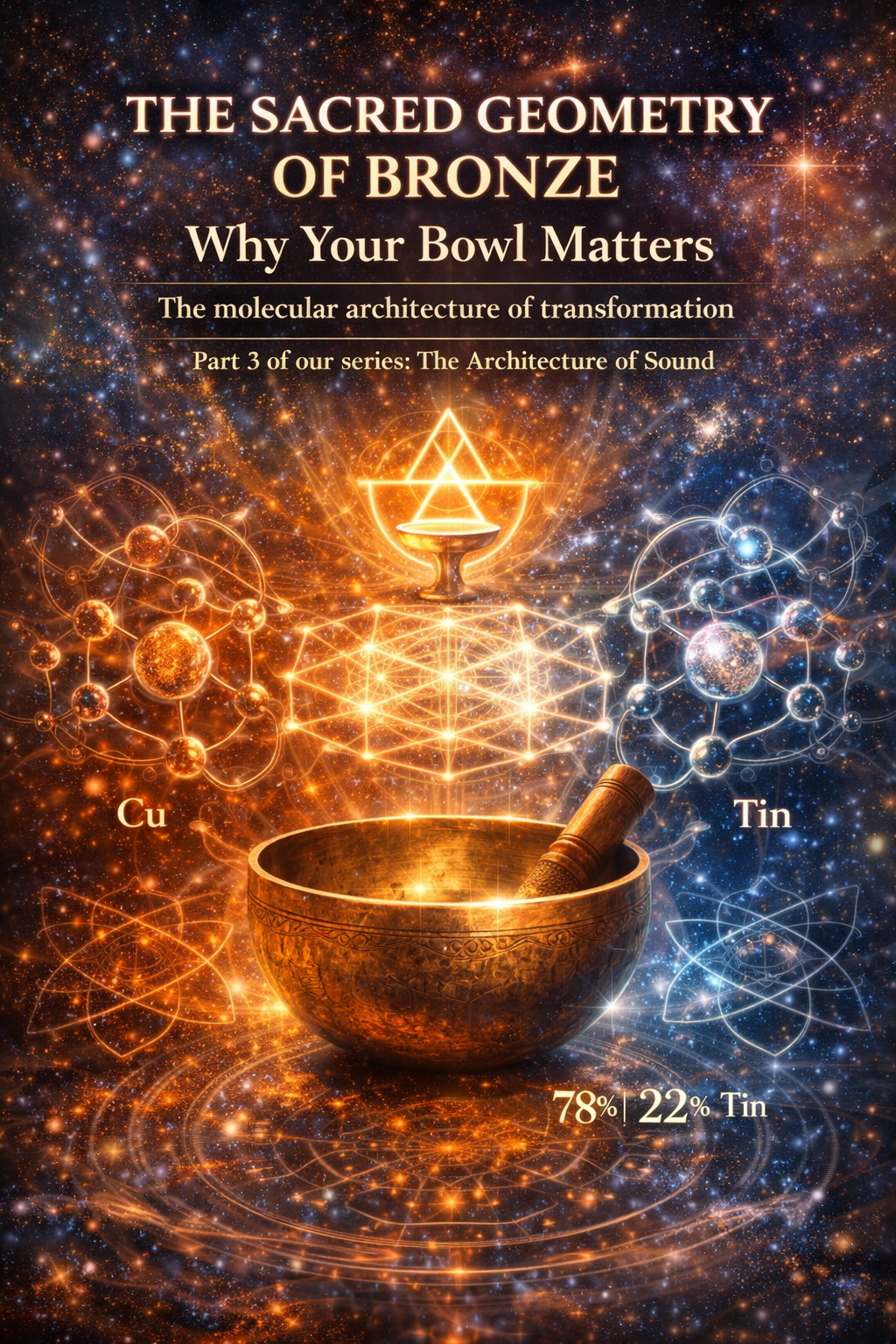
In our next article, we'll dive into why practitioners are so particular about specific bronze alloys for singing bowls, and why crystal bowls are often dismissed as "too one-dimensional." It turns out that the material composition of an instrument isn't just about sound quality—it's about the very nature of the information your cells receive.
The universe speaks in frequencies. Your body listens in cymatics. And the conversation happening right now, whether you're aware of it or not, is shaping your reality from the cellular level up.
Next in the series: "The Sacred Geometry of Bronze: Why Your Bowl Matters"
To experience high-quality sound instruments and explore the difference in cymatics-informed healing, visit your local Ohm Store or browse our curated collection of authentic bronze singing bowls online.