

A better way to choose your
singing bowl
for therapeutic impact.
Beyond the chakra chart — how sound actually creates therapeutic impact.

Most people choose singing bowls by chakra note. After a decade of working directly with the artisans who make these instruments, and learning the acoustic science behind how they create therapeutic impact, we'd like to offer you a more grounded perspective.
The chakra chart is well-intentioned.
It's also very new.
If you've spent any time in the world of singing bowls, you've encountered the chart: seven chakras, seven notes, seven bowls. Root chakra — C note. Heart chakra — F note. Crown chakra — B note. It's clean. It's intuitive. It gives you a framework for choosing.
Here's what that chart doesn't tell you: the note-to-chakra assignment has no basis in the original texts. The Vedas don't mention chakra notes. The tantric traditions that developed the chakra system mapped those energy centres to seed mantras, deities, and the five elements — not to musical notes, and certainly not to the Western C major scale.
The note-chakra system you see on virtually every singing bowl website is a modern Western overlay — one that emerged in the late 1970s as Eastern philosophy met New Age thought. That doesn't make it harmful. Many practitioners find meaning in it. But as a guide for choosing a bowl that creates genuine, measurable therapeutic impact on your nervous system — it is incomplete.
"When I interviewed elder healers in Nepal and spoke to a shaman of the Bon Po tradition, they weren't familiar with the concept of the Western musical scale or relating certain notes to chakras."
— Frank Perry, Himalayan Sound RevelationsA single bowl doesn't produce one note.
It produces dozens.
This is the fact that makes the chakra-note framework acoustically untenable: a handmade singing bowl is not a tuned instrument in the Western sense. When you strike or sing it, you don't hear one note — you hear a fundamental tone, overtones, harmonics, and — most importantly — beating frequencies produced by the slight irregularities in the hand-hammered metal.
These aren't flaws. They're the mechanism. The beating frequencies your bowl produces — the "wah-wah" pulse you hear when you sing it — fall in the 1 to 8 Hz range. That range corresponds directly to the Delta and Theta brainwave states: the same states associated with deep meditation, memory consolidation, and genuine rest.
Assigning a bowl to one chakra note ignores all of this. It reduces a complex acoustic instrument to a single frequency — and in doing so, misses what makes the bowl therapeutically powerful.
The beating frequencies — not the musical note — are what entrain your brainwaves. The chart assigns you one note. Your bowl produces everything above simultaneously.
The brain's auditory processing system synchronises with repeating rhythmic stimuli. The beating frequencies your bowl produces — the pulse you can hear and feel — coax your brainwaves toward the same rhythm. This is entrainment, and it's the measurable, documented reason sound works on the nervous system. It has nothing to do with which chakra your bowl is "assigned to."
This is what therapeutic impact sounds like.
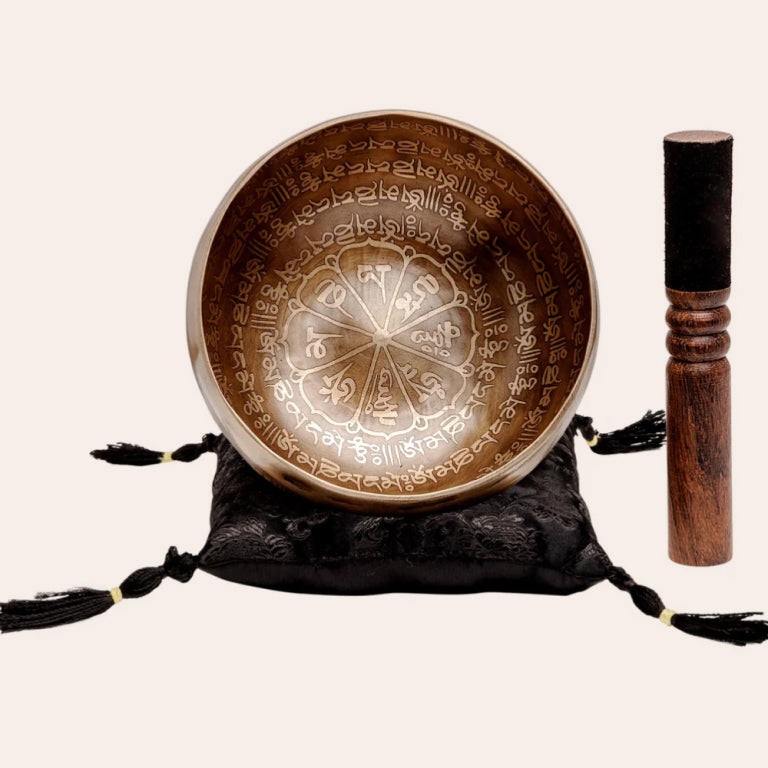
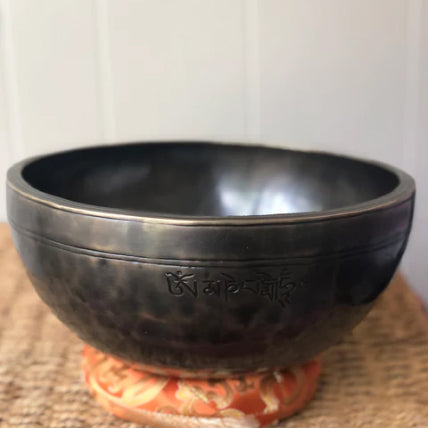
Before you read another word about bowl selection — listen. This is the Purity Bowl, one of our most popular handmade bronze bowls from Kathmandu. Notice the pulse within the sustain. That beating quality — the gentle oscillation underneath the tone — is the entrainment mechanism at work. Your nervous system responds to it whether or not you're thinking about it.
Listen for the oscillation within the sustain — the gentle "wah-wah" pulse underneath the tone. That's the beating frequency. That's what your nervous system is responding to.
How to choose a bowl
for therapeutic impact.
This is what a decade of working with handmade instruments — and learning the acoustic science behind them — has taught us. It isn't complicated. It's just different from what the chakra chart suggests.
Care to dive deeper?
What you've just read is the foundation — the acoustic and historical context that makes bowl selection less mysterious and more intentional. But it's the beginning of a much larger body of knowledge.
The Art & Science of Sound is The Ohm Store's complete course in singing bowl technique, acoustic science, and the neuroscience of why these instruments create therapeutic impact. It was built to answer the question we hear most from practitioners at every level: "I know I love this instrument — now how do I truly understand it?"
It's taught by Jonathan Adams (Sonic Yogi), a classically trained recording artist who came to sound healing through his own recovery from acute anxiety — and who brings the precision of a trained musician to the science, and the empathy of someone who's needed it to the teaching.
Want to become a fluent
practitioner of sound?
10 modules. 47 lessons. A guided meditation library by recording artist Sonic Yogi. Everything you need to move from curiosity to a genuine, grounded practice. $197, one time, yours forever.
Explore the Course — $19710 modules · 47 lessons · Lifetime access · No prerequisites


