



How a Singing Bowl
Changes Your Brain State
Your brain runs on rhythms. When those rhythms fall out of sync, everything suffers — sleep, focus, the ability to feel genuinely calm. Here's the mechanism behind why a singing bowl changes that, and why it works when other things haven't.
Your brain has gears.
Most of us are stuck in one.
Think of your brainwave states as gears in a car. Fourth gear — high Beta — is where you spend most of your waking hours. Alert. Analytical. Processing. Problem-solving. It's the gear that gets things done.
But driving everywhere in fourth gear destroys the engine. The human nervous system was never designed to stay there indefinitely — yet modern life has made it the default. The result is a nervous system that doesn't know how to downshift, that equates "doing nothing" with anxiety rather than rest.
But for many, the hardest part is giving the restless mind something to follow — something that makes the shift happen.
That's exactly what a singing bowl does. And the reason it works is precise, measurable, and grounded in neuroscience.
The gear you're in determines everything.
Each brainwave state has a job. The problem isn't Beta — it's being unable to leave it.
14–30 Hz
8–13 Hz
4–7 Hz
0.5–3 Hz
The body repairs, consolidates memory, and processes emotion in the lower gears. Most people today slam directly from fourth gear (Beta) into sleep — skipping Alpha and Theta entirely. That gap is where chronic stress, anxious nights, and the inability to feel genuinely at rest live.
What each state actually feels like.
Named, measured, real. These aren't metaphors — they're electrical oscillations measured in hertz, with decades of EEG research behind them.
A singing bowl targets Theta and Delta directly — the states associated with deep meditation, memory consolidation, and the entry point to sleep. These are exactly the states most people skip on the way from stressed to unconscious.
The physics behind why singing bowls work.
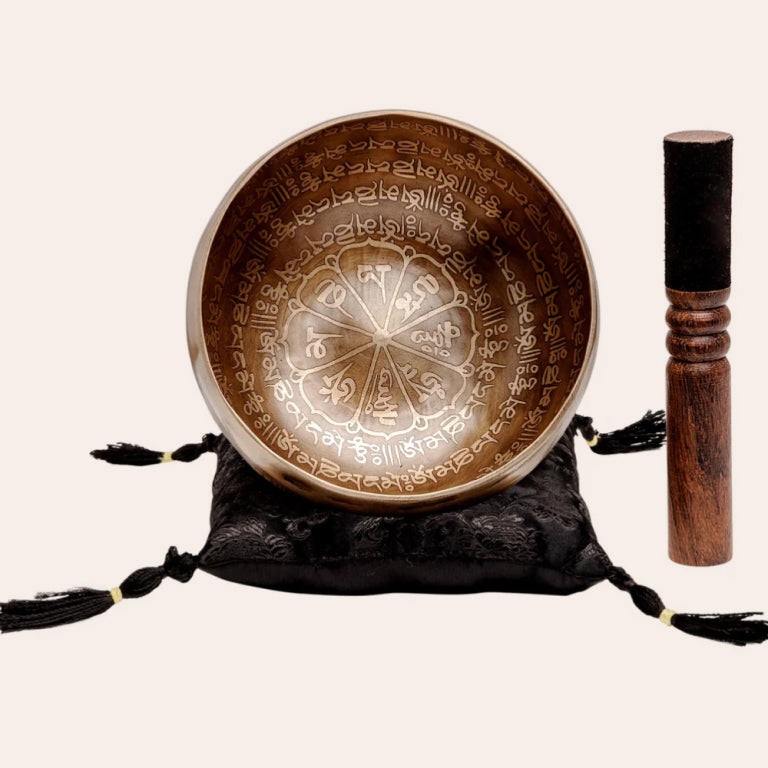
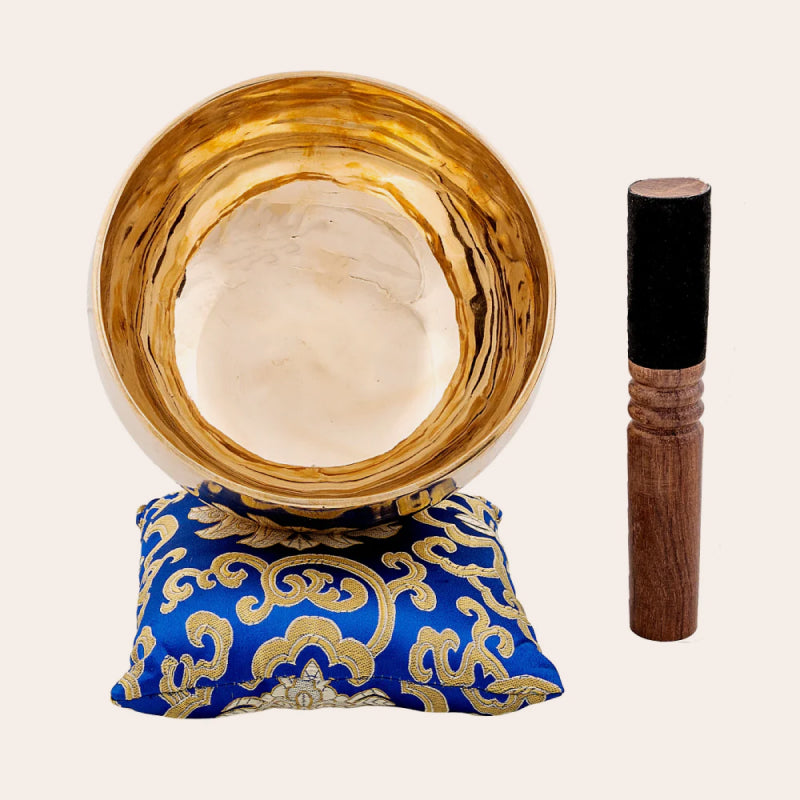
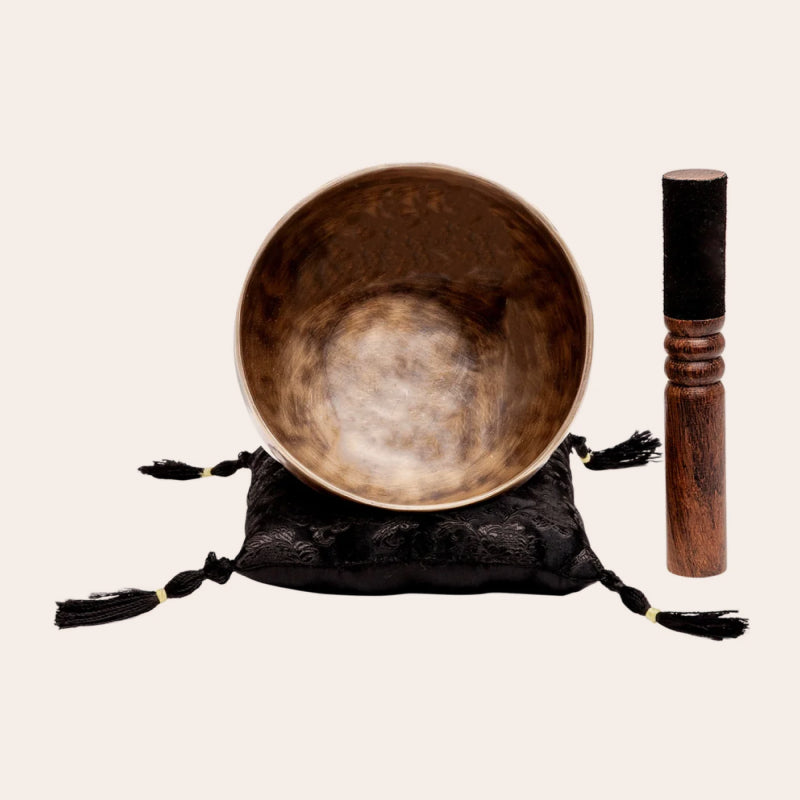
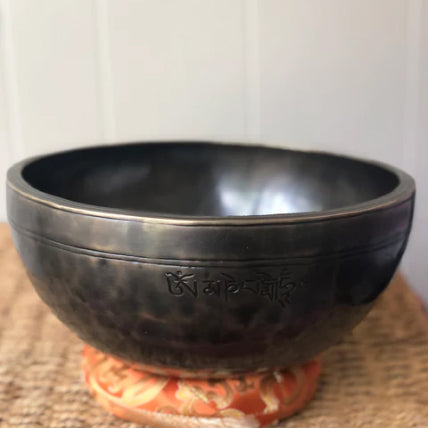
When a handmade bronze bowl is struck or sung, it doesn't produce a single clean tone. It produces a cascade of frequencies — a fundamental note, overtones, and something more specific: a beating pattern created by the slight imperfections in the hand-hammered metal.
Those imperfections — the tiny mass asymmetries left by the artisan's hammer strikes — cause what physicists call mode splitting: each vibrational mode of the bowl splits into two closely spaced frequencies. When those two frequencies interact, they pulse. And that pulse rate falls in the 1–8 Hz range.
That range corresponds exactly to Delta and Theta brainwaves.
The neurons in the inferior colliculus — the brain's primary auditory processing centre — are specifically tuned to respond to this amplitude modulation. The brain doesn't passively hear the pulse. It synchronises with it. This is the measurable, documented mechanism behind brainwave entrainment.
"Your brain literally starts to synchronise with the bowl's pulse. This is called entrainment, and it's the primary mechanism by which a singing bowl shifts your state of consciousness."
— The Ohm Store, The Physics of Therapeutic VibrationThis is also why the irregularity of a handmade bowl matters. A machine-pressed bowl, turned on a CNC lathe to perfect dimensional uniformity, produces a clean, harmonically simple tone — and almost no beating. The sound is purer. The therapeutic effect is significantly weaker. The imperfection of the handmade bowl creates the irresistible-to-the-brain complexity, creating the conditions for a restorative, meditative experience.
A 360-year-old fun fact.
In 1665, Dutch physicist Christiaan Huygens noticed something strange: the pendulum clocks in his workshop, hanging on the same wall, would gradually fall into sync — even when started at different times. The vibrations travelling through the wall were enough to lock their rhythms together.
He had discovered entrainment — the tendency of oscillating systems to synchronise with one another. Your brain does this naturally. It's called the frequency-following response.
Brain and bowl oscillating in theta — together.
You may have heard of binaural beats?
Binaural beats are experienced between your two ears — you need headphones to hear them. A singing bowl's beats are monaural: physically present in the air, received by every person in the room from the same wave simultaneously.
Machine-pressed bowls have perfect acoustic symmetry — nearly no mode splitting, nearly no beat frequencies. The irregularity of handmade bronze is not a flaw. It is the mechanism. The imperfections left by the artisan's hammer are precisely what make the bowl therapeutically effective.
Why you feel it —
not just hear it.
Sound doesn't just enter through the ears. Your ear contains the auricular branch of the vagus nerve — the only place in the body where the vagus nerve surfaces externally!
The vagus nerve is the primary conduit of the parasympathetic nervous system — the "rest and digest" counterpart to fight-or-flight. When acoustic stimulation reaches Arnold's nerve (the auricular branch), it directly activates parasympathetic response: heart rate slows, breath deepens, the body's threat-assessment system begins to quiet.
This is a bottom-up process. It doesn't require belief, intention, or the right mindset. The physiology responds to the stimulus regardless.
Want to learn more and become
a fluent practitioner of sound?
The Ohm Store's Art & Science of Sound Course covers instrument technique, the complete neuroscience, and a permanent guided meditation library — taught by a classically trained recording artist. $197. One time. Yours forever.
Explore the Course10 modules · 47 lessons · Lifetime access · No prerequisites
Instruments handmade in Kathmandu, Nepal — shop handmade singing bowls


