Sound School · September 2026 cohort
A serious education in the craft of therapeutic sound.
Nine weeks of musicianship, nervous-system science and facilitation practice, taught by working practitioners, conservatory-trained musicians and PhDs. You finish able to hold a room — and certified to do it professionally.
Join the waitlist → four lessons, free
Enrollment opens September 1 · Every student applies
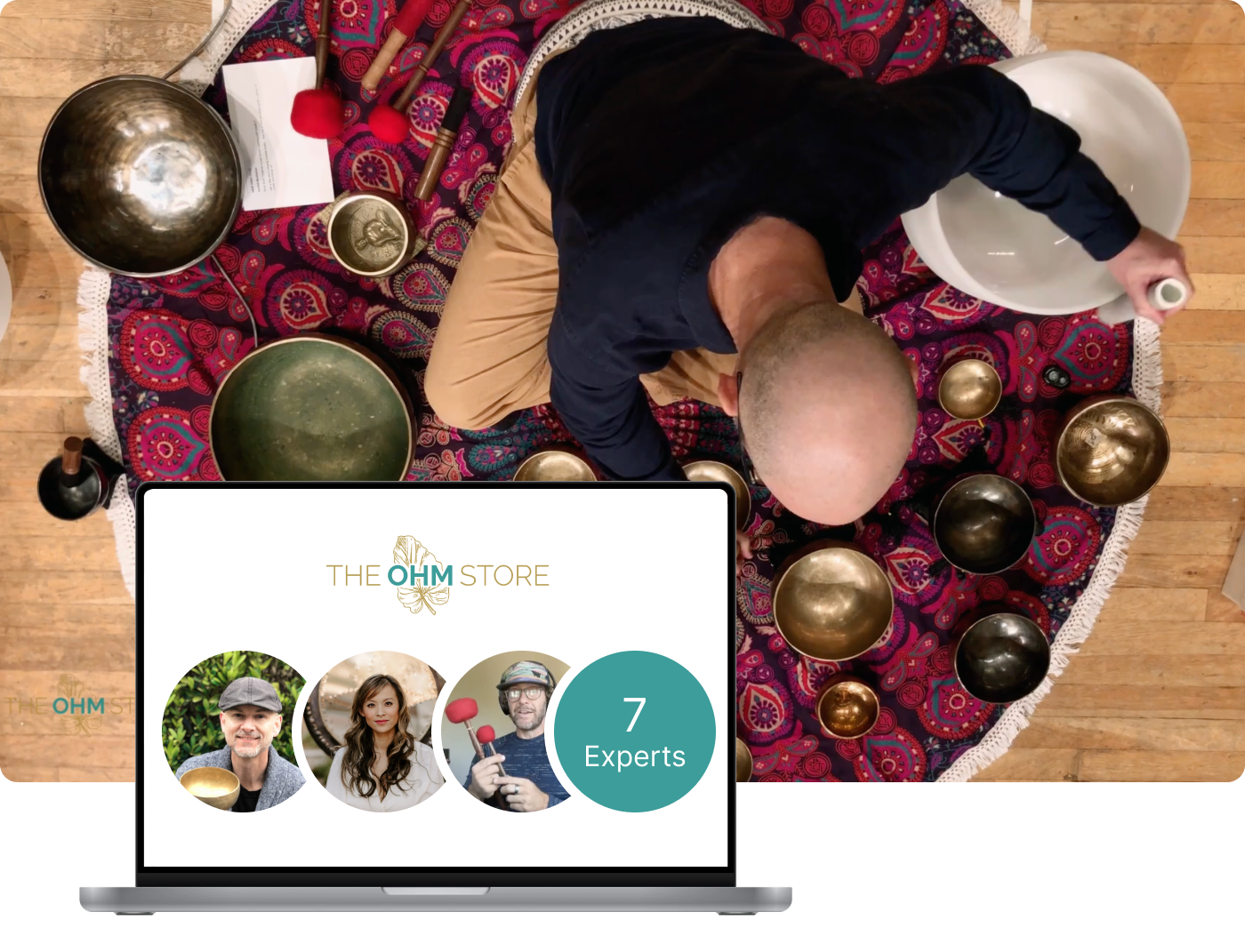
The program
The purpose of Sound School is simple: to teach you to create transformational experiences for yourself and others using singing bowls and sound.
Most training in this field teaches you a sequence of instruments to strike. Sound School teaches you why a perfect fifth feels open, what happens in a nervous system when it settles, and how to structure forty minutes so that a room full of strangers can let go.
You will move through the material with a faculty available on Zoom up to three times a week and a cohort of fifty people learning alongside you. The work is equal parts study and practice: the physics and feeling of resonance, the confidence to facilitate sound baths and one-on-one sessions, and the steady presence that separates a performance from an experience someone can actually rest inside.
It is built for people who want this to be real — a practice they can offer, a service they can charge for, a skill they can be trusted with.
What we teach
Three disciplines that rarely live in one program.
Musicianship
Tone, interval, scale, mode and tonal centre — why certain relationships open a room and others hold tension. Taught from the ground up. No prior musical training is assumed or required.
Technical craft
The instruments themselves, and everything between your hands and the listener: playing technique, session structure, room acoustics, recording, tuning and audio clarity for the sessions you stream or sell.
Presence
The part no curriculum can fake. Managing your own nervous system so you can hold someone else's, and the humility to stop trying to fix anyone and simply keep the field safe.
“What makes great practitioners is not how they play. It is how they are.”
Jonathan Adams · Head teacher
Your faculty
You will learn from people who do this for a living.
Sound School is built on the university model. Rather than one teacher's method repeated for nine weeks, you study under a faculty of specialists — each teaching the thing they have spent their career inside.
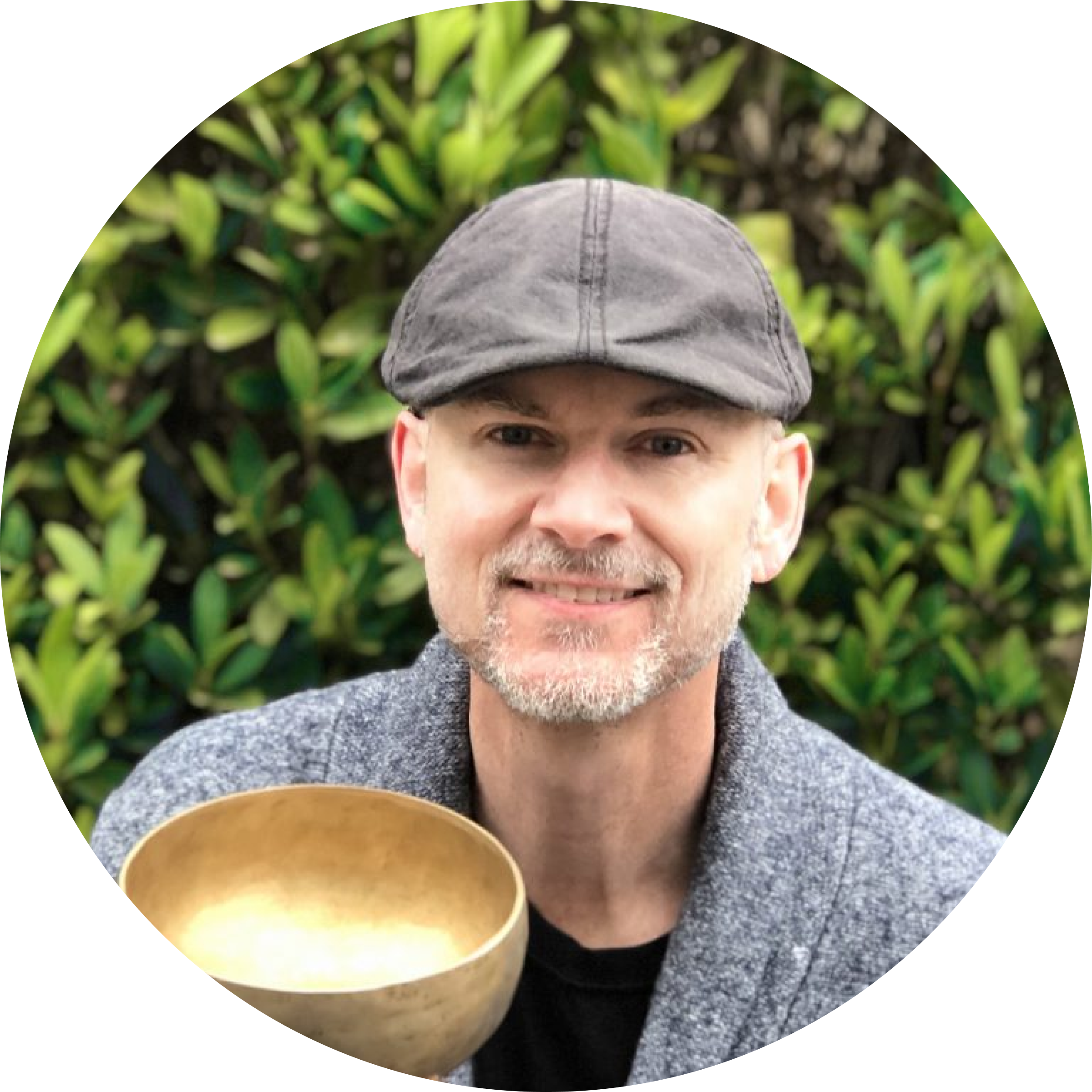
Jonathan Adams
Head teacher · Sonic Yogi · Meditation & entrainment
Jonathan came to sound therapy through his own extreme anxiety, then spent years exploring what frequency could do for relaxation and meditation. He has led talks and workshops at TEDx and beyond, and his recordings reach listeners on Spotify, Insight Timer and SoundCloud. Tricycle: The Buddhist Review described his work as both deeply relaxing and energizing. He leads the live Q&A every week of the program and gives direct feedback on your capstone.
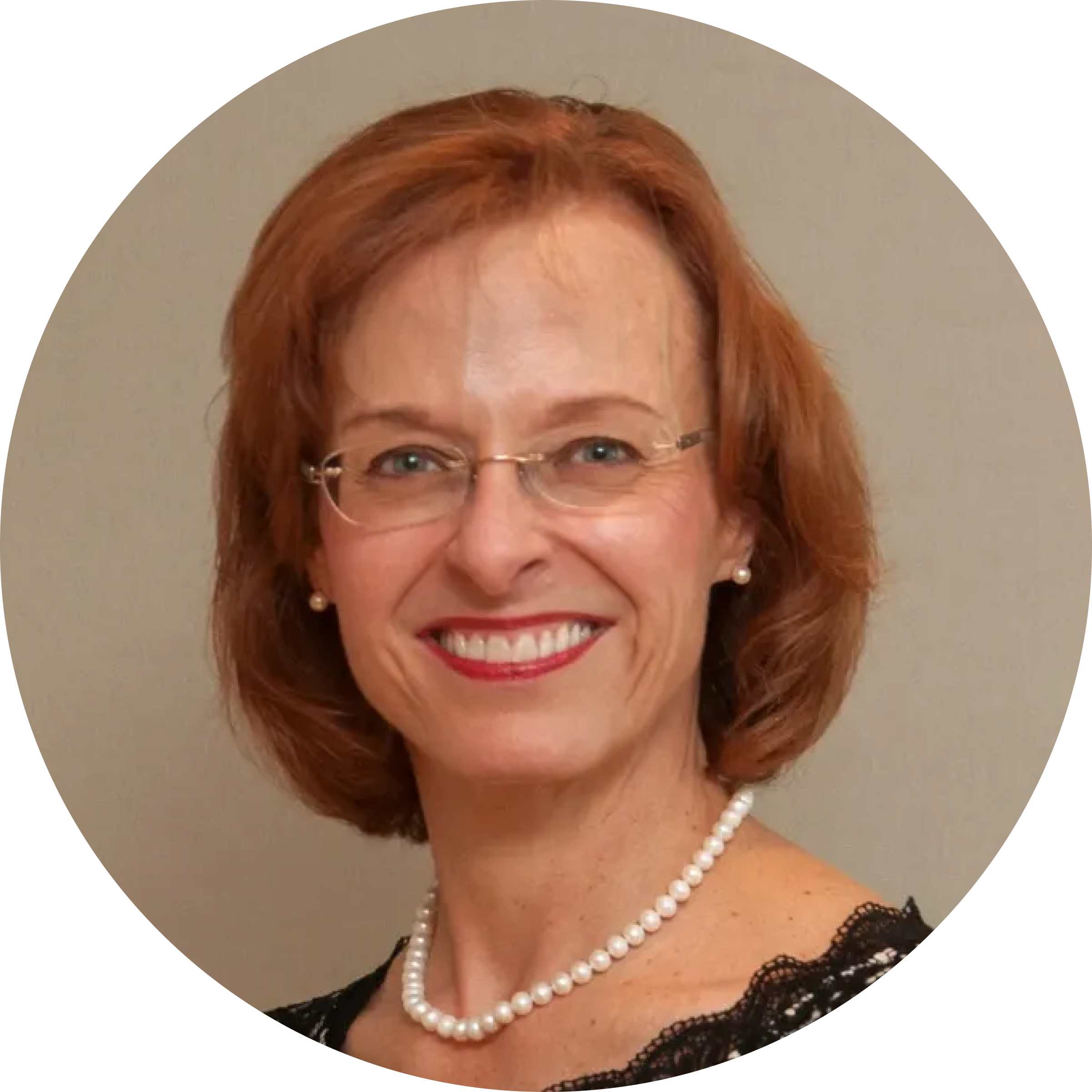
Dr. Sandra Sluberski
Voice, mantra & vocal technique
A PhD in vocal performance and thirty years teaching in a university setting. Her work sits at the intersection of trained voice and therapeutic sound: breath control, vocal production, and the strange fact that the one instrument every practitioner already owns is the one most of them never use. She hosts the weekly community town hall.
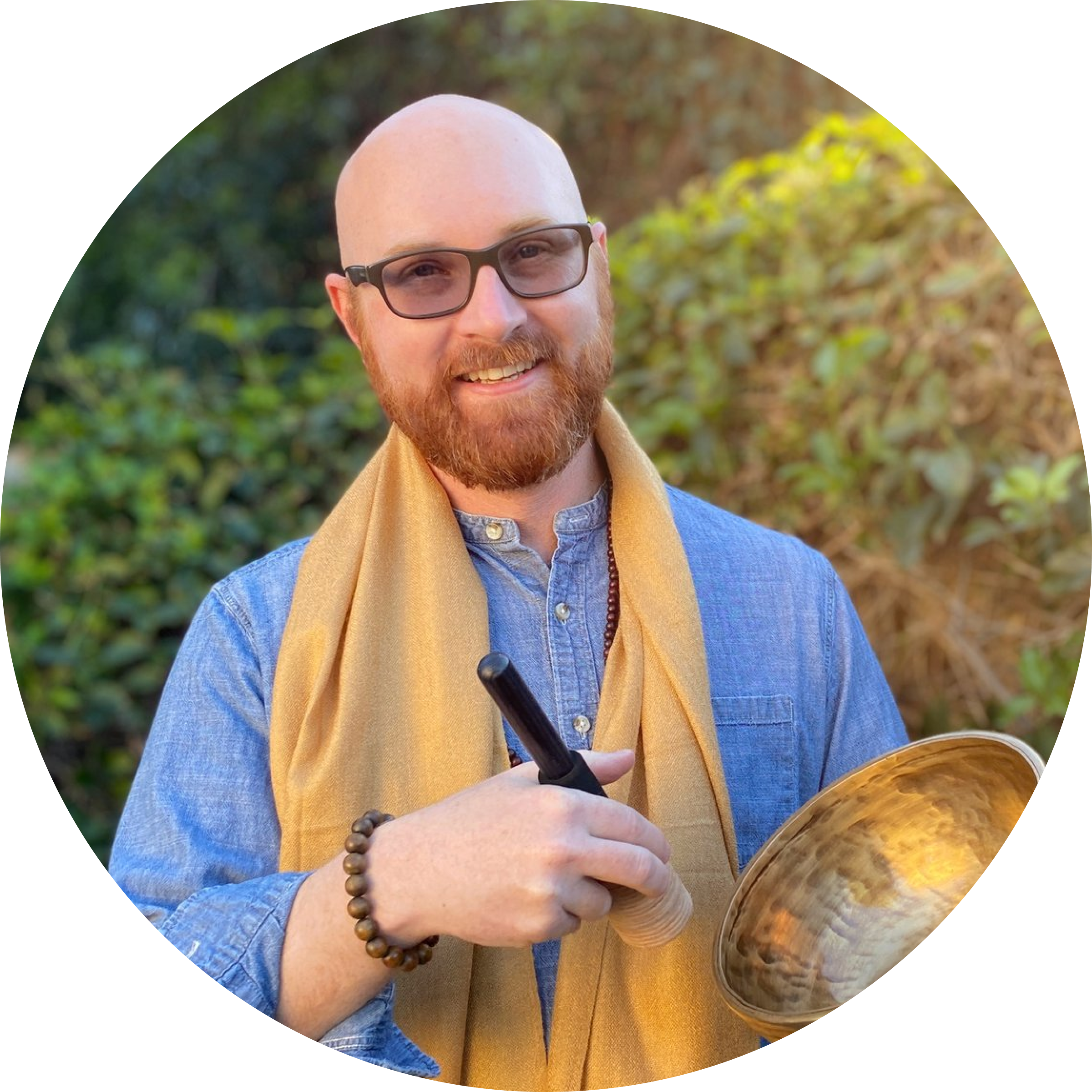
Benjamin Irons
Gong technique & vibrational therapy
A conservatory-trained percussionist who leads The Ohm Store's Gong School. Ben knows the history, the construction and the physics of these instruments, and he holds sound work to the standard he was trained under — which is a higher one than this field is used to.
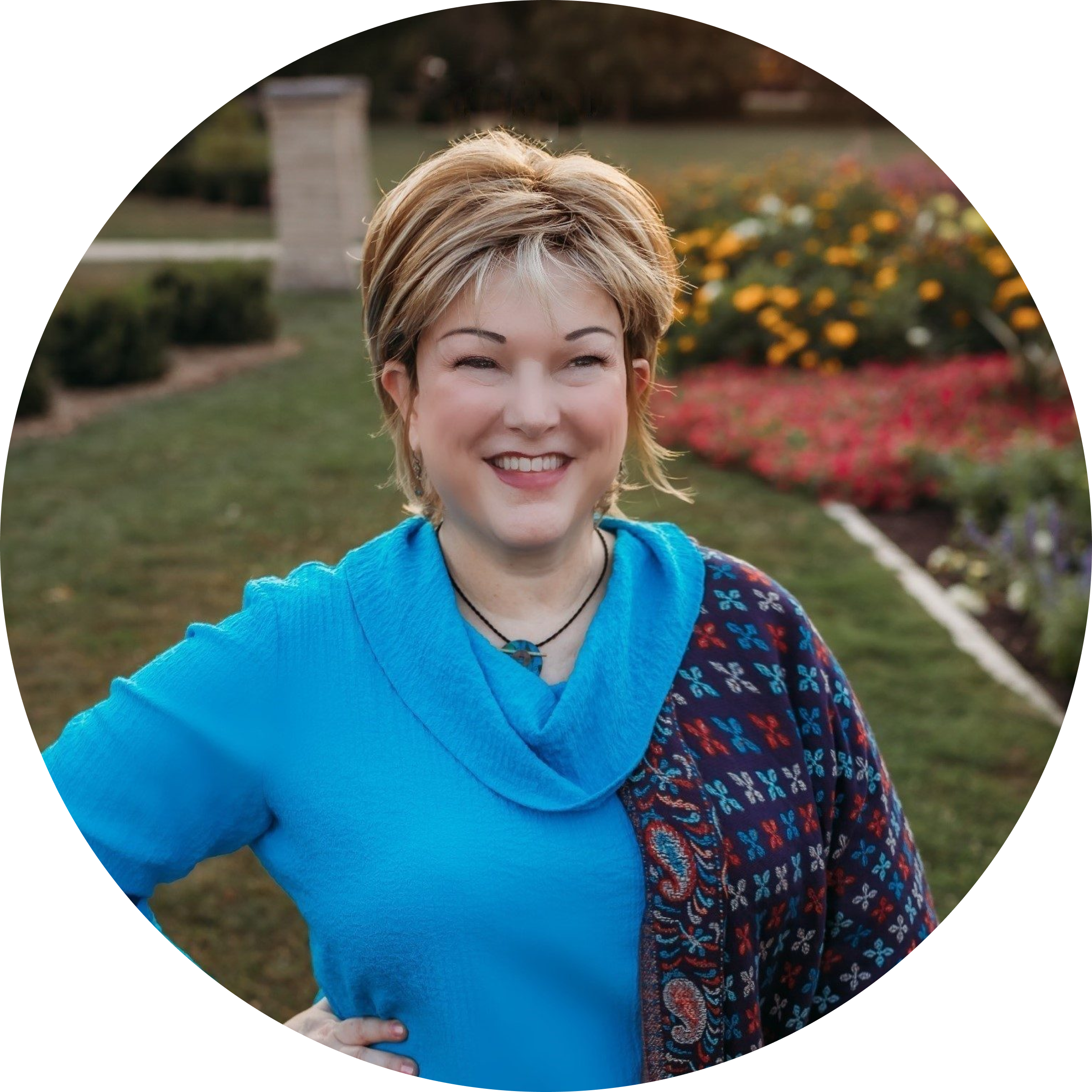
Lynne Stukart
Facilitation & sustainable practice
A professional musician and certified sound therapist who has performed on stages in eight countries. With a background in fine arts organizations and a degree in music and business, Lynne works at the seam most practitioners avoid: how to create genuinely safe, transformative rooms and still build something that lasts.
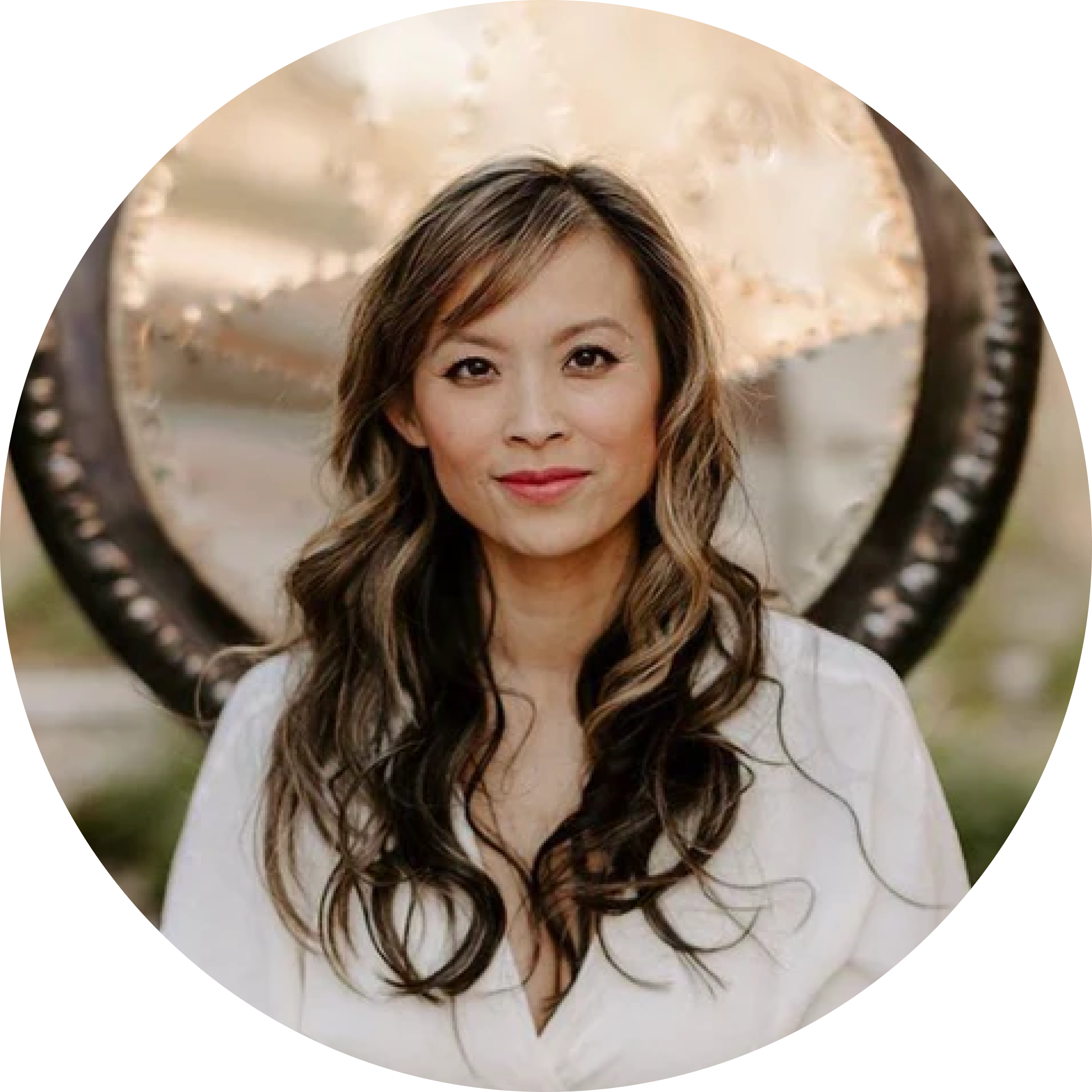
Jen Vu
Blending musical & healing modalities
A sound practitioner with a background in both music and holistic healing, Jen teaches how separate traditions can be brought into a single coherent session rather than stacked on top of one another. Her classes focus on making several modalities sound like one intention.
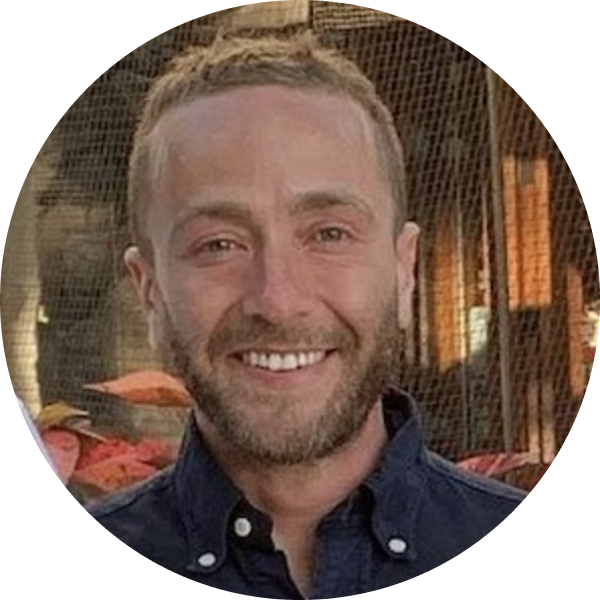
Frank Mocerino
The instruments themselves
Co-founder of The Ohm Store, which has spent a decade making sound therapy instruments in partnership with craftsmen across Nepal and India and has introduced more than 400,000 people to singing bowls. Frank teaches how these instruments are actually made, and how that knowledge changes the way you choose and play them.
A word from three of your teachers.
Before you decide
Sit in on four complete lessons first.
Two thousand dollars is a real decision, and no sales page should be the thing that makes it for you. Join the waitlist and we will send you four full lessons from the program — not previews, not trailers — so you can judge the teaching on its own terms.
- 01 The foundations of sound & frequency
- 02 The harmonic series
- 03 Sound for healing
- 04 A full live coaching session with Jonathan Adams and Frank Mocerino
Waitlist members also get first access when enrollment opens on September 1, and the application arrives by email a few days before.
How a week works
Structured enough to finish. Flexible enough to fit a life.
New material unlocks every Monday. Three live sessions follow it, all optional and all recorded and posted the next day. Graduates consistently say the calendar is what carried them across the finish line.
Lessons unlock
One to three hours of new material each week, yours to move through when it suits you.
Live Q&A
Every week with Jonathan Adams. Bring what you are stuck on and get it answered live.
Community town hall
Hosted by Dr. Sandra Sluberski. Where the cohort actually becomes a cohort.
Sound Lab
Watch a practitioner design a journey from the inside, then experience it end to end.
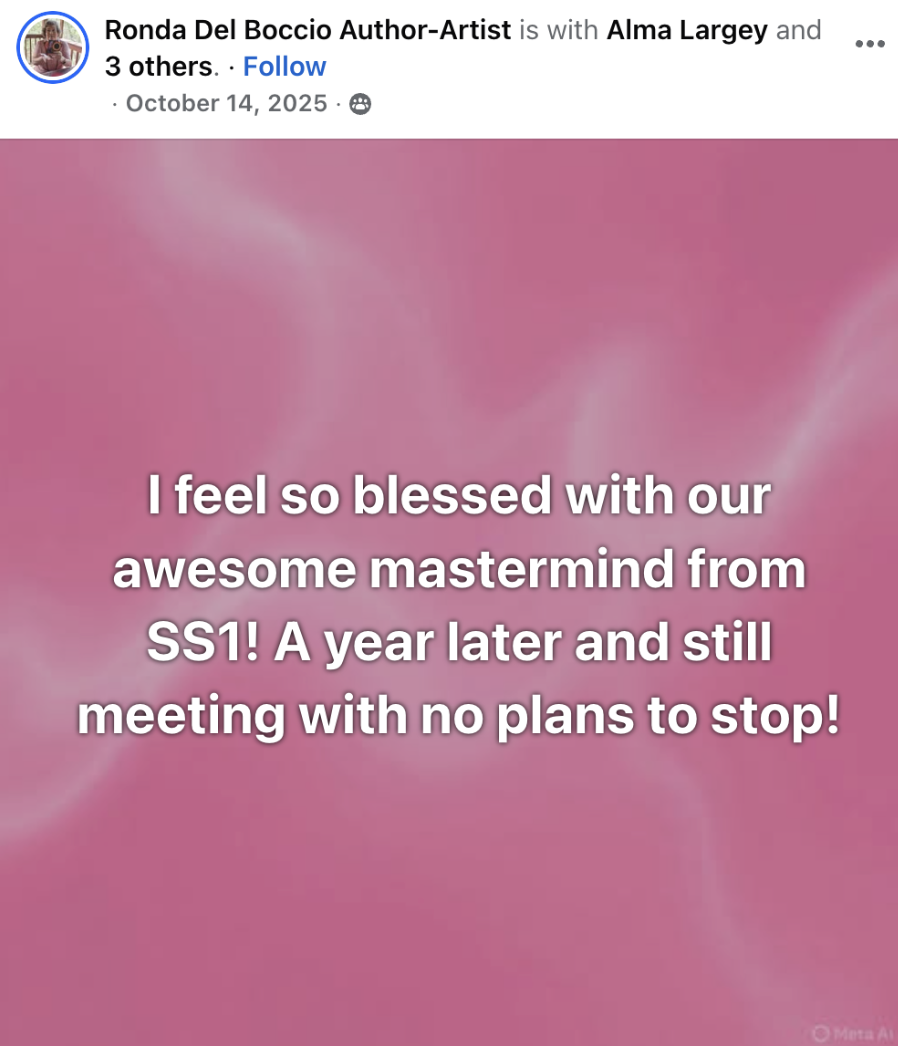
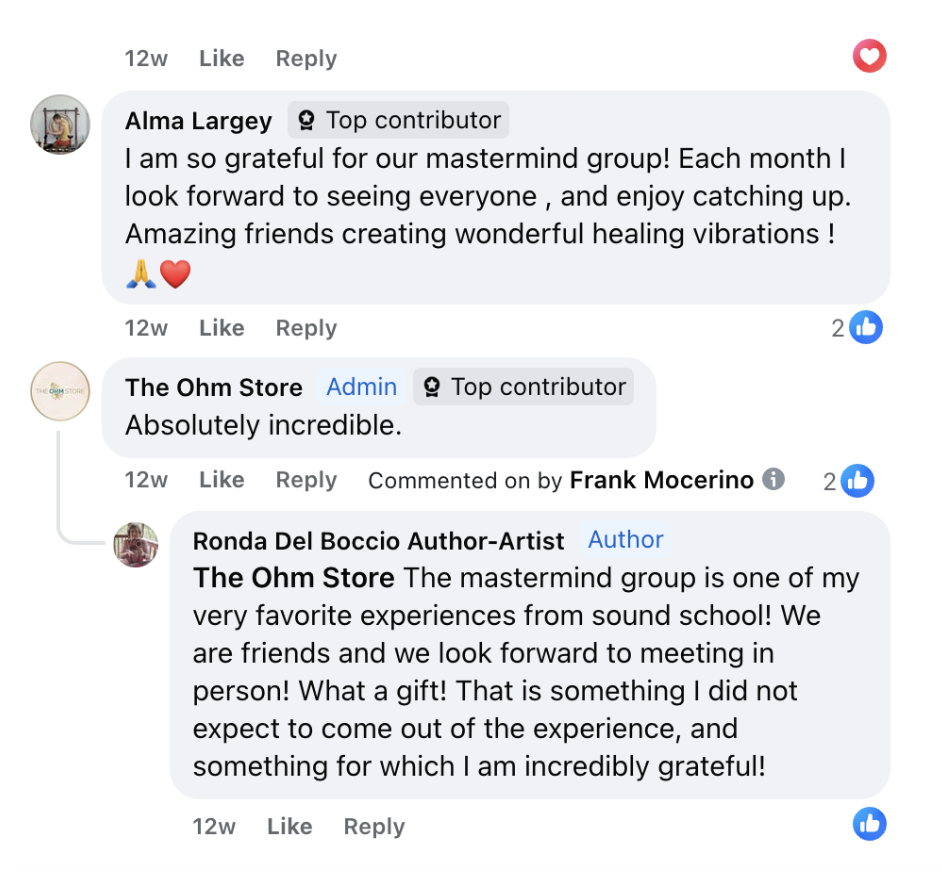
Alongside all of it you are placed in a small mastermind group with peer check-ins, plus the private community for the cohort. Access to the material and the community is for life.
The nine weeks
Learn, watch, do.
The first weeks build the intellectual foundation. The middle weeks put it in your hands. The last weeks are about what happens inside you while you play — and then you make something and hand it in.
Live calls run Tuesdays at 11am ET; town halls Wednesdays at 9pm ET; Sound Labs Thursdays. Every one is recorded and posted the following day.
Graduates
What people say when the nine weeks are over.
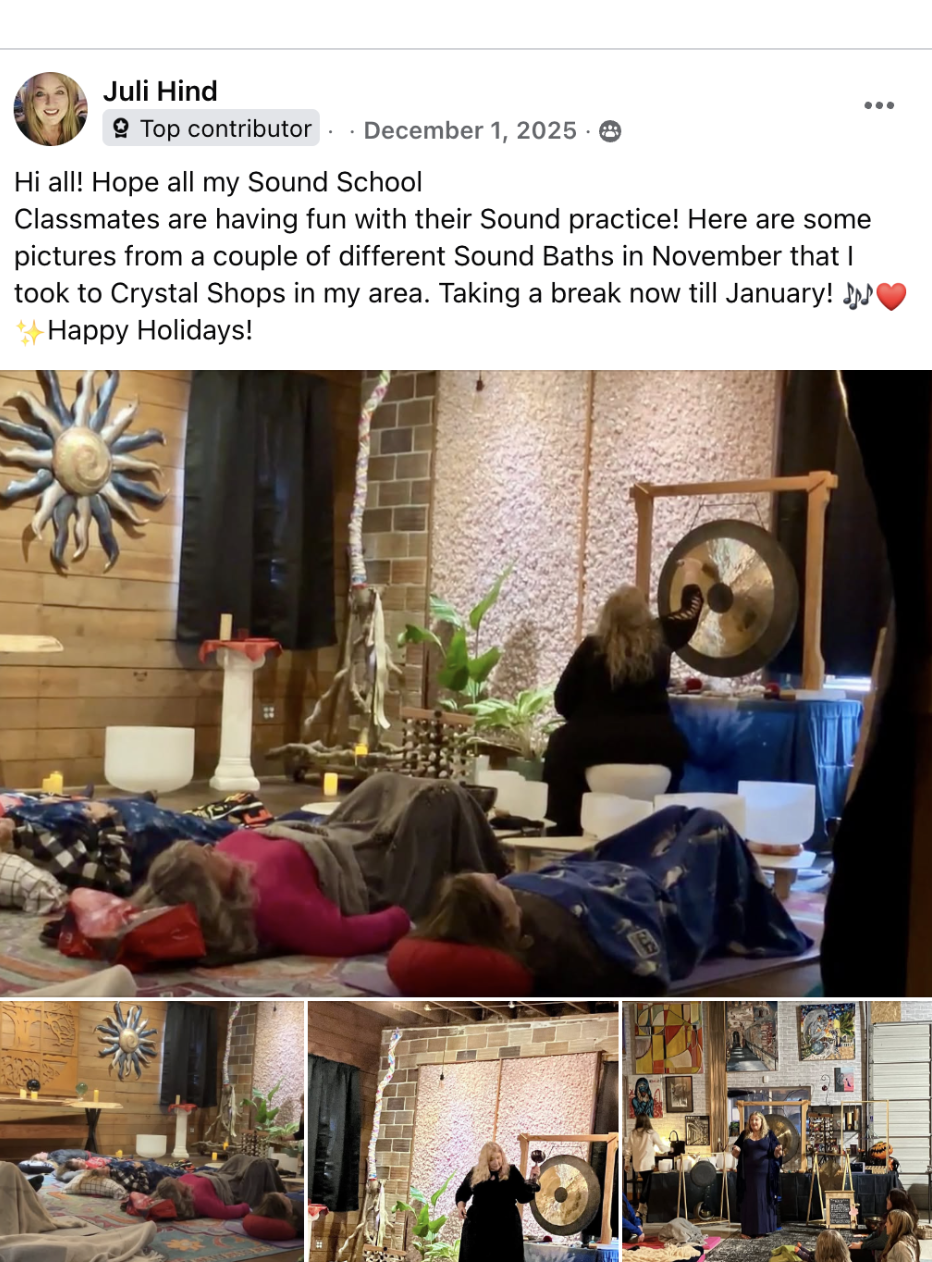
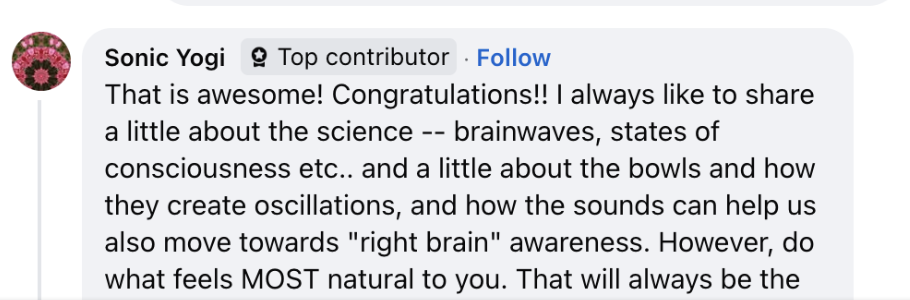
“Sound School is a comprehensive program that will benefit people from all levels of musical experience, and lay the foundation for those who want to learn how to heal themselves and others through the use of sound.”
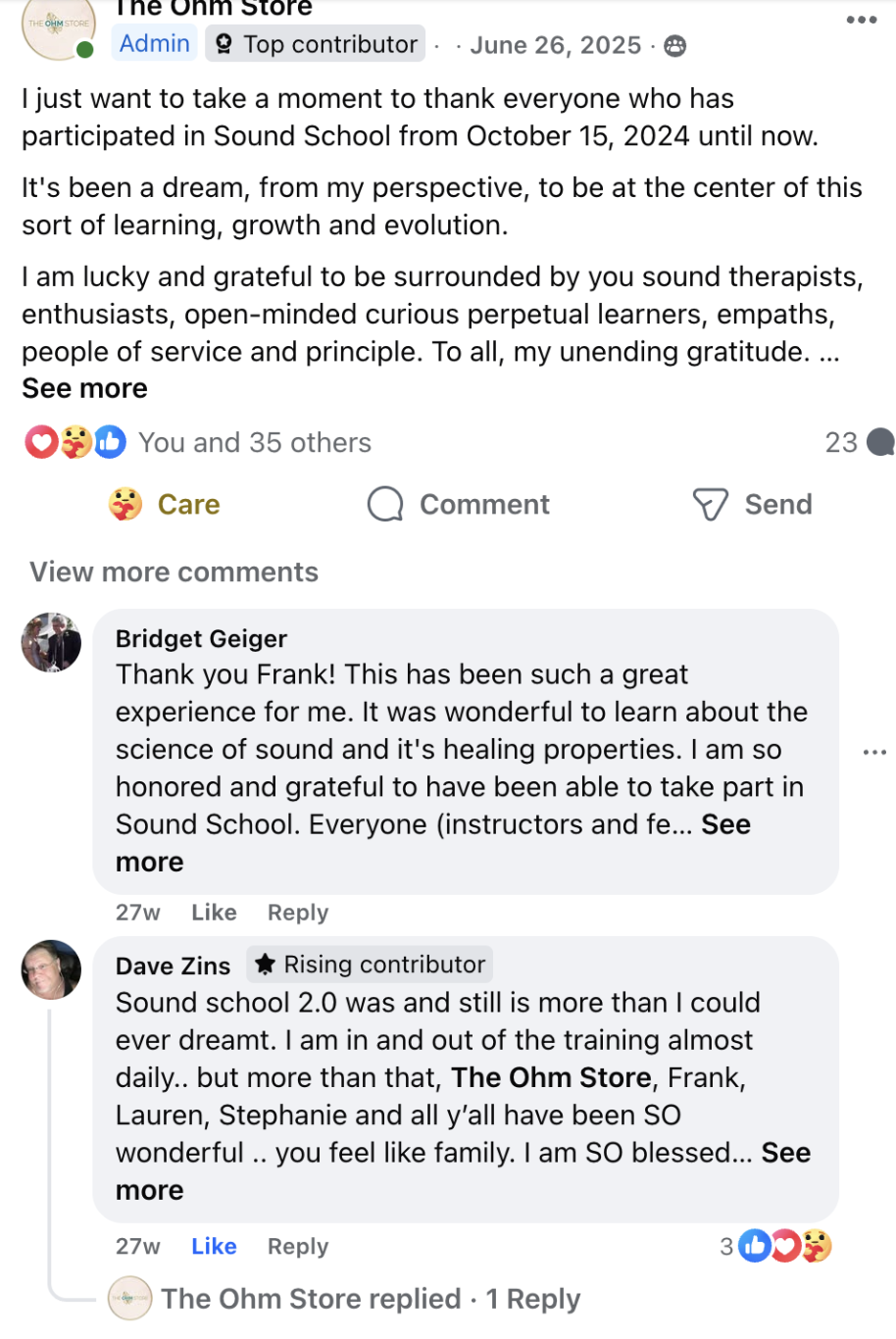
David Flowers“I appreciated that it was not just ‘at your own pace’ but had scheduled meetings. It kept me on track and engaged, and it meant more students took part in the discussions together.”
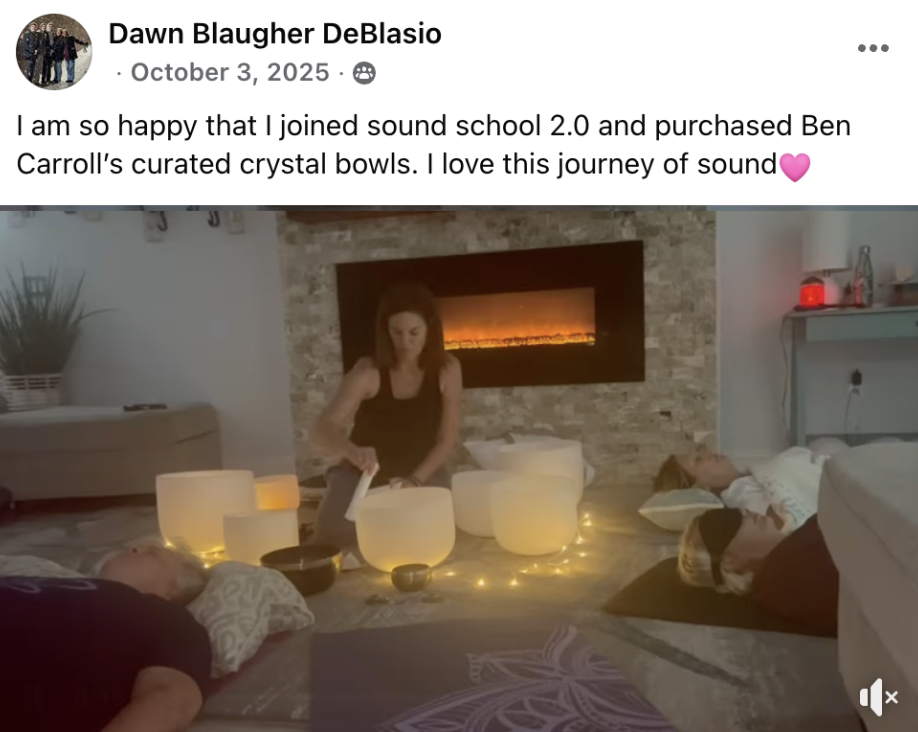
Margaret Nee“All the teachers are experienced and knowledgeable, and covered a lot of areas I was not already familiar with.”
Sue Huss“I really appreciated the specific homework assignments. The guest instructors shared a lot in their areas of expertise, and the guidance on recording and streaming was thorough.”
Krista Loetscher“I’m a nurse. I knew noise could harm — I had no idea sound could heal. Sound School introduced me to a whole world I didn’t know existed.”
Perry R.“After submitting my capstone I realised I can actually offer something of service. I’ve always believed in the healing power of sound. This gave me the courage to share it.”
Julie C.
Certification
A credential with something behind it.
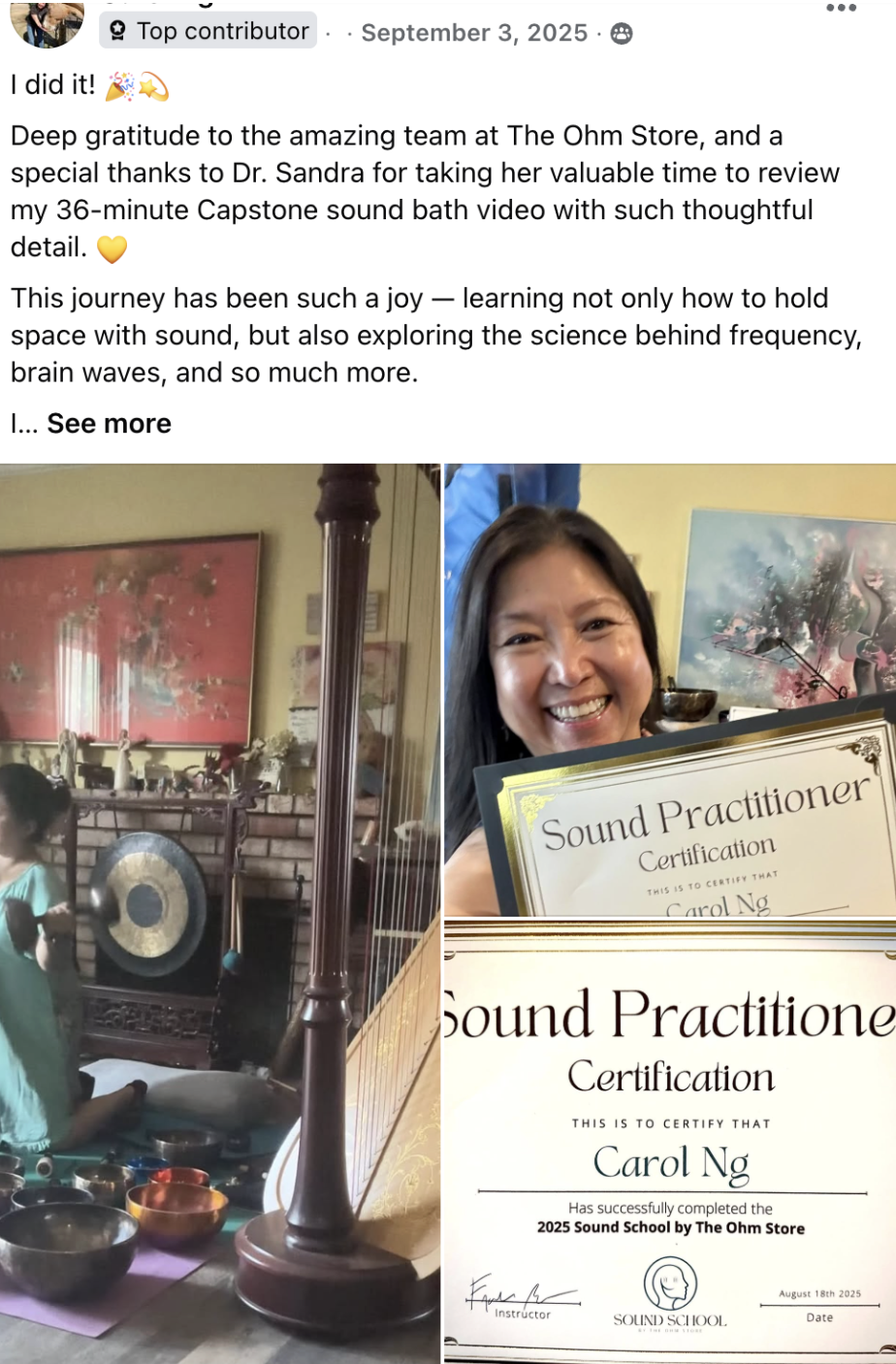
To certify, you complete the coursework and submit a capstone: a recorded sound bath that demonstrates what you can actually do. Jonathan reviews it and gives you direct feedback on your playing. Certification is earned, not granted on attendance.
- Accredited through the Complementary Medical AssociationWith continuing education and further accreditations in progress.
- Listed in our practitioner directoryYour profile on The Ohm Store's site, in front of people actively looking for a practitioner.
- Lifetime accessEvery recording, every future update to the curriculum, and the community, for as long as you want them.
- 30% off your instrumentsWholesale-level pricing on Ohm Store bowls and gongs while you are enrolled. Every bowl we make is guaranteed for life.
Sound School by The Ohm Store is accredited by the Complementary Medical Association.
How enrolling works
We ask everyone to apply.
Fifty seats, one faculty, and nine weeks of live contact. Keeping the cohort small is the only way the live calls stay useful and the mastermind groups stay real, so we read every application and take the people the program can genuinely serve.
-
Join the waitlist
Four complete lessons arrive by email. Nothing to pay, and nothing decided.
-
Your application arrives
Shortly before enrollment opens on September 1, we email waitlist members a short application. It asks about your experience with sound, why now, and what you want to build.
-
We read it and reply
Usually within a couple of days. If we think another moment or another path would serve you better, we will say so.
-
Accepted students enroll
You receive your enrollment link and choose to pay in full or over time. Seats are held in the order applications are accepted, and the cohort closes at fifty.
-
Class begins September 15
Week one unlocks, your mastermind group is assigned, and you meet the cohort.
Tuition
Payment plans available through Shop Pay, with installments up to 12 months, subject to approval. Partial scholarships exist — write to soundschool@theohmstore.co and ask.
What it asks of you
Two to four hours a week for the core coursework, plus whichever live sessions you choose to attend. Everything is recorded, so a busy fortnight does not put you behind.
You need one bowl to start. Three to seven will deepen the work, and your 30% discount is there from the day you enroll.
Join the waitlist → four lessons, free
Applications go out to waitlist members first
Who is teaching you this
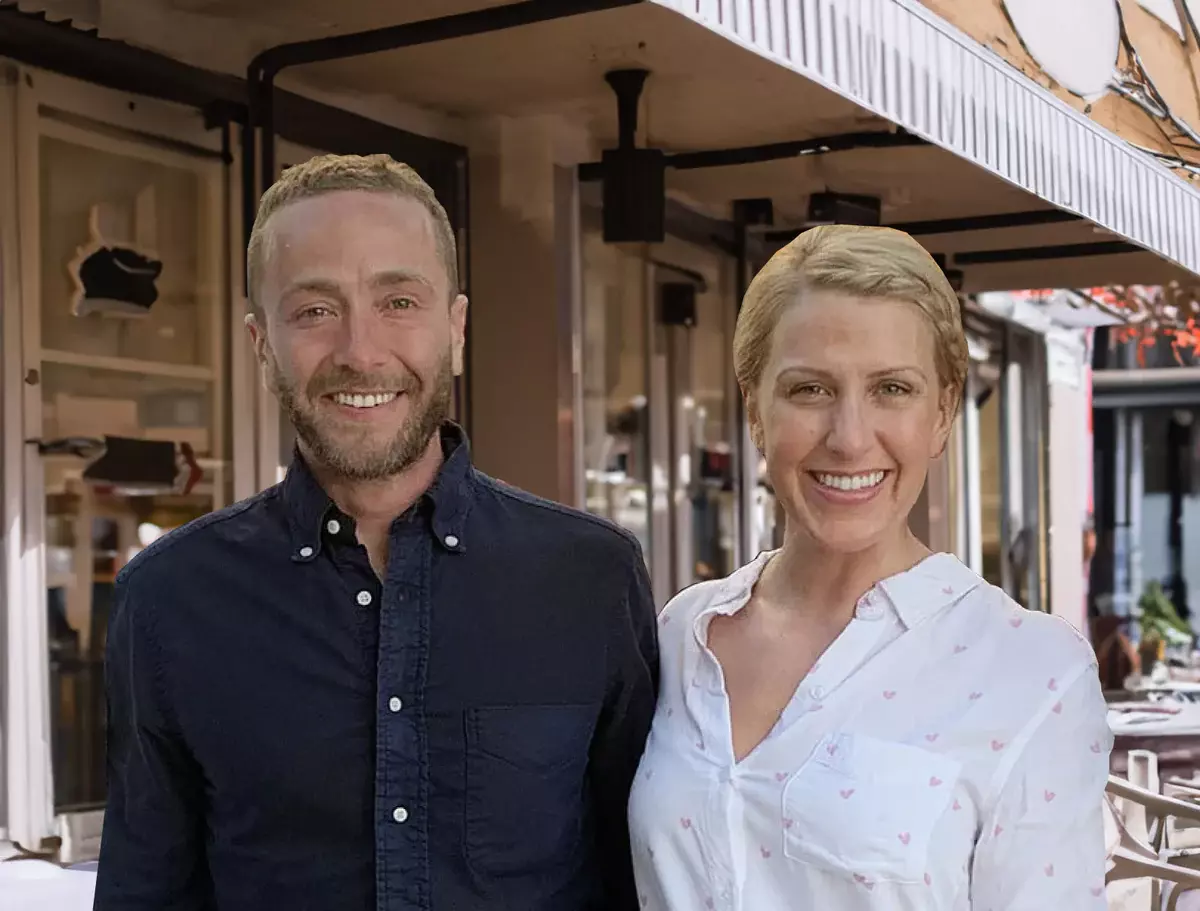
Ten years of listening to bowls, one at a time.
We play thousands of singing bowls a year, selecting relentlessly, studying how differences in shape, alloy, weight and hammering change not just the sound but the experience of sound in the body. We do not chase novelty. We refine fundamentals, and we guarantee every bowl we have ever made for life.
Sound School exists because that decade of listening turned into something worth teaching.
A note from Frank:
Nikki and I did not come to singing bowls from a classical music background. I heard the sound of one, and it was an undeniable calling. Sound is the first sense we develop in the womb and the last to leave us. It moves human emotion like nothing else, and it does it without asking permission from the intellect.
So we gathered the most talented and accomplished practitioners we know and asked them to teach what they actually do. Whether you are new to this or already facilitating, that is what is waiting for you here.
Frank Mocerino — Co-founder, The Ohm Store
Questions
Before you join the waitlist.
Do I have to apply, or can I just pay?
You apply. Enrollment opens on September 1 and the application goes to waitlist members first. It is short, and it exists so that the fifty people in the room are people the program can genuinely serve. We reply within a couple of days.
What if I have never played a singing bowl?
That is a common starting point and it is not a disadvantage. Musicianship is taught from first principles, and no previous musical training is assumed. You need one bowl to begin.
How much time does it actually take?
Two to four hours a week for the core coursework, plus any of the three weekly live sessions you choose to attend. All of them are optional and all are recorded and posted the next day, so a difficult week does not put you behind.
What is the capstone?
A recorded sound bath of your own, submitted at the end of the program. Jonathan reviews it and gives you direct feedback on your playing. It is due November 15, and it is what certification is based on.
What does certification give me?
Recognition as a certified sound practitioner through a CMA-accredited program, a profile in The Ohm Store practitioner directory, and lifetime access to the curriculum and to future certifications as we add them.
Are there payment plans or scholarships?
Tuition is $2,199, reduced from $2,500. Payment plans run through Shop Pay with installments up to 12 months, handled by a third party and subject to approval. For partial scholarship information, write to soundschool@theohmstore.co.
What makes this different from other practitioner trainings?
Three things. A faculty of specialists rather than one teacher's method. Musicianship taught seriously, so that you understand why what you are doing works. And a cohort that does not disband when the nine weeks end — the community, the recordings and the future updates stay yours.
What if I fall behind?
Week five is an integration week with no new material, built in for exactly this. Beyond that, everything is recorded and access is for life, so you can catch up on your own schedule. Your mastermind group tends to be what keeps you moving.
When will this be offered again?
We run Sound School roughly once a year and keep each cohort at fifty. If September is not your moment, join the waitlist anyway — you will hear about the next one first.
How long do I keep access to the material?
For life. Every recording, every resource, and every future update to the curriculum.
September 15, 2026 · Fifty students
Start with the lessons. Decide after that.
Four complete lessons, sent free. Then the application, when enrollment opens on September 1.