What a Wind Gong Actually Is, and How to Choose One That Is Built Correctly
An expert guide to wind gongs for people who want to understand the instrument the way an orchestral percussionist or a working gong maker does.
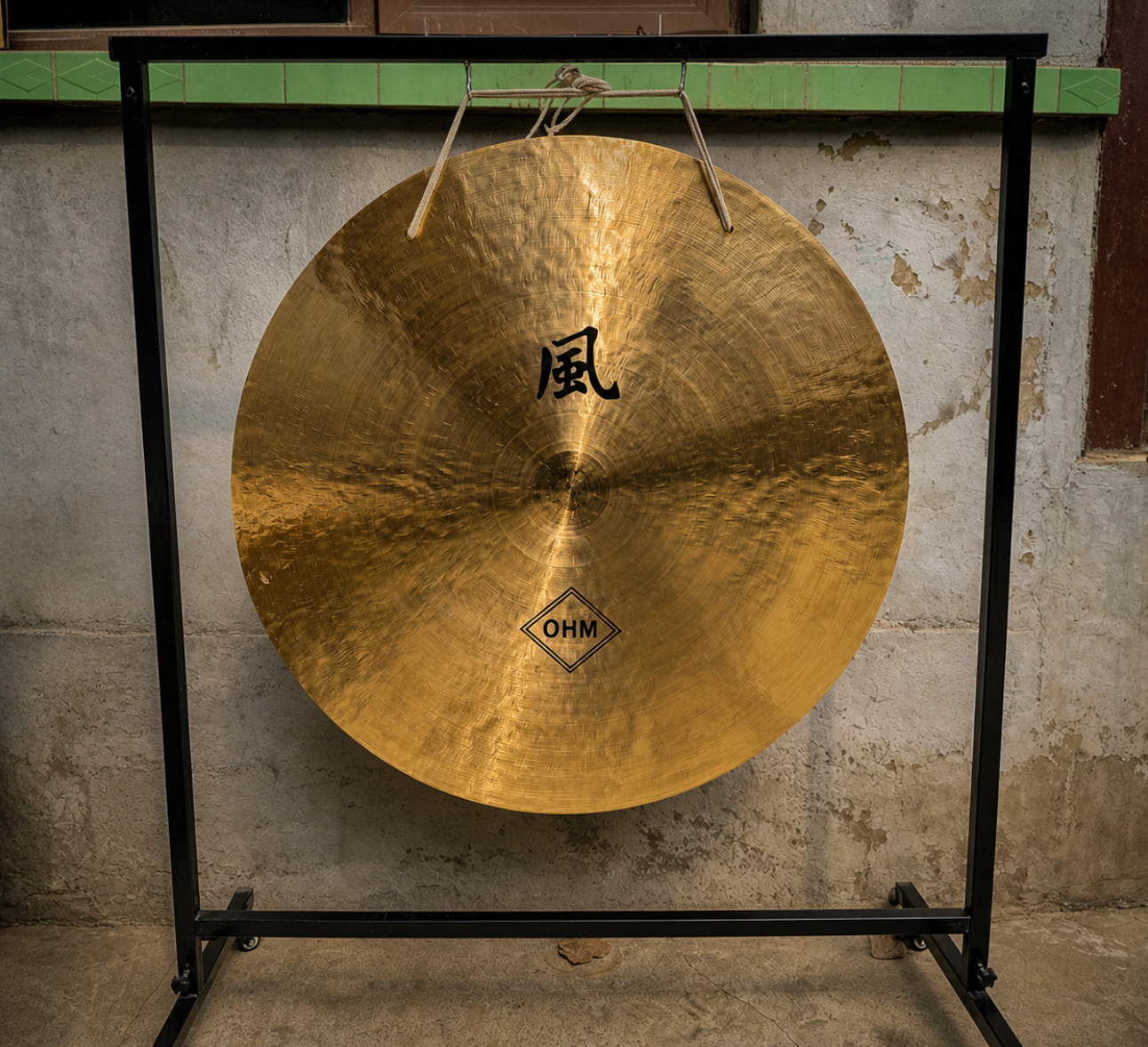
The wind gong is the most misunderstood instrument in the gong family. Most descriptions reach for vague words such as shimmering, windy, or splashy. Those words describe a real acoustic behavior, but they rarely explain the construction that produces it.
What follows is what an orchestral percussionist or a working gong maker would tell you if you sat down with them. The guide covers the physics, the construction, the sound, and the markers you can use to tell a real instrument from a decorated disc of bronze.
The Wind Gong Construction Chain
What a Wind Gong Actually Is
A wind gong, sometimes called a feng gong or lion gong, is a flat circular bronze disc. Unlike the Chau gong, it has no turned-up rim, no raised central boss, and no significant curvature. The face is essentially planar from edge to edge, with at most a very slight taper. This single structural choice, flatness, is responsible for nearly everything that distinguishes the instrument acoustically.
When you strike a flat metal disc supported at its perimeter, the surface vibrates in a large number of modes simultaneously. Without a rim to contain wave energy or a boss to anchor a dominant fundamental, the result is a broad, complex overtone field rather than a clear pitched tone. This is what people are reaching for when they describe a wind gong as shimmering, windy, or splashy. Those words describe a wide, evenly distributed spectrum with no single dominant frequency.
By contrast, a Chau gong has a turned rim and a defined central area, which constrains the vibration into a more orderly pattern. The Chau builds slowly, develops a recognizable fundamental, and sustains for a long time. The wind gong speaks immediately, presents a wash of overtones at once, and decays faster. Same alloy, different geometry, completely different instrument.


-
1
The Bronze and the Hammering
B20 alloy • Plate geometryThe acoustic potential of any traditional Chinese gong begins with the alloy. The bronze used is B20, which is approximately 80 percent copper and 20 percent tin. This is the same alloy used in high-grade cymbals from Zildjian, Sabian, and Paiste, and it is not coincidental. B20 is extremely difficult to work with. It is brittle when cool, narrow in its working temperature window, and intolerant of imprecise heat treatment.
Cheaper alloys with lower tin content are easier to shape but produce a duller, more contained sound with fewer overtones. The 20 percent tin content is what gives B20 its acoustic complexity and its characteristic shimmer.
A wind gong starts as a cast disc of B20 bronze. The disc is then heated and hammered repeatedly across its surface. This is not decoration. Hand-hammering varies the local thickness and the internal stress field of the metal across the disc. Those tiny variations are what allow a large number of vibration modes to exist with slightly different frequencies, which is what gives the gong its complex, evolving sound.
This is the first marker you can use to evaluate a wind gong. If the surface shows visible hammer marks across the face, the gong was hand-worked. If the surface is glassy and completely uniform, the gong was likely formed primarily by machine rolling or stamping, and the acoustic complexity will be correspondingly lower.
-
2
The Lathing Question
Surface mass • Brightness • FinishAfter hammering, most wind gongs are lathed. A lathe, in this context, is a spinning fixture that holds the gong while a cutting tool passes over the surface, removing a thin layer of bronze in a controlled spiral. Lathing has two functions. The first is visual: it produces the fine concentric grooves and the satin sheen that wind gongs are known for. The second is acoustic: the controlled removal of material refines the surface mass distribution and contributes to the brightness of the overtone field.
You will sometimes see wind gongs marketed as un-lathed or earth wind gongs, with a roughened surface and a darker visual character. These exist and have their place. They tend to be slightly drier and less shimmery in the high overtones, which some players prefer for specific contexts. Neither is more authentic than the other. They are tonal variants of the same family.
What you should be skeptical of is any claim that the lathing pattern itself is tuned to a specific frequency or chakra. The lathing is a finishing process. It influences overall tone color, but no maker, anywhere, is precisely lathing a flat 36-inch disc to land on, say, 528 Hz. That is not how flat bronze plates work. The geometry of the disc, the thickness profile, the alloy, and the support point together determine the dominant frequencies.
-
3
The Sound, as Professional Players Hear It
Fast attack • Broad overtonesSteve Weiss Music, one of the longest-running percussion suppliers in the United States, describes wind gongs in straightforward technical terms: flat bronze discs, with little fundamental pitch, a great windy wash, heavy tuned overtones, and long sustain. Note what they say and what they do not say. They name a property, a structural consequence, a perceptual quality, and a measurable behavior.
A fast attack. The sound is there immediately. Compare a wind gong with a Chau gong of the same diameter at moderate volume, and the wind gong will reach near its full sound within a fraction of a second while the Chau is still building.
A broad, bright overtone field. The sound is dense with mid and upper partials. There is no clear note. If you tried to hum along, you would find nothing stable to hum to. This is the design.
A reasonable but not extreme sustain. Wind gongs sustain for many seconds at full volume, but they decay faster than Chau gongs of comparable size. The energy spreads quickly across the flat surface and radiates into the room rather than being contained and recirculated by a rim.
A dynamic range that is highly mallet-dependent. Played softly with a small mallet, a wind gong can be subtle, almost speech-like. Played hard with a heavy mallet, it can rival a Chau in raw volume, with a brighter and more aggressive character.
-
4
Orchestral and Professional Usage
Mallet choice • Repertoire • TechniqueThe wind gong has a real place in the percussion ecology of working orchestras and ensembles, and the mallet manufacturers tell you exactly how. Zildjian makes a Wind Gong Mallet, separate from its general gong mallet, with a thinner diameter and a yarn-wrapped head, designed for lighter playing when the music calls for a more delicate sound. Grover Pro Percussion makes the TT-5A Wind Gong mallet, specifically intended for smaller tam-tams and gongs, and points players toward Puccini's Turandot, which has notated parts for tuned gongs that benefit from a wind gong mallet's response.
This matters because it tells you something the wellness market generally will not. The wind gong is a serious orchestral instrument with dedicated tooling and dedicated repertoire. Composers from Puccini to John Cage have written specifically for flatter, more articulate gongs because the sound serves a musical function that a heavy tam-tam cannot fill.
The professional gong player Michael Bettine, who has written extensively on technique at Percussion Deconstruction, distinguishes wind gongs from Chau gongs by their behavior under different stroke patterns. He notes that wind gongs respond well to swipe strokes, where the mallet moves across the face rather than bouncing off it, because the flat geometry allows energy to transfer efficiently along the surface.
-
5
Wind Gong vs. Chau: When to Use Which
Immediate response • Long swellIf you are choosing between a wind gong and a Chau gong, the question is which behavior your context needs.
Choose a wind gong when you need an instrument that speaks immediately and shifts the sonic character of the room within a second of being struck. Choose a wind gong when you want a bright, complex overtone field rather than a deep, anchored fundamental. Choose a wind gong when you are working in a context that needs articulate, varied gestures more than long sustained washes, or when you are layering with a Chau gong and want a contrasting voice.
Choose a Chau gong when you want a slow, building swell that develops over many seconds. Choose a Chau gong when you need a clearly anchored low fundamental, or when you are using the gong as a continuous bed of sound rather than as an articulate gesture.
Most working sound practitioners, and most orchestral percussion sections, eventually keep both. They do different jobs.
-
6
How to Evaluate a Wind Gong
Alloy • Hammering • ResponseStrip away the marketing language and there are about five things worth paying attention to.
Alloy. Insist on B20 bronze, approximately 80 percent copper and 20 percent tin. Reputable makers will state the alloy explicitly. Vague references to premium bronze or high-quality bronze alloy without specifics deserve skepticism.
Construction. The disc should be cast and hand-hammered, not stamped or rolled from sheet. Hammer marks visible across the face are the indicator. A glassy, uniform surface is a warning sign.
Diameter, weight, and thickness profile. A larger wind gong is not automatically a better wind gong. Diameter sets the lower limit of frequency content. Below about 30 inches, a wind gong cannot produce the deepest undertones, no matter how well made. Above 36 inches, the bottom end gets serious, and the surface is large enough to support a wide range of strike positions and mallet sizes.
Strike response. A good wind gong responds across a wide dynamic range. Strike it lightly near the edge: you should hear a clear, articulate response, not a dead thud. Strike it firmly in the center: the sound should bloom into a full, broad wash without any hollow or rattle in the metal.
Sustain and decay. The sound should sustain for many seconds and decay smoothly, without abrupt drops or pulsing beats from poorly matched modes. Some beating is normal and even desirable in a complex gong. Heavy, dominant beats that intrude on every strike are a sign of uneven hammering.
-
7
Sizing: When 36 Inches Works, When 40 Is Right
36 inch • 40 inch • Room sizeA 36-inch wind gong sits at the lower edge of serious size. The diameter is large enough to support a wide overtone field with real low-frequency content, and the gong has the surface area to take a heavy mallet and produce a full, room-filling sound. At the same time, it remains practical to mount, transport, and play in spaces that cannot accommodate the largest gongs. For most working practitioners, percussionists, and serious players, 36 inches is the size that delivers most of the sound of a larger gong with a fraction of the logistical complexity.
A 40-inch wind gong is a different animal. The additional surface area produces noticeably deeper undertones beneath the bright shimmer, longer sustain, and a strike response that rewards larger mallets and more varied strike positions. A 40-inch gong fills a larger room more completely and produces a more enveloping wash of sound. It is the size most orchestral percussionists would reach for when the score calls for a large, articulate gong with serious presence.
Two Sizes, Same Construction Standard
Both of our wind gongs are handcrafted in China to Ohm Store specifications, cast from B20 bronze, hand-hammered, and finished on the lathe in the traditional way. They are commissioned to specific dimensional and acoustic parameters and selected individually.
40 Inch Ohm Wind Gong


The orchestral-scale wind gong gives you a full overtone field, serious low-end content beneath the shimmer, and sustain that holds in a larger space. This is the size most professional percussionists would choose when the brief calls for a large, articulate wind gong with room-filling presence.
| Diameter | 40 inches / 100 cm |
| Alloy | B20 bronze |
| Style | Wind gong / Feng gong |
| Included | Starter gong stand |
36 Inch Ohm Wind Gong
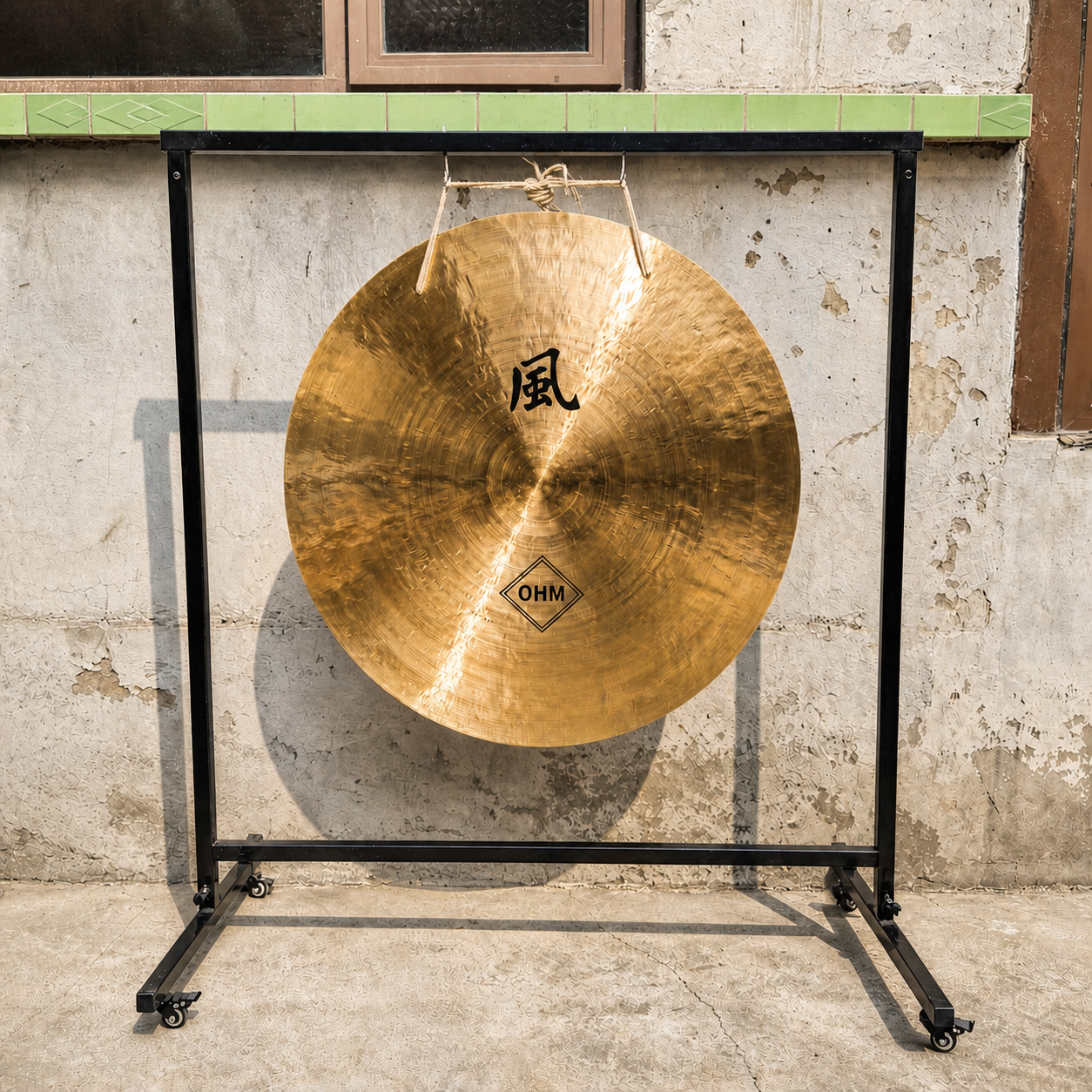

The 36 inch size is where many serious players land as their primary wind gong. It gives you a wide overtone field, full dynamic response, and a strike presence that handles both intimate sessions and larger rooms. It is easier to mount, transport, and integrate into a working setup than the 40 inch, while still giving you most of the sound.
| Diameter | 36 inches / 90 cm |
| Alloy | B20 bronze |
| Style | Wind gong / Feng gong |
| Included | Starter gong stand |
What to ignore: claims about specific Hz tuning, chakra correspondences, ancient secrets, or traditional formulas without naming the maker, the alloy, and the process. Real instruments come with real specifications.
If you are evaluating a wind gong, look at the alloy, the hammering, the diameter, and how the instrument responds to your mallet. The instrument will tell you what it is if you let it.
Start with the size that fits your room and your playing style.
The 36 inch gong gives you the practical serious size. The 40 inch gong gives you deeper undertones, longer sustain, and greater presence in larger spaces.
Shop the 40 Inch Wind Gong Shop the 36 Inch Wind GongThe wind gong is a real instrument with real physics, a documented manufacturing tradition, and an established place in orchestral and percussion repertoire. Most of what you read about it is true on the level of acoustic behavior and false on the level of mystical claim. The instrument itself does not need the mythology. Bronze, hammered correctly, in the right shape, produces a sound that is worth understanding on its own terms.